Kurukulla

Kurukulla
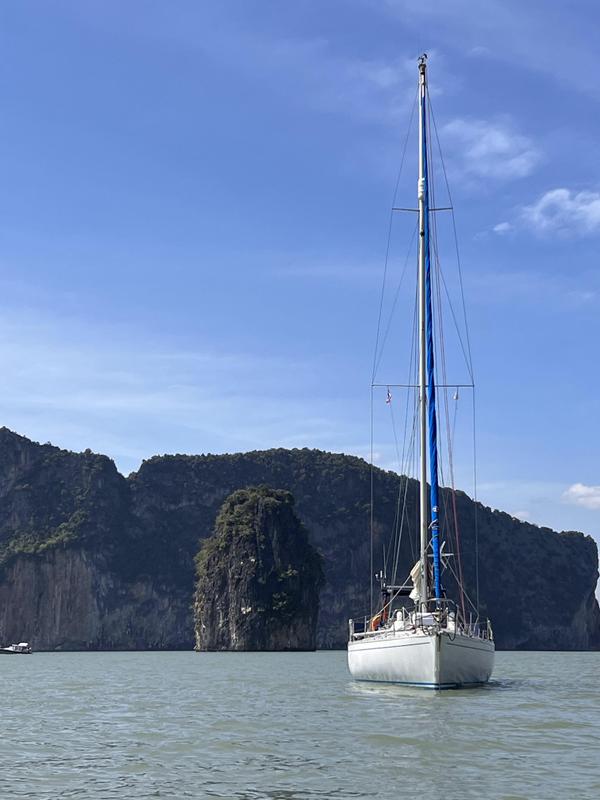
Kurukulla, anchored at James Bond Island, Thailand

Tuesday, 2 July 2013

Closing the circle

As planned I berthed Kurukulla stern to on the yacht pier at Adhamas, the port of Milos, at 1000 next morning. Sea Cloud had already departed. The conditions were a blustery north wind, to back up to the jetty against, but there was plenty of space and two French guys in an adjacent yacht very kindly took my lines and offered up the holding off rope (AKA Lazy line). Several boats along the jetty was also White Sands, the yacht who had invited me to dine onboard when in Faro, Sifnos.
Kurukulla stern to in Milos
The town is not large but has three moderate sized supermarkets and a plethora of bars and restaurants, all of which seemed to be doing a fair trade. I decided to go off in pursuit of a replacement gas bottle which the pilot advised was available here. A very friendly German couple, who operate a small travel agency on the waterfront, came to my aid and after several telephone calls advised that nowhere in Adhamas was gas available but at the next village, a few km away, is was obtainable. As one of them was going in that direction they even gave me a lift to Vato and stayed to interpret at the agricultural agents that also sold gas. There was only one problem, my gas bottle was “Camping Gas” and their contract was with Greek Gas! The bottles are identical and in the past have been accepted in exchange, irrespective of provenance; however, as a result of a recent court case (which they lost), Greek Gas now only accept their own bottles in exchange! No mine could not be refilled as they did not have the connections needed to do so. In other words, a wasted journey. I headed back to Adhamas, carrying the still empty bottle and consoled myself with a cold beer in a café whilst waiting for the bus!
That night Melvin, a friend who has sailed in Kurukulla every year for the past four years, arrived at mid-night, off the ferry. After a couple of glasses of wine in a local bar we both decided we had had enough and headed back to the boat. Next day it was shopping at the supermarket, lunch ashore and then sail at 1600 to head to the south side of the island. As we departed we said goodbye to White Sands and her crew who were planning to head west the next day. We sailed off the jetty, drawing some complimentary comments from our neighbours, and headed for the exit from Ormos Milos. Between leaving the jetty and getting to the entrance the wind went from northerly force 4 to variable force 0, just our luck. For the next hour we part sailed, part motored, towards the south coast in some horrid residual seas! Once on the south coast it was a flat water sail and much improved.
Departing Ormos Provatas, south side of Milos
We finally arrived at Ormos Provatas at 2000, anchored in a delightful bay, in 3m of water, went for a quick swim to check the anchor, and then set about producing lemon chicken for supper.
The next day there was a gentle northerly breeze which carried us off the Folegandros in good style, departing at 1000 and arriving in the anchorage at Vathi at 1530, not a fast passage but a pleasant one.
Ornos Vathi, Folegandros
We spent the next three hours swimming and reading after which we decided to research the small hamlet ashore. A brief walk, a bit of photography and a plate full of calamari plus a beer each and we were ready to return aboard, (in fact it was two plates full of calamari but the portions were so enormous that we gave one away to a table full of locals!). This was followed by a film on deck and a relatively early night.
Next morning we had a gentle sail off the anchor and an even more gentle sail to Ios passing along the south coast of Sikinos in the process. If being honest we did resort to the engine for a total of one hour or less, finally ghosting into Ormos Negros, my favourite bay in Ios, at 1800.
Entering Ormos Negros, Ios
A swim followed by green chicken curry and a film on deck completed the evening. All was not to remain so tranquil though! At 0400, out of nowhere, arrived a swell from the south-west accompanied by a gentle breeze (as forecast) from the north. The combination turned Kurukulla across the sea and had her rolling onto her beam ends! Quite enough to wake all onboard in minutes. After a few moments surveying the situation I decided that this mysterious sea, that seemed to have appeared from nowhere, was not going away; there must have been some serious wind somewhere to the south-west of us but no evidence of it where we were; hence we would have to move. We motored out of Ormos Negros, and southwards to the southern tip of Ios which we rounded and sought shelter from the seas in the NW corner of Ormos Manganari, anchoring on sand, in 3m of water, just as the sun rose. Even here the swell was creeping round the corner, not enough to keep us awake though!
Five hours later we sailed again in a light southerly breeze and set off to sail up the eastern (sheltered from the swell) side of Ios. We were heading for the bay at the north end of Epano Koufonisia, just SE of Naxos. The trip was a bit like the proverbial “Curate's egg”. Initially enough wind to sail followed by rolling arround in the swell becalmed and then a good flat water sail up the east side of Ios before losing the wind again as we approached Koufonisia and eventually motoring into the anchorage.
Sunset at Epano Koufonisia
The bay was delightful and although there were several other yachts anchored there when we arrived only two opted to stay the night.
Departing northern bay of Epano Koufonisia
It was an anchorage where we would have stayed longer had it not been for a flight booking for Melvin out of Astipalaia, only days away.
Next morning we decided to wait for the wind to set in before heading to Amorgos; the sail across was again good in parts but we eventually conceded defeat, when the seas got up again but the wind did not; ultimately we motor-sailed the last four miles to Katapola, the main port of Amorgos. On arrival we anchored off a beach, in a bay, on the north side of the harbour before moving to anchor off Katapola itself an hour before sunset.
The anchorage at Katapola
Our luck was in! Shortly after we had anchored inshore of the other boats in the anchorage the Port Police arrived and invited all of those outboard of us to move because of a ship coming in; we were OK! The ensuing melee lasted about three quarters of an hour whilst all those dislodged joggled for a position nearer the shore; we watched with interest, occasionally warning off those that tried to anchor too close to us or across our anchor cable. One Italian boat in particular had eight or nine attempts to re anchor, on each occasion either too close to others or he dragged his anchor too near the shore by motoring astern too hard trying to get his anchor to take; in the end he anchored close to us, despite our protests, and settled for the night.
Supper at "Caramel"
We went ashore to eat in an eatery I had discovered on a previous visit, Caramel, and returned to find that they had moved yet again in the dark; obviously, at some stage, they had swung close enough to us to worry even them! Next morning we discovered they had re-anchored 200m away. We went ashore to purchase victuals, replace the empty gas bottle and then returned onboard to head round to the anchorage at Ormos Kalotiri, which was to be our departure point for Astipalaia next day. Before sailing off the anchor we put two reefs in the mainsail and as we got under-way left ten rolls in the genoa. We were not to be disappointed, as we exited the shelter of Ormos Katapola we were in big seas and 25 knots of wind gusting 35. It was an exciting sail, albeit only an hour and a half in duration; by 1600 we were ghosting along in the lee of Nisos Nikouria, inside the protected anchorage at Ormos Kalotiri and struggling to make headway. We finally anchored at 1630 joining three other boats sheltering in the bay.
Departing Amorgos, Ormos Kalotiri
We had decided on an early start next morning to ensure a timely arrival in Astipalaia. We motored out of the calm anchorage at 0730, heading out via the narrow northern exit, and into large seas but little wind. The only way to make progress was to motor sail at least as far as the NE tip of Amorgos. The environment onboard was rather like being in the drum of a washing machine! An hour and a half later we rounded the northern tip and headed east, the motion was somewhat easier but still there was little wind and hence we kept the engine on. All the flogging of the sails had also contrived to cause one of the batten cars to detach from the mainsail, hence despite the sea we had top drop the mainsail to reconnect it, not a difficult task provided you are not rolling onto your beam ends whilst you try to do it. Fortunately we were able to tuck ourselves into the lee of the SE side of Amorgos for the few minutes that it took but after that any complaints of lack of wind were silenced; once on the southern side of Amorgos we were dead downwind with 15 gusting 35 knots of wind and making 9 knots! As we left the island behind the seas built up so that we were surfing at times and enjoying a roller-coaster ride downwind. This lasted for the four hours it took us to arrive at Astipalaia but as we approached the island the wind again started to drop such that as we rounded the SW tip we were again forced to resort to the engine. We decided to lunch in a bay just round the SW tip of the island, and motored in in an almost flat calm. The bottom in this anchorage is mostly rock with a thin covering of sand, not good holding but only intended as a lunch stop. Needless to say before we had even got halfway through lunch the wind had got up and the anchor was dragging. Just our luck!
Approaching the anchorage in Ormos Livadhi
We bailed out and headed for Ormos Livhadi, just SW of the main port of Skala We motored round in the flat water but strong gusting winds along the south coast of Astipalaia, anchoring in Livhadi at 1700 on good sand and excellent holding.
Kurukulla stern to on the repaired jetty
This was a secure anchorage for the night despite the wind!
A liquid lunch in Skala
Saturday dawned bright and clear with the wind still blowing but somewhat less fitfully. We motored the mile and a half round to Skala port and berthed stern to on the newly refurbished jetty, a very different condition to that which it was in last year!
View across Ormos Agrilithi, Kurukulla in the distance
Melvin caught a taxi to the airport at 1230 to catch his flight to Athens and then UK and I settled down to a lazy evening in port, preceded by an afternoon beer on the waterfront. One night in harbour is enough for me and so the next day I set off for the anchorage at Ormos Agrilithi; this is described in the pilot as offering good holding and I assumed I had been unlucky on my last visit not to have got the anchor to hold first time. (it is a Bruce type anchor, notoriously bad in weed). This time it took me four attempts to get it to set and even then I dragged the next morning when the wind (average 20 kts) started gusting over 30kts. Fortunately I was reading on deck and realised immediately what was happening; without waiting for the anchor drag alarm to sound we got under-way, left the bay and headed for the, less protected but more open, eastern beach of Ormos Maltezana where even if the anchor did drag there was plenty of room to recover. Tonight I move back towards Skala and will enter the port early tomorrow in anticipation of the next friends arriving at mid-day. Then we just need to await a weather window to commence our passage east towards Marmaris.
More when I leave Astipalaia.......

Thursday, 20 June 2013

The best anchorage so far

Fish and chips Faros style!

Sunday 16 June dawned clear and bright with a moderate north-easterly wind blowing, almost ideal conditions for heading south to Milos and its surrounding islands. By 1000 two of the other boats in the anchorage had already departed and I prepared Kurukulla for getting under-way, under sail. By 1030 we were sailing gently out of the anchorage past the remaining yachts and past the scene of the celebrations some days earlier. In the interim I had discovered that what I mistakenly described as a church was in fact the monastery of Panagia of Chrissopigi (1650), the protector of Sifnos.
The monastery of Panagia of Chrissopigi (1650)
Some of the flags and banners were still flying as I passed.
Manolisi on arrival
The passage south was uneventful but for the wind coming and going and backing round to the north west. My intention was to head for the anchorage at Manolonisi on the island of Poliagos some 7 miles east of Milos.
Manolisi at sunset
On entering the anchorage I was overwhelmed by its beauty, well protected, crystal clear azure water, sandy beach and only goats for company; well until that evening anyway! The winds were light and the sea warm so I swam ashore taking the camera and flip-flops and set about getting some good pictures of this little piece of paradise. That evening another single hander came in to anchor, obviously well travelled, in an aluminium hulled boat Belgian registered; he himself was Italian. He explained later that the reason for the Belgian flag was to avoid the Italian bureaucracy; having spent many years living in Italy I sympathized with him! We were later joined by another Italian registered yacht.
The bay from inland
Next morning strong northerly winds were forecast and did not disappoint, not a day for going anywhere! All three boats spent the day swinging round our anchors and frequently swimming out to check their security. With 40m of cable out in only 4m depth my anchor had buried itself so deeply into the golden sand that nothing was likely to move it.
The offending fridge motor
The terrain of Poliagos
Thus it was I stayed four days here, partly by choice and partly by necessity. On the evening of day two my refrigerator gave a grunt and stopped working, not ideal, and so on the morning of day three I set too to repair it, which would have been a simple-ish task had it been on a work bench. Tucked away on the top shelf of the corner cupboard under the sink was a different matter. There are some times when you really would like to meet the designer of some of the equipment used in the marine field, just to educate them on the environment in which their equipment is used. After a two hour long struggle to remove it I finally managed to wrestle the cooling water pump motor free of the heat exchanger coil inside which it had, for some reason unknown to mankind, been encased. It was not even to cool the motor as they had carefully wrapped it in rubber sheet before using it as a former around which to coil the heat exchanger pipe; madness! This stupidity overcome it took me another hour or so to dismantle the motor, rectify the problem, and reassemble it. An hour later saw it on its was back in, minus much of the rubber, making it a much easier fit. Two hours later I sat down to an ice cold beer, the fridge having recovered its temperature and running efficiently again.
One of the inhabitants of Poliagos
Day three was spent on a hike round part of the island. The terrain is amazing, like walking on a field of railway ballast. It must be the remains of the volcanic explosion that created the crater in the centre of Milos (Milos being rather like the more famous Santorini in form, an island with a flooded crater at its centre). There is very little wildlife to be seen, a few goats but otherwise almost nothing, not even the ever present lizards that are prevalent in most of the other islands. It was beautiful for its desolation, all the same. Four hours later I was back onboard enjoying another cold beer! That evening the Italian single hander left and I decided to head for Milos next day; in the morning if the wind had abated, evening if it had not. Suffice to say it is five in the afternoon of the next day and I am still here. Hopefully the wind will drop as evening approaches but it is not showing much sign of it at the moment! At least it is only 15 miles or so to Adhamas, the main port of Milos.

The chora of Milos
Ultimately I decided go for it and so at 1730 we sailed off the anchor with two reefs in the main and 10 rolls in the No 1 genoa (I did consider changing to the No 2 but the forecast in 24hrs time is for much less wind and hence it would be a change back; too much effort for such a short sail and it was likely to be nothing closer than a reach). As soon as we cleared the anchorage we were doing 7 kts plus so this was going to be a quick sail! The straights between Milos and Kimolos were negotiated without problem despite gusts up to over 40 kts (force 8) and from there it was beam reaching in open water and with lumpy seas until turning downwind through the gap between Nisos Akradhia and Milos and thence into the entrance of Ormos Milos. Once in Ormos Milos there were still three miles to go but things calmed down a little!
Sea Cloud at Milos
We finally anchored in 10m off Adhamas, the main port of Milos, at 2030; deploying 50m of cable in the poor holding and gusty conditions. Who should we find anchored here, Sea Cloud, the same square rigger we saw in Delos.
Tomorrow morning I will berth Kurukulla on the main town jetty but this passage had provided enough excitement for one evening!
More when I leave.

Friday, 14 June 2013

North versus South!


Mykonos is a sort of magnetic anomaly; there are things about the island that attract you and others that you feel compelled to reject, some aspects have a magnetism that tempts you to stay and others drive you away.
The elusive north winds have blown fitfully but never consistently, or not for more than a day. For this reason I decided to enjoy an extended stay on the island. In such a small place it is impossible not to get to know a fair few of the people who live here; in some ways it's a bit like village life! After being storm bound here last year, for almost three weeks, and having spent nearly four weeks here or here abouts this year, it is incredible how many people I now know. You are greeted like a long lost fiend in all the places you have visited before; goodness know how the Myconian people have developed such a good recollection for faces and names but they are amazingly good at it!
Rubbish cascading into the sea!
The net result has been a few very late nights, or early mornings, usually preceded by an invitation to dinner at a friends house. Mykonos night-life does not close down until after 0600, a fact I have witnessed more than once! What Mykonos lacks is a good marina; the basics are there, albeit that the structure is already beginning to collapse in places, but the services are not. That said this year water was intermittently available at many of the berths, an improvement on last year. The Port police seem to have abandoned the place. The office carries a sign saying “In case of emergency ring this number”, other than that on my three visits to their office I found no one other than the maintenance man / general factotum. Hence it was a free visit, unlike last year when I was charged by the day (one overnight equalled 2 day charges!) There are rumours around that a Turkish firm has bought the rights to operate the marina; if that is the case I suspect things will improve rapidly.
Many of the Mykonians will privately admit that Turkish style organisation and inward investment is what Greece needs! Symptomatic of the Greek problem is rubbish collection where, I am told, the local Mayor and associates established a firm who then bid to provide the rubbish collection services on the island. Having won the contract they have now decided there is insufficient money to provide a full service, the result can be seen in the photo, rubbish being dumped in the sea. No wonder the Aegean is full of floating plastic!
Agrari and Elia drop into the distance on departure
Faros town from the anchorage
I finally departed Mykonos on the morning of 11 June; amazing how time passes. The departure morning dawned bright and clear with a brisk south easterly wind. Not particularly comfortable for the anchorage I was in but ideal for a fast passage to Seriphos or Sifnos. Under-way at 1000 and all was going superbly for the first 2 hours. It was 47 miles to Sifnos (the furthest of the two potential destinations) and we were beam reaching at 6 – 7 knots; then the wind changed! In the next four hours the wind went through 360 degrees resulting in very confused seas, and it varied in strength between force 5 – 6 and force 0! Mediterranean sailing can be a cause of much frustration! We were sailing at times under every sail combination from single reefed Mainsail and 8 rolls in the Genoa to all sail set and becalmed. Suffice to say we arrived towards dusk and anchored in the most easterly of the two bays at Faros in Sifnos. My recollection of this bay was that the bottom was weed covered but with some good clear patches of sand to anchor on. This year it would appear the weed had multiplied somewhat! After two failed attempts to get the anchor to hold (it is a Bruce anchor and not good in weed) I headed for the western bay and anchored well into the bay with 50m of chain out, despite the depth being only 6 – 8m. The wind that evening decided to settle in the E but because ot the variation in the wind from earlier in the day a swell continued to roll in well into the night leading to a very roly and disturbed night. Next day the wind had settled into the north and life became much more stable.
Greek Navy presence at the celebrations
As a result of a family bereavement my next crew member has had to defer joining by four or five days and so I have a few days to spare around this area before I need to be in Milos. As a result I decided to stay put in Faros for a day or two. By chance I had arrived on the day before the local saints day, for which much of the island turned out; visitors arrived by a variety of means including a chartered fast ferry and the Greek Navy. The celebrations seemed to centre on the small church, on the coast, just south of the entrance to Faros; I would estimate more than a thousand were present for the sunset celebration and of course it was a local public holiday next day to allow them to get over their hangovers! That same evening I was joined by a group of three charter yachts who arrived an hour or so before dusk. Having shouted at two of them to avoid them anchoring over my anchor cable they finally got themselves anchored and set off ashore, closer than I would have liked but not excessively so.
View of the town with Kurukulla in foreground
By 0100 when they all came back onboard the wind had changed and two of them were excessively close to each other; also somewhat closer to me as my cable had pulled out into a straight line with the force of the North wind. (I had originally anchored on a SE wind and it was now from the N). The noise they made woke me and there followed a form of “ballet of the night” as they first tried to uncross their own anchor cables (which they had managed to get crossed whist weighing anchor) and then had several attempts at re-anchoring before they could get their anchors to hold. I watched silently, but with interest! As I have said before the most dangerous thing a yacht owner will come across in the Mediterranean is a charter yacht with an inexperienced skipper. Charter yachts are also very much larger these days. Almost nobody charters a vessel under 40ft long and many well over 50ft. The skipper may well have qualified on something very much smaller and easier to handle, if indeed he/she has any formal qualifications at all! Next morning we exchanged pleasantries and they informed me all three were heading for Mykonos at the end of their charter; in a brisk NE 4 – 5 they had a lumpy ride ahead of them.
The day was grey and threatened rain, hence I decided not to move on but to have a day relaxing, reading and doing some minor maintenance. It passed amazingly quickly! The following day has dawned equally grey with intermittent rain, hence it looks like another day anchored in Faros. Sailing in the wet and cold is what I and Kurukulla are in the Mediterranean to avoid (if possible). More when I leave.......

Sunday, 2 June 2013

Pottering around the northern Cyclades.

Sunset at Naoussa
We finally departed Naoussa on Saturday morning at 0930 having dined ashore a second time the previous night and filled the boat with enough victuals to last for a month! The intention had been to head for Ios and for the crew to take a ferry back from there, to Mykonos, in order to catch their flight home on the Tuesday. With the winds forecast to be strong south west or west for the next five days we decided Ios was a non starter, there are no protected anchorages in Ios in such conditions, and so we decided to go north again so that the team could leave directly from Mykonos.
Supper at the Glafkos Taverna
Hence from Naoussa we sailed north towards Delos with the intention of navigating the Delos channel and then deciding whether to turn left to an anchorage on northern Rinia or right to Panormos on the north coast of Mykonos.
Sea Cloud anchored off Delos
As we sailed past Ancient Delos the sailing cruise ship “Sea Cloud” was also anchored in the straights, making a splendid sight. In the event the wind died for an hour as soon as we were north of Delos and so, after navigating the channel, we lunched in flat calm seas whilst motoring towards Panormos; conveniently, after lunch, the wind came up again and we arrived in Panormos at 1530, sailed onto the anchor and set about enhancing our sun tans!
Lunch under way (On engine!)
Next day dawned with the predicted westerlies blowing hard and, as a consequence, we stayed put in Panormos until it abated. In the event this didn't happen until late in the evening and so we opted to stay put for an extra night and to circumnavigate Mykonos the next day.

The swimmers ashore ready for lunch
Monday dawned clear and bright with a steady north westerly breeze and thus it was that we sailed off the anchor at 0930 and beat out of Panormos before turning east and heading round the eastern end of Mykonos. By 1200 we were anchored in the quiet bay at Tigani ready to swim ashore for a final crew lunch, the only slight snag turned out to be that the taverna on the beach was not opening before 1 June and today was 27 May! Not to be defeated we sailed off the anchor and headed for Agrari Beach where we knew from experience that the restaurant was open. We were not disappointed , the welcome was excellent, service friendly and the food fresh and delicious. Our opinion was in no way swayed by the free desert and liqueur provided on the house at the end of the meal!
Delicious lunch in fantastic surroundings
After a short sojourn in the sun we set off again for Mykonos Marina, that well known (by now) dust hole on the outskirts of Mykonos town. A final night in the bars and clubs of Mykonos ensured that no one was up early the next morning and, following a late breakfast in the Mathew Taverna (adjacent to the marina), we rented a car for two hours and I drove the departing crew to the airport. I suspect they slept well on the flight, they certainly needed to! I then returned to the marina via the supermarket, returned the car and set about sorting the boat out ready for departure next day.
Shortly after my return I received a text from Joachim and Michael, the two friends from Munich whom we had taken for a sail to Paros; they invited me to supper in a local taverna that night. They had found an excellent taverna about a mile from the marina and a very pleasant night was spent sampling their cuisine. Next morning they were also heading to the airport and so they came round for breakfast in the Mathew Taverna before passing a final hour on the beach and then they too were off on their return journey. I was alone onboard, single handed, for the first time this year.
The forecast strong south and south east winds made a departure that day unattractive and so I decided to stay put for a further 36 hours, finally departing Thursday morning at 1000. By now of course there was no wind! Typical, but after half an hour motoring south the wind came up and I was able to sail south to Agrari Beach and spend a quiet afternoon sorting myself out. That evening I decided, slightly against my better judgement, to stay put and remain tied back to the rocks at the end of the beach. It was so quiet and peaceful, that was until 0330 in the morning when the sea and wind got up resulting in me having to make a rapid departure, leaving the shore line tied to the rocks! I certainly wasn't going for a swim to release it in those conditions, in the pitch dark, and it wasn't going anywhere; it was after-all tied to the rocks. Twenty minutes later I made a night entry into the bay at Super Paradise, which was much more sheltered, and anchored Kurukula in 5m of water, 50m from the beach. Needless to say the discotheques were silent; the one time I could have done with their lights to light up the bay! Moral of the story, look at the weather forecast before going to bed!
Super Paradise beach with competing discos' right and left
Paros, viewed from Mykonos, Super Paradise
Next day I returned to Elia, in slightly calmer seas, and anchored for 20 minutes to recover my shore rope. Someone had kindly coiled it on the rock for me. After that I headed back to the shelter and noise of Super paradise for the rest of the day and the following night. The discotheques, which compete to out-do each other in volume, stopped at midnight; fortunately, the wind however had other ideas!Between midnight and 0900 it managed to blow from every direction under the sun, throwing up a short uncomfortable chop entering the bay and then veering round to west to hold Kurukulla across the waves. A very roly and uncomfortable night was had by all! But that's sailing!
I now have two weeks single handed before my next guest arrives; Melvin is joining via Athens and then ferry to either Sifnos or Milos. The present eight day forecasts are mostly light and variable hence it will be a slow drift down through the islands, that is once I leave the Mykonos area, I may just wait a day or three and see if the forecast improves!
More when I do.

Thursday, 23 May 2013

To the northern limit for this year.

On passage Simi to Leros
On departure from Simi we headed west intending to leave Kos to starboard but as we approached the end of the Turkish mainland the wind veered and we changed the plan from, heading out to Asti Palia, to, rounding the eastern end of Kos and then heading north through the Dodecanese. The result was a fast sail northwards to Leros where we anchored at 1630 in the bay on the south end of the island, at Xerokambos; an excellent 65 mile sail, most of which had been with good winds and on a close reach, the fastest point of sailing.
During the thunderstorm
The anchorage at Ornos Roussa, Dhenousssa
Next day was a 1000 start in rather variable conditions. The weather was overcast and the clouds unstable. Prime thunderstorm conditions and we were not to be disappointed! Our original intention was to sail north to Fournoi or Patmos ready for an early departure next day over to Mykonos where our next crew members were due to join. By the time we had sailed off the anchor and cleared the bay it was already raining and the first lightning strikes were visible. Half an our later we had to set course westwards to clear the worst of it but even so we were treated to a spectacular show of thunder and lightning with very many strikes visible onto the hills of Leros. The boats closer to the shore had a much worse time than we did; we managed to skirt the worst or it but not without heading more than a few miles west. The result was another change of plan and we continued west to the very small island of Dhenoussa, about ten miles east of Naxos. We anchored in Ormos Roussa just as the sun was setting. On our approach to the island we had been followed by a French catamaran who, on entering the bay, motored past us at full speed to ensure he got first choice of anchorage position. We continued to sail in, rounded up and anchored in our chosen anchorage; we then went for a brief swim, served ourselves a gin and tonic and settled down for a pleasant evening on deck. The French were still trying to get their anchor to hold! Eventually, after several attempts in their chosen spot they motored over in our direction and anchored about 50m away. We grinned quietly!
On the waterfront, Naoussa
Next morning dawned bright and warm with a good northerly breeze. With time in hand to get to Mykonos we decided to head for Naoussa in Paros first and to fill up with water and food there. Easier and cheaper than Mykonos. By mid afternoon we were anchored in the north-western bay, Ormos Ay Ioannou, in Naoussa bay. We had the anchorage to ourselves and so settled down for the night.
Next morning we motored gently across the bay, in no wind, and moored up in the marina at Naoussa town. The marina used to be well maintained but is obviously in decline. Few of the holding off lines remain and they have ceased to charge for it's use. Obviously not covering its costs and another example of EU money potentially going to waste! The town itself seems to be doing well enough, smartly painted and awaiting the start of the tourist season. It also possesses two very good supermarkets (by Greek standards) on the outskirts. Watered, re victualled and refreshed by a beer in the taverna on the quay we set sail for Mykonos. A 20 mile beat to windward. The wind held for the first hour or so but then died away. Rather than drift for hours with the sails flogging we decided to motor in and thus we arrived in the anchorage at Agrari at around 1600; still no wind.
In Mykonos marina
The small beach at the western end of Agrari has a stage structure, now in ruins, built for Yehudi Menuhin to entertain the Greek King and his guests when the Royal yacht was anchored offshore in the spot we now occupied. It is also the beach that featured in the film “Shirley Valentine”. We spent just one night there before moving into Mykonos Marina (which now hardly deserves the name). It is becoming more run down every year and there is no sign of the facilities ever being completed. Even more of the holding off lines in the non charter yacht berths are now defunct. We managed to take the same alongside slot that I occupied last year but fortunately it was only for a day or two this year. That night Christoph and I headed into Mykonos town to give him the conducted tour. It does not take long but the architecture is very attractive and given that I was pinned down here by strong winds for almost three weeks last year I was greeted like a long lost friend in several of the bars; no wonder my bank account took such a hit last year! A bottle of local beer is €6 in almost every establishment!
Next day we hired a car to collect the new joiners from the airport and, given that the weather was not great for sailing, we headed from the airport for lunch in Ano Mera, the second town on Mykonos. It was a chance to introduce Stephen, Chris and Jason to normal life on Mykonos before exposing them to the tourist hot house that is Mykonos town itself. We lunched in a very simple Greek taverna, found last year and run by a very entertaining Greek girl and her parents. Their welcome alone made the trip worthwhile, notwithstanding good food and wine at a sensible price.
On completion we returned to the boat, decanted the travellers onboard for a snooze (they had been up since 0400), then Christoph and I headed for the best supermarket on the island to top up the victuals. That done we returned the car, enjoyed an early evening sundowner onboard and finally headed for Mykonos town for a second night out on the tiles and to show the others the lights!
Anchorage on Rhinia west coast
Most awoke with a slightly thick head the next day and so, after a slow start combined with a light breakfast, we sailed out of Mykonos and headed for the northern anchorage on Rhinia. On arrival, an hour and a half later, we sailed onto the anchor in our chosen spot but, although the water was flat, the wind was still slightly troublesome; as a consequence, after a leisurely lunch we sailed off the anchor and headed to the better protected anchorage on the west side of the island. There we cooked supper, pasta with meatballs, watched the sun set and retired for a relatively early night; compared with the previous two that is!
Tied back to what remains of the small quay in Paradise
Elia beach
Anchored in Ornos Ay Ioannou, Naoussa, Paros
Fishermans harbour, Naoussa
Naoussa at dusk
Sunday dawned windless and stayed that way. Great sunshine but no wind! As a consequence we motored the ten miles back to Elia and this time anchored with a long line tied back to the rocks. Sun and sea were the order of the next two days. No sailing to be done with no wind. Our only excursion was to motor to Paradise Beach, where we tied back to the old quay for a pair of hours whilst a team went ashore to replenish our wine and beer stocks that had run dangerously low, and then it was another motor round to Super Paradise for lunch. Sadly only one of the three restaurants on Super Paradise was open (slow start this season) and that was the self service café associated with the beach disco bar at the eastern end. The food was mediocre and the noise uncomfortable, hence we decided to go back to the boat and head back to Elia which was all the more tranquil. Readers should not be misled by the names Paradise and Super Paradise.. they are misnomers! Whilst preparing to leave we were hailed by two German holidaymakers on whom Christoph decided to practice his mother tongue. Suffice to say they became part of the crew for the next two days but very kindly also took Christoph to the airport from Elia beach for his departure to UK next day. The day was windy but by 1600 it had abated enough to set sail for Paros again and by 1900 Kurukulla was anchored in Naoussa for a second time but this time in the eastern side of the bay, where the protection from the forecast south east winds would be better. The winds never materialised that night and next morning we spent an hour ghosting across the harbour and returning to the idyllic anchorage where Christoph and I had anchored following our arrival in the Cyclades. A day of swimming and sunning (with what sun there was, it was slightly overcast) and then we headed to the marina in the evening for a night alongside; we entered with the intention of supper ashore and a pre departure run to the supermarkets next morning. In the event the forecast strong southerly winds arrived during the night and so it was we decided to stay in the harbour for two nights enjoying the free berthing, electricity and water!
More when we leave.....

Sunday, 12 May 2013

2013, We're off again.

Kurukulla ready to launch
The 2013 season started in some chaos, In the last two weeks before departure I managed, with the aid of an excellent solicitor in the form of my friend Nick Stuart-Taylor (Biscoes, Petersfield office), to buy the top floor apartment in the same block in which I live; with completion occurring, at earliest, on the day Kurukulla was originally due to go in the water. Fortunately I was able to delay launch by 12 days, at modest cost; giving time to complete the purchase, move apartments, introduce tenants into the old apartment, finalise all the necessary administration (changing addresses etc.) and fly out to Marmaris, all with three days to spare to do the anti-fouling and underwater maintenance before the launch. Not much of a challenge there then! To compound this I managed to put my back out two days before the move; fortunately this time it recovered relatively quickly, but to make life easier I sub contracted this years underwater painting and topside polish, (I concluded having my back in good shape for the start of the season was worth more than 600YTL approx £220 the hull work cost).
Another advantage has been having company this year for the preparations. A friend, Christoph, had volunteered to sail the first leg out to the Greek Islands. When the programme changed he very kindly agreed to stick to his original dates and assist with the commissioning work enabling me to catch up the time lost in the programme and thus enable us to arrive on time at his departure point from where his flights are already booked (we hope!).
330 ton crane seems a bit excessive
The launch of Kurukulla was straightforward and the work to be done soon completed. The most complex item was the manufacture of new fairleads on the bow, to replace the ones broken in the storm in Bozyazi last year, and this was completed by Wednesday. Thus it was Wednesday night we set off into Marmaris to have a last meal ashore and to visit the local Transas supermarket to top up on all the necessities for the voyage north into the Greek Islands. I had decided to depart Turkey from Marmaris to avoid having to make additional stops en route, this should have been easy but bureaucracy had taken its toll. Instead of being able to pay the agent at the marina to do all the necessary administration it was now necessary to appear in person at the international ferry port at an appointed time for a head count of those onboard. As we arrived for this process we were waived off the berth nearest their office and sent to the far end of the liner berth, half a mile away, from which we had to walk to and fro to the office. All designed to be helpful! In addition one now has to have a “Blue Card” on which all of your black water (i.e. sewage) pump outs have to be recorded; as I had not had one previously (I had deliberately avoided getting one to avoid the hassle) I was now require to buy one before I was allowed to leave! Not only that but I had to buy a “virtual” pump out (from the agent) to prove that the boat was empty before departing. Nothing was ever pumped out of anywhere but honour was satisfied for the officials!
Anchorage at Marathouda, Simi
Alongside in Simi, waiting.......
Simi town drops into the distance

All that done we set off for Simi, our first port of call in Greece and the scene of the next battle with bureaucracy. We had a great first sail into the Rhodes Straits, light to moderate winds and varying from broad reach to close fetch. This resulted in us reaching Simi in the early evening and thus we decided to anchor overnight in the inlet at Marathouda on the south eastern side of the island. Next morning dawned bright and clear but with very light winds and so we sailed off the anchor and made a slow passage north up the east coast to the port of Simi where the necessary paperwork could be completed. We arrived in Simi port at 1410, 10 minutes after the immigration police had closed the office for the afternoon! Since the cutbacks in manning to reduce the Greek deficit (there are now only two officials to man the office), they only open from 0800 – 1400 and 1800 – 2100. The Port Police (aka Coast Guard) on the other hand are open all day but sadly, they explained, they could do nothing until the Immigration Police had stamped the crew list form with which they, the Port Police, had provided me. We settled down for a frustrating four hour wait. Our in and out visit was not to be! To add to my black mood one of the ferry line handlers tried to persuade me to reposition the boat from the temporary alongside position (on what used to be the quarantine berth) that we had taken to a Mediterranean moor in the harbour for which he would of course we then would have had to pay. He got short shrift! His friend, whose fishing from the quay had been momentarily interrupted as we came alongside, and who had persuaded him to intervene, was equally disappointed. At the end of it all we finally got away at 1930, four hours later that planned, and headed for the nearest anchorage in the adjacent bay, Ormos Emborios, where we arrived just after dusk. Not the best of anchorages, especially when visibility is constrained by poor light, but we managed to anchor in 10 m just off the hamlet and spent a safe night there. Next morning, at 0800, we got under-way again just as the wind was setting in. This wind built to 20+ knots from the west and so we limited our days sailing to a quick motor round to the anchorage near the monastery at Ay Emilianos, on the west side of Simi but protected from the west. The monastery seems to have only one inhabitant, and elderly caretaker or monk who scrutinised us closely on arrival but then paid us no more attention.
The monastery and anchorage at Emilianos
The anchorage was not as good as described in Heikell's pilot but give we were sharing it with only two other fishing boats it served our purpose for the following 18 hours.
We leave tomorrow at 0600. More when we are further north!