Kurukulla

Kurukulla
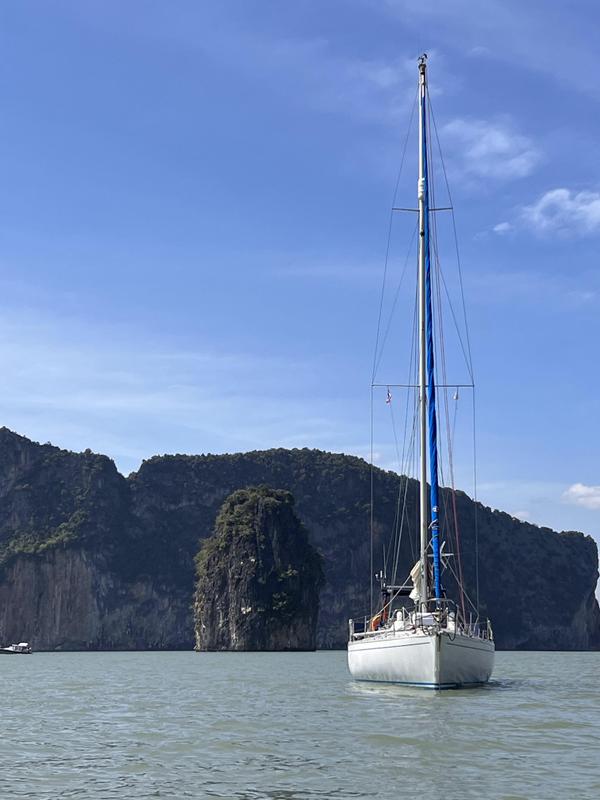
Kurukulla, anchored at James Bond Island, Thailand

Friday, 22 August 2014

Zakynthos to Corfu. Quiet, gentle, sailing.

I should first start by explaining why there has been such a long break between this post and the last. It was always planned that I would return to UK at the end of this leg to visit elderly relatives (in their 90s') and attend the wedding of the daughter of lifelong friends. Sadly whilst I was in UK my mother passed away and so a short stay had to be extended to cope with all the organisation that surrounds such an event. A planned 10 day stay became a 24 day one. The blog that was going to be written in spare time in the UK simply never got written, until now!

Enough sadness. 

Zakynthos Harbour from above the town

Tim was originally due to join me in Ayios Nikolaos, on the north east corner of Zakynthos. Despite visiting the bus station and trying all means I knew to get a taxi at a sensible price a journey from airport to Ayios Nikolaos was destined to be upwards of €60. It was evidently €50 cheaper for me to motor back to Zakynthos town and pick him up. It was flat calm anyway!

Wreck Beach, Zakynthos
With Tim safely onboard we set off on a clockwise circumnavigation of Zakynthos, stopping overnight at Ornos Keri, in the Bay of Laganas (famous as a turtle breeding beach amongst other things!), a night in Wreck Bay on the NW corner (most photographed beach in Greece!). This proved to be an uncomfortable night due to the wind getting up from the north for a brief period, just long enough to create a sea, but worth it to have the beach to ourselves in the early morning; a rare treat. We ended with a final night in Zakynthos in Ayios Nikolaos tied back to the rocks in front of the tavernas. The taverna owners are expert at getting you tied back somehow, swimming out to take your lines.

Kurukulla anchored Sarakiniko, Ithaca
On the 2nd of July we set off northwards to Cephalonia, anchoring off the long sandy beach at Ornos Katelios, near the southern tip of the island, for the night before heading on up the east coast to the island of Ithaca and the anchorage at Ormos Sarakiniko. The final stages of the sail were challenging, with two reefs in the main and the Genoa well reefed, hence we were glad to reach the shelter of the anchorage. Space was tight. Locals had laid a random selection of buoys fouling the available anchorage area and declared a swimming area closer in. Yachts wishing to anchor there were obviously not a consideration!
One House Bay, Atokos
We were first in the anchorage and chose the only really tenable position in this small bay. We watched later, with interest, as two other boats tried several times to find a second suitable spot but without complete success. Both spent a nervous night swinging close to the rocks. The bay was delightful and fairly well sheltered but only if you were first in!
Next morning we set off for a gentle sail to Atokos island and anchored in “One House Bay”. This almost deserted island (it has one house and a chapel on it) is delightful but popular! By day the bay is full of boats visiting for the day but by the evening we were able to get a good anchorage spot, on sand, and anchor near the beach.
Chapel at one House Bay, Atokos
That night only three of us stayed and we had by far the best spot again.
From Atokos we sailed back to the north of Ithika, to Frikes, finding a delightful bay just to the north of he main harbour in which to anchor and tie back for the rest of the day and the following night.
Windsurf Beach, Frikes, Ithaca
On the beach were the remains of someone’s dream, an old motorboat, previously used as a windsurf school base, still bearing graffiti from the last instructors who worked there some 20 years back. Next morning we moved into Frikes harbour itself to see the town and get some fresh victuals.
Frikes, Ithaca


After an enjoyable afternoon in Frikes we set sail across the straights toOrnos Doluicha where we spent the night before heading on to
Ornos Doulicha, Kefalonia
Fiskardho, a much much more commercial town then Frikes but also easier to get to from the airport in Cephalonia for our two new joiners, Stephen and Andrew. On our arrival the only available berth was one tied back to the jetty but 10m from it. With some assistance from our neighbours either side we opened the gap, slotted in, and Tim swam the lines ashore. Some six hours later, just before midnight our two new guests arrived.

Fiskardho
Next morning we set off north towards Levkas, enjoying a very pleasant sail in moderate winds. With no overnight stop destination in mind we simply cruised the east coast until something took our fancy. In the end it was a small beach just south of Ormos Dessimou that took our fancy and we tied back to the rocks and settled in for the night.
Next day we headed to Meganisi for a quiet day at anchor and then the day after we headed north through the Levkas Canal spending the night in Levkas Marina (very expensive) and enjoying a meal ashore in Levkas town.
Supper at Ey Zyn (Good Life) Levkas
From here it was to Preveza where I had promised to check out a friends boat ashore in the Aktio Marina, and to remove and despatch the life-raft for servicing so that it would be ready for a planned launch date in a few weeks time.
Approaching Levkas swing bridge
After a night at anchor off Preveza town we re-anchored off Aktio Marina and the crew went for a tour of Preveza whilst I got on with the tasks ashore. By mid afternoon we were reunited and sailed east up the inland sea to Vonitsa where we spent a very pleasant night at anchor. The only downside of the inland sea here is the green water, a product of a mixture of salt and fresh water plus excessive quantities of fish food from the fish farms and nitrates from the farms around and about.
Next day we sailed out of Preveza channel and northwards towards Corfu. A night in Gaios, Paxos
Gaios, Paxos
was followed by Nisos Sivota / Ay Nikolaos just off Mourtos where we stopped for a day of swimming and later in the day anchored between the two islands for an evening BBQ on the sand spit that prevents passage between the islands.
Anchoring off Mourtos Island
The following day it was lunch in Mourtos followed by a night at anchor Ornos Valtou, a wonderfully protected anchorage in 3m of water and protected from all sides.
Gouvia Bay, Corfu
From here it was onwards to Corfu, a meal ashore in a taverna and then into Gouvia Marina to say goodbye to the friends onboard and to await the arrival of Nigel and Sarah, plus Giles and Fi. All long-standing friends of mine who wee to use Kurukulla whilst I was back in UK visiting relations and attending a wedding in France. In the event, as stated above, my stay was to be prolonged by 10 days due to the death of my mother, a blessed release but traumatic all the same.
Following the funeral etc. I finally headed back to Corfu some 10 days later than planned and set about catching up on the programme.
More of the next leg in the next edition.......

Saturday, 28 June 2014

Kalamata to Zakynthos via Methoni, Koroni, Pilos and others!


Koroni Castle
With Jaco safely onboard we finally set off westwards. Our first stop was a short hop away across the bay to Petalidhion; a small town, apparently with not much to offer, (we didn't go ashore) but a good anchorage in NW winds and ideal in the time available.
Next morning we set off south to Koroni, a much more interesting place, where we anchored for lunch in the bay to the west of the town and then, in the evening, we motored back into the bay under the walls of the castle, to the south of the main harbour.
View of the harbour from the Monastery at Coroni.
A delightful anchorage but in the bay that we chose a little bit of care is needed. There are some rocks on the 4m line which are just below the surface, and easy to miss. Fortunately we saw them and anchored clear. The next morning we set off to explore the town plus visit the castle and monastery (the latter being inside the former). It is a delightful place and well worth a visit. A town not quite forgotten by time but very tranquil.
That afternoon we sailed off the anchor, headed slowly round Ak. Livadhia and headed for the anchorage at Maratho; in the event we did not go that far.
The major (but now derelict) chapel of the castle
As we approached Ak. Akritas, the southern tip of the western arm of the Peloponnese, the wind died and we noticed an enticing bay just to the east of the Cape. Thirty minutes later we were anchored there, with the bay to ourselves; swimming and sun were the order of the day and two hours later we settled down to a G&T, on deck, to watch the setting sun. Another piece of paradise.
Kurukulla anchored in bay to east of Ak Akritas
Next day we sailed off the anchor, ghosted around Ak Akritas, and headed for Maratho, this was to surpass even the anchorage of the previous night! A fantastic enclosed bay with two beaches to choose from and relatively well protected. We fortunately chose to anchor off the northern beach; not only because the holding and beach were better but we later discovered a team on the eastern beach who were preparing for a “Music Festival” to be held in two weeks time. The east beach could be reached by an unsurfaced road, the north beach had no such connection. The location was so fantastic that we decided to stay two nights and BBQ'd on the beach the second night; it was then that we met Johannes, a man of the road, who was constructing a path to connect the two beaches.
The bay at Maratho
He was not being paid for his work, had not been asked to do it but had just taken the initiative and was busily constructing a half mile path, across difficult terrain, of his own. He also spoke good English! Asked when he would move on … “When the path is finished”..... He will leave his mark on the place in his own particular way. Good for him.....
From Maratho it was a very gentle sail to Finakounda where we anchored off the beach, debated going ashore and set sail again. Not an unpleasant place but seemed rather commercialised after the tranquillity of the past two days. We chose instead to go to Port Longos on Nisos Sapientza. The bay here has two possible anchorages and I had been here before. The northern anchorage looks attractive but proved to be very poor holding and rock strewn so after two attempts to find good holding we eventually opted for the southern part where I had anchored before. Sadly the fish farm has expanded and this is now all but impossible to anchor in.
Anchorage at N end of Nisos Skhiza
The space is very limited and again the holding not great, the result being that you cannot find enough room to swing to the anchor. After another fruitless hour, trying to find a suitable spot, we gave up and headed for the less protected but much easier anchorage at Ornos Sapientza, a mile and a half up the coast.
This was much better, good holding, a beach to ourselves and idyllic surroundings. It is totally open to the SE but this was not a problem with the current forecast and sea conditions.
Next morning, after a leisurely swim, we set off for Methoni with an afternoon lunch stop in the anchorage NE of Ak. Kolivri.
Methoni harbour
Methoni is another of my favourite towns and this too was to be a two day stop so that we could get to know the town better and visit the castle etc.
Methoni Harbour
The great discovery was the taverna called “Old Story”, situated 200m back from the waterfront. Excellent food and delightful owners who had mover here to escape the turmoil of Athens some years before. The photographs of Methoni will speak for themselves.
From Methoni it was onwards to Navarino Bay, scene of the last great battle between wooden sailing ships; it was here that Admiral
Self at Methoni Castle
Codrington led a combined British, French and Russian Fleet into the bay where the combined Turkish and Egyptian fleet were anchored. One Turkish ship decided to open fire and, despite the lack of any declaration of war between the parties, the British led squadron took up the challenge. They were heavily outnumbered in ships and guns; however, they succeeded in devastating the combined Turkish/Egyptian Fleet and weakened their ability to resupply their occupying forces to such an extent that Greece was able to use the opportunity to advance their fight for independence, this they achieved some years later. The monument in Pilos town square commemorates the battle and the three Admirals commanding the combined British/French/Russian fleet.
Methoni Tower from the Castle
With a NW wind forecast we initially chose to anchor in the northern end of the bay, 4 miles from Pilos town, for the first night only and from here we walked northwards along the edge of the lagoon to the small bay at Voidhokoilia where we hoped to anchor the next night. Sadly this was not to be, the weather turned foul for 48 hours and in the event we spent two days in Pilos “Marina”. This is yet another EU funded “white elephant”, unfinished, unloved and untidy.
Panorama at north end of Navarino Bay, showing bay (R) and lagoon (L)
A waste of EU money and totally neglected.
How else do you tie up?
Even the Coastguard smash holes in the pontoons to create points to tie up their vessel. If they, a Government Agency, commit such acts of vandalism what hope is there!
Monument to battle of Navarino and Admiral Codrington
We were also in need of water, there are two working taps in the whole marina, one for the coastguard (locked) and the other for a small (2 boat) charter operation that operates from there. A polite request for us to take water was refused. Amazing! Later a “traveller” came round asking for
Pilos marina
“Payment for the Marina” which on further questioning became “€10 for security”. My request for some proof of his authority to collect money went unanswered; he went away empty handed....
From Pilos we had a cracking good sail to Kaparissia, on the wind but with 15 to 20 kts over the deck for most of the way. Only in the last two miles did the wind die away.
Kaparissia harbour is another EU “White elephant”. The outer breakwater has recently been extended to give good shelter from all directions and so it is now a good place to shelter....but, .. the harbour is resoundingly empty and although we managed to spot a water supply on the NE arm of the harbour, and quickly took advantage of it, we were soon informed by a local that the “Port Police” are not keen on yachts being alongside.
Kiparissia Harbour
That explained the reason for the mile or so of empty quay and the five yachts (the only vessels of any size in the harbour) anchored in the middle! It is tempting to ask “who paid for all this?” That night we went ashore for a meal. After a long search and walking a half mile to the centre of the town we found the only open taverna that we could find. Good though some of the food was, it was a long way to walk to be left with no choice! Kaparissia is a good place to run for shelter if the weather turns bad but not a great “Run Ashore”.
From here it was a 30 mile fetch up the coast to Katakolon; another newly built or extended harbour. We decided to anchor in the bay overnight and enjoy the beautiful clear water and sand. Next morning we decided to go into the harbour and see what the town was like. (It is also a calling point for cruise liners so that they can ship their clients to Olympus from here.). On arrival in the “marina” (yet another EU White Elephant) we were greeted by the watchman who informed us that it would be €15 to berth there. When told we only wanted to stay for 2 hours and that the first 2 hours should be free he reduced this to €10! We didn't stay!
Katakolon "Marina"
We anchored 30m off the quay and rowed ashore. I headed straight for his office and demanded a copy of the price list. “No, only if you are staying here.” was his defensive reply When questioned again about the amount he had tried to take from us this became “€10 for the night and yes the first two hours were free!”. The man was a lying thief and I told him so. I also threatened to report him to the Port Police, (I didn't do so because that would have involved us in a process which could have gone on for ever and he probably knew that!) As we were departing we spotted the pontoons for the marina rotting on the wasteland to the north of the harbour wall. They have never been installed and now have concrete cancer! Another marina investment spoilt by the total lack of interest in looking after, managing and maintaining that which the EU has funded for them. After two hours we left for Zakynthos.
The sail across to Zakynthos was a gentle beat to windward and we finally arrived in Porto Roma, on the SE tip of Zakynthos, at 1800. We dropped anchor in the centre of the bay where the protection from the wind was best and the noise from the beach tavernas and hotels was least. Here we stayed for nearly 24 hours.
The cascade of rubbish, fly tipped!
The only sadness was the “cascade” of rubbish fly tipped from the top of the cliff and collecting on the beach below or worse still being washed into the sea. No wonder the seas round Greece are full of plastic! Next afternoon we had another visitor, a tourist boat, who anchored 20m from us in an otherwise empty bay, what is it with these people? Half an hour later the wind changed and they had to beat a hasty retreat before their boarding gangway hit us as they swung towards us.
and then the wind changed........
They missed by 1m but not before some of their swimmers had been forced to abandon their water toys and make a scramble for the boat! Sheer stupidity on the part of the skipper.
As the day drew to a close we moved into the harbour at Zakynthos town and berthed stern to alongside the other yachts. The plan was that Jaco would leave from here and I would spend the next few days around the island awaiting the next crew member, Tim, to arrive. Needless to say a quick walk along the waterfront confirmed that Zakynthos marina had only gone backwards since my last visit three years back, still dirty, still derelict with no pontoons or facilities; empty except for a few local small craft and tourist boats (some abandoned).
That night Greece qualified for the next stage of the World Cup, the town exploded into celebrations at 0200 in the morning with car horns sounding, motorbike tyres screeching and festivities all round. If only the Greeks would address their other challenges with the same enthusiasm!!!!
More when I leave Zakynthos.........

Tuesday, 10 June 2014

From Kithera into the Peloponnese – Sun, Rain and Gales!


Departing Kythera
After a relatively pleasant night anchored in Platia Ammos, Kithera, it was time to make my way north, towards Yithion, where I was to meet my next set of guests. The choice was to go now, in windy but not unpleasant conditions, or wait a day, until Saturday and see what the gods would offer 24 hours later. I decided not to trust the gods and got underway there and then. It was a relatively pleasant close reach up into the gulf, “Lakonikos Kolpos” and as ever, having covered 75% of the distance without a struggle, the winds headed us making the final 7 – 8 miles a beat to windward in choppy seas. C'est la vie!
Anchored in Yithion
Notwithstanding the vagaries of the wind the conditions were sunny and warm and the anchorage at Yithion welcoming and calm.
I decided to stay in the anchorage overnight and to move into the harbour the next day. I had a day in hand as my guests were not expected to arrive before the early evening of Sunday. In the event I rowed ashore next morning to do battle with the Vodafone shop staff (I was, and still am, being royally ripped off for my internet connection and was hoping, in vain, to resolve the problem. His ultimate advice “Go to Kalamata, they have an expert!”). On arrival at the shop I discovered I had forgotten to take the “dongle” with it's SIM card with me (I had everything else including the computer) and so was forced to return to the boat and collect it. Having done my reconnaissance of the harbour I chose a berth next to another British boat, (delightful couple Chris and Margaret) and was able to have Kurukulla in the chosen berth and be back to the Vodafone shop within the hour; well before they closed for the day; but all to no avail!
Alongside in Yithion
That night I went for a quiet meal in a restaurant recommended by my neighbours and, that done, settled for a relatively early night. Next morning dawned bright and clear and I went in search of fresh water, there being no facilities on the quayside. The Yithion Hotel, on the opposite side of the road to where I was berthed, had an outdoor tap on the pavement but no amount of door bell ringing would elicit an answer. A request of one of the adjacent shopkeepers elicited approval to use the tap but, as always happens, my initiative led to three other boats wanting to use the hose to fill up. The shopkeeper who had given me approval became distinctly nervous! Our efforts to get an answer from the owner of the hotel, by knocking repeatedly on the door, came to nothing but another neighbour, we know not who, helpfully rang her and told her that the boats were “stealing” her water! This resulted in two things, a lock being put on the tap at 0800 the next day and a demand for €10 per boar for the water taken (we could have bought similar quantity of bottled water for less!). We never did meet the owner of the hotel but I for one will never be a client of hers and I would suggest no one else patronises the establishment either. Distinctly unhelpful and unpleasant!
Later that day, Giuliano, Peter and Mike arrived from Kalamata airport in a taxi. Despite all my efforts, and those of a Greek friend who lives in Corfu, we could not ascertain in advance whether there was a bus service from Kalamata to Yithion; only after my arrival did I discover, by going to the bus station, that there are four buses a day! Greek organisation of such things (or lack of it) defeats me! Notwithstanding this they arrived safely. As they were all first time sailors we had planned to do no more than go from one side of the central peninsula of the Peloponnese to the other; Yithion to Kalamata; a total distance of 60 miles in 8 days. This was to prove to be quite enough!
That night we returned to my restaurant of the night before and then turned in for an early night. In the morning we victualled followed by my usual battle with the Port Police before departure. By mid day we were away and on our way to Plytra. The forecast was about as bad as it could get; Westerly winds for today followed by gale force easterlies tomorrow.
Our french neighbour, Elaphonisos
Oh joy! In the event we decided only to stay in Plytra long enough for lunch and then to head 15 miles south to the island of Elafonisos where there are secure anchorages around the island for every wind direction. On arrival we anchored off the beach on the western side in preparation for the east winds during the night. In the event it was a North East wind that arrived and as a result, early next morning, we moved round to a bay on the the south side, Ornos Frangos, to achieve better shelter. Here we were to stay for 36 hours listening to the winds whistling through the rigging, with gusts of up to 50Kts. Quite a baptism of fire for three novice sailors! The anchor held well and another French boat joined us (at a respectable distance) to shelter in the same bay. 40 hours after our arrival, and following a brief swim and walk ashore, we sailed away from Elafonisos, heading west across the mouth of the gulf towards Porto Kayio.
Porto Kayio
This is a well sheltered anchorage, just NE of Cape Matapan. (We spared Giuliano (who is Italian) the details of the battle of Cape Matapan where the British Navy accounted for several of the Italian Navy's major ships in WW11). On arrival in Porto Kayio we were the only vessel in the anchorage, a marked difference to my previous visit, some years before, when I had struggled to find an anchor spot with sufficient swinging room. Later in the day we were joined by four other vessels. Supper ashore in a taverna, a quiet night and next day we set off for Yerolimena, our planned lunch stop.
The rounding of Cape Matapan was relatively peaceful but as the morning progressed the winds strengthened and by the time we arrived in Yerolimena it was gusting from the west at 25 knots. Not excessive but enough! The anchorage was calm but with northerly gusts funnelling down through it. Tolerable! By the time we came to leave, after a leisurely lunch, life outside the bay was somewhat different! A steep and very uncomfortable sea had built up but the wind had declined. Twenty minutes of bouncing from wave top to wave top (in full foul-weather gear and harnesses!) convinced us that a night in Yerolimena was by far the best option available on the navigation table. We turned back and half an hour later were anchored in Yerolimena again and debating dinner ashore.
Kurukulla anchored in Yerolimena from the terrace of Hotel Kyrimai
The strongest WiFi signal we could receive onboard was from the Kyrimai Hotel and for that reason we headed there first (we wanted to connect via their system). A fortuitous decision. After a drink to try to justify obtaining the WiFi access code (sadly they didn't give it out to non residents) we debated dining there also. It was an absolutely delightful place, well restored from a waterfront warehouse and , as we later found out, rated as one of the best restaurants and waterfront hotels in Greece. The meal was fantastic and we obviously managed to consume enough wine with it to justify us being presented with the WiFi code on departure! We were doubly grateful we had chosen to dine there!
Kurukulla anchored off Kardamila
Next morning we set off in light winds and half sailed, half motored northwards towards Ormos Dirou where there is a great beach and spectacular limestone caves where you can take the tour underground by boat. The crew rowed themselves ashore to tour the caves whilst I spent some time sorting out items on the boat. Least said the better but their rowing skills improved as the day went on! From there it was next stop Kardamila, our planned anchorage for the night.
Kardamila is a beautiful bay with a few luxurious villas built a hundred or so metres from the shore.
Supper at Kardamila
Deep blue water and an ideal anchorage in these conditions.
Next morning we all went for a leisurely swim, discovering in the process that the only minor problem here was that the locals don't appreciate yachts spoiling their view of the otherwise empty bay. Needless to say we ignored them!

You can own the beach but you can't own the water! At 1200 we set off again towards Kalamata making a final lunch stop at Kitries. Peter and Mike swam ashore to try to obtain bread but none of the Tavernas were willing to oblige and the nearest shop was 3 miles inland!
Departing Kitries
As a compromise I knocked up fried bread from what we had! Lunch finished, we set sail for the marina at Kalamata. It was 5 miles away but even so it gave time for us to sail through a torrential downpour! This really isn't Greek summer weather!
On entering the marina we were directed to a berth next door to a boat I knew from my time wintering in Brindisi, Italy. Small world! Kurukulla's next crew member, Jaco, was waiting to join, standing on the jetty, as we arrived and the current team started packing their bags for departure.
The very good but indecipherable taverna!
We all had dinner ashore, in a local taverna, eating very well and for €15 per head including wine!
The leaving photo. Giuliano, Peter, Self & Mike
That was the start of two days in the marina. The intention had been one night only but as nothing in Kalamata opens on a Sunday we had no choice but to wait a day and re-victual on the Monday. Even then the choice was limited as we had struck a public holiday. Even more galling was that the Vodafone shop never did open! Or not before our departure anyway....
Kalamata railway park, all that is left of the 1m guage systemthat served the Peloponnese
More soon.....

Saturday, 31 May 2014

Onwards to the western end of Crete and beyond.

Friday night was spent alongside in Ayos Nikolaos collecting George and Nigel from the airport at Iraklion and the following morning, using the same hire car, delivering Steve and Mike to the same airport. All achieved for €37 plus €20 fuel. Somewhat different to the €80 per journey requested by taxi drivers!
A traffic jam on the lanes of Crete (milk collection)!
That done we decided to make use of the hire car and make a tour of this end of Crete, whilst the opportunity presented. Christoph had lived in the area for a period some years ago and was keen to revisit the mountain village, Agios Ioannis, where he stayed. Late that evening we returned the hire car, settled our bill at the marina, and set out for one of the anchorages at Spinalonga. In the event we chose to anchor, just as the sun was setting, in the anchorage on the eastern side of Spinalonga island.
Agios Ioannis
A superb anchorage but one that is on the “grockle boat” itinerary and therefore we vacated fairly early next morning to coincide with their arrival. (For those unfamiliar with “Grockle” it is the term used in Cornwall to describe tourists). At 0930 we sailed off the anchor and very slowly edged our way into the lagoon again, here we were to stay for the following 24 hours.
The night anchorage was in the furthest of these two bays
It really is a superb anchorage and I took the opportunity to climb to the top of Spinalonga island to take some shots of the anchorage we had used the previous night.
Kurukulla and anchored in a bay on the west side of Spinalonga
Next day dawned clear and bright, with a light northerly breeze, and hence we sailed off the anchor, beat out of the lagoon and northwards to the point where we cold turn west towards Iraklion. Our first stop was to be the small port of Khersonisos; our original intention was to make this a lunchtime stop but the anchorage outside the harbour looked only barely tenable and at best uncomfortable; hence, we opted to enter and try to find a space. In the event we were lucky and managed to find a spare slot between two fishing boats in the inner end of the harbour. The Port Police kindly volunteered to take our lines and informed us that if we were only planning to stay one night then the berth was available to us. The Khersonisos harbour chartlet in the Heikell pilot shows a shallow patch in the centre, rocky and less than 2m in depth, making it a tricky harbour to enter. We had carefully skirted around this obstruction on entry only to be informed by the Port Police (Coastguard), when attending to pay my dues, that the obstruction had been removed and the whole harbour centre is now dredged to over 3m in depth, not all was lost though as they also declined to charge me on the basis that a one day stay was not worth the effort! That night we went ashore to investigate the town (very touristy and hardly worth the effort) before dinner and also took the opportunity to top up on victuals from a very well stocked supermarket.
Our departure next morning was to be rather less smooth than our arrival, yet again on lifting our anchor (having been careful to lift it as near as possible over the point we dropped it) we discovered we had picked up a 4 claw mooring anchor for the second time in four days. These really are a pain in Greek harbours. In so many ports every fisherman lays this type of mooring anchor for his individual holding off line meaning that the harbour bottom is littered with them, making them almost impossible to avoid for visitors dependent on using their own anchor. Sinkers and a chain to which all attach is a much more satisfactory solution but one that requires cooperation!
Departing Khersonisos
A forlorn hope I suspect. Anyhow after a five minute “ballet”, in the centre of the harbour, we were free and on our way.
Next stop was to be in the Nisis Dia, a group of islands just north of Iraklion. Our landfall in the islands was just before 1400 and by 1430 we had chosen our spot and were anchored in a small cove, on the southern shores of the main island, ready for lunch. To limit our swinging radius to the available width in the cove we had anchored in the shallower water, reasonably close to the beach; something that we were to slightly regret later! A swim in the crystal clear waters, a foray ashore and a good lunch, what more could we ask for. The answer was a more consistent wind! During lunch, unnoticed by us all, we had turned and gone very gently aground on the beach. It was a very light bump that alerted us to the event. Notwithstanding the softness of our landing it took us a good 10 minutes, and a quick swim by me, to discover that we were very delicately balanced on a small rock, hence the engine alone would not be enough too get ourselves back off the beach. The crew were duly invited to climb onto the boom, the boom pushed out to heel us over, and with our draught duly reduced by the angle of heel we were off in 10 seconds. We changed bays!
Balast on the boom to get us off the beach!
For the overnight stop that we had planned we anchored in the western bay which is less enclosed but offers more swinging room. The western end of the western bay is not quite as well sheltered from the westerly winds and care is needed of several shallow areas on the western side as you enter but it offers much more swinging room!
The night here was uneventful which is more than can be said for the following morning! Our plan was to sail off the anchor and reach over to Iraklion in time for lunch and to do the tourist trip to Knossos. As the mainsail went up something quite substantial, from the top of the mast, hit the deck and bounced over the side. It was the masthead pulley for the main halyard! In 9m depth there was no point in trying to find it and recover it and so we decided on the next best option, motor over to Iraklion and get a new one made!
The trip to Iraklion was and uncomfortable motor with the wind and sea on the beam. However after an hour of rocking and rolling (I really do not understand the joys of motor-boating!) we were safely inside Iraklion harbour. Fortunately we were able to find a berth inside the old Venetian harbour however life was never going to be that simple. The “marinaio” (marina hand) ashore directed us to a berth in a downwind corner of the marina which was about as tight as is it possible to get Kurukulla into with a force 5 wind blowing her into the corner. His misjudgement was not understanding that Kurukulla does not have a bow thruster, mine was accepting the berth! It was to be a one shot attempt to get her in, no second chance would be available. In the event I probably should have gone in faster but entering a blind berth, with no where to go, at speed, is a brave man's game. My compromise resulted on a lot of heaving and hauling, by all concerned, but we got in, inelegantly, and without doing any damage to anything other than my pride. Now it was back to the mast problem! George and Nigel were despatched to go and do the Knossos thing whilst Christoph and I stayed to sort out the mast (we had both seen it before, if some years ago).
My first trip up the mast confirmed, my diagnosis that the main halyard pulley had come free, and
Iraklion port across the marina in the Venetian Harbour
Christoph's judgement that winding me up the mast was going to be a challenging process! The pulley spindle, common to both halyard and topping lift pulleys, was held in place by two flimsy stainless steel plates (not a clever design) and one had detached allowing the spindle to move sideways and the halyard pulley to escape. I came down armed with the topping lift pulley to use as a pattern, the offending spindle and failed “keep plate”. The next challenge was to find a new pulley. A trip to the local yacht chandler was unsuccessful other than obtaining the name of a local craftsman who could potentially make one.
A one mile walk later and into the port area via gate 3 and we found Manolis Dimitrolioi (+30 2810 289 765) in his workshop; an absolutely charming artisan who, despite our lack of a common language, did everything he could to help. By 1900 that night he had made a new pulley, out of PTFE that he held in stock, and it was ready to fit next morning. That night we did a walking tour of Iraklion before having supper in one of the waterfront fish restaurants to celebrate our success.
Some of Irakleon's amazing architecture
It was not to be that easy! When I collected the pulley Manolis explained to me that it was 0.5 mm wider than the original but as both he and I were sure that the tolerances were not that tight I was not worried. We were wrong; as I found out on reaching the top of the mast next day. There was no choice but to return to Manolis's workshop and get him to reduce it to the exact dimension. This I did, accompanied by slight mutterings from the crew about having to wind me up the mast for a third time! Whilst walking back to Manolis's workshop I also contemplated, again, the securing arrangement for the pulley spindle at the top of the mast. I decided to avoid the need to re-rivet the rather under-designed keep plate, to remove the other one, and go for a bolted solution that would last for the rest of my lifetime at least. As a consequence I needed to persuade Manolis to make me two spacers in addition to reducing the pulley.
Me doing mast repairs at Iraklion
He initially shrugged his shoulders and offered me a collection time of 1900 that night. Once I had produced the necessary material from his scrap stock he turned up the piece required, on his lathe, in 5 minutes and I was on my way. My attempt to pay him for this further work was robustly repudiated and any attempt by me to press the matter only resulted in a deep frown. His total bill for manufacturing the new arrangement €15! (Plus a further €2.50 for the new bolt and nylock nut from the chandler). An hour after my return to the boat we were ready to go to sea again.
Our initial plan had been to set sail for Rethimno that day, early, but with a robust westerly wind and too little time even to make Ormos Bali which was the next suitable recommended anchorage
The hamlet at Ormos Bali
(about half the distance), we decided to return to the western bay on Dia Island and set off early next day. This we did. A pleasant second evening was passed anchored under the church on the western end of the island and we finally set off westwards at 0800 next day. Our plan of heading straight to Rethimno was again thwarted by the westerly wind which, although it had moderated to F3-4, had left a lumpy swell for us to battle. After six and a half hours on the wind we decided it was time for a comfortable lunch and headed into the shelter of the bay at Ormos Bali and anchored just outside the small breakwater there. Indeed it was so comfortable that we stayed for the rest of the day and the overnight.
Lianos Cavos
Our slight delay had required a rethink of where George and Nigel would need to depart from. The original plan had been Khania, near the airport of the same name, but now it would have to be from Rethimno. Next day we set off westwards again in an almost flat calm. We motored, motor sailed and sailed as far as Lianos Cavos where, in an almost flat calm, we anchored off the caves for lunch and a swim into the caves.
Our first berth in the old Venetian Harbour at Rethimno
Both were excellent! Two hours motoring later we were in the harbour at Rethimno and decided to at least poke our nose into the old Venetian Harbour there, to see if there was space, before opting for the marina where berthing was bound to be available. To our surprise there was an empty berth just on the left as we entered. Five minutes later we were tucked in on the corner and George and Nigel had set off ashore to organise a hire car. Christoph set off on a photographic expedition around the old town and I tried unsuccessfully to find the supplier of diesel oil, as listed in the pilot. (I was later to find out that the reference is to the marina where they will direct you to the right garage). As part of my research I decided to
Rethinmo's treasures
ask the local Port Police if they knew from where fuel was available. Mistake! Almost before I had made my request I was being told by an over officious Port Policeman that there was no way I could stay in the old harbour, I “must move immediately to the marina” “the berth was needed tonight”,
Rethinmo's treasures
neither of which was true. I suspect there was a backhander somewhere between Marina operator and Port Police (Coastguard), there is almost no other explanation for his insistence! As it was I got my documents inspected and, once the crew returned, we left for the marina; a quarter mile away. We berthed there for the night and were never invited to pay. I didn't object and, after my experience with the Port Police, neither did I volunteer!
Entering Khania
The evening was passed doing a return trip (1 hour each way) to Khania airport to drop off Nigel and George, followed by a quick outing with 2x25 ltr jerry cans in the back of the car to get fuel for the boat, This was followed by a meal ashore and to round it all off, an ice cream in the old port area just to check whether our earlier berth was still empty; it was, as were many others.
The "Mosque" (museum) at Khania
The marina at Khania
Next morning we returned the hire car, watered ship, and set off at 1000 for Khania from where Christoph was due to depart next day. It was again light airs sailing and mixed with more than a bit of motoring towards the end. We arrived in Khania at 1730 and berthed just inside the marina without difficulty; there was even a holding off line available!

A quick trip to the bus station confirmed the availability of buses to the airport next morning and a recommendation from the local owner of the powerboat next door produced an excellent meal ashore at the “Hrysostomos”
Self at Khania
Taverna (near the Yacht Club at the end, and back from the waterfront), all accompanied by rather too much local wine and excessive quantities of free digestif (which might have accounted for my fuzzy head next day).
Christoph departed next morning, for UK, and I set off at 0900 for the western end of Crete.
Anchorage under the castle at Nisis Gramvousa
At the time I was undecided whether to go straight to Andikithera, an island half way to the Peloponnisos or head to Nisis Gramvousa a delightful anchorage at the very western tip of Crete. In the end, given that it was a downwind sail, I opted for Gramvousa. From the photograph you will appreciate why! The anchorage is in the shadow of the fort on the top of the island and is in a lagoon filled with crystal clear, blue, water. There are a couple of dwellings ashore and a few fishing boats but otherwise nothing. Paradise.
The wreck of the old coaster
Whilst there I was also able to snorkel around an old coaster (I suspect built circa 1920) which ran aground on the rocks in the bay. Her side is split open and her cargo of bagged cement is spilling onto the sea floor in perfect bag shaped blocks. She represents a sad end to what was once someone’s livelihood.
Departing NW Crete
From here, next morning, it was onwards; north-westwards to the island of Andikithera; a beam reach in a north easterly breeze. Ideal sailing conditions. As I approached the island the wind went round, as forecast, to the west meaning that the anchorage at Andikithera was likely to be ideal, as it subsequently proved to be. The holding there is not good, very little sand on an otherwise rocky bottom so conditions need to be right. As it is the only tenable anchorage on the island I had allowed enough time to reach the next island, Kithera, in daylight, if required; it wasn't!
The harbour at Andikithera
The anchorage at Andikithera was calm and well protected and so after a long swim, (after which I moved Kurukulla's anchorage to the centre of the harbour where the holding looked better) and supper I settled in for an early night. The following day I set sail at 0930 for Kithera, again on a close reach, this time with the wind in the west. Strengthening as the day passed. My departure was timed perfectly, and purely by chance! Just as I exited the anchorage the weekly ferry turned the corner and entered. My anchorage position was in the middle of his turning area. An hour more sleep and I would have had a very rude awakening!
By the time we arrived off the SE coast of Kithera we were doing over 7 knots, close reaching; flying along. This speed persuaded me to miss out Kapsali, with it's walled chora (the capital of the island) and head to Ayios Nikolaos a bay further up the east coast. I eventually anchored here at 1400, just in time for lunch! The beach was all but deserted; unsurprisingly, as the day was starting to cloud over. Notwithstanding the cloud the air was warm and I swam ashore for a walk and some exercise. Whilst on the beach I was invited to take tea with Dimitrios, a Greek guy who had been working on a conservation project in the island's capital for the past winter and who had decided to leave his rented house but to stay on the island and camp on the beach for the summer His plan was eventually to leave the island and return to Athens next autumn. By the time I left the beach at 1800 it cooling rapidly and 90% cloud cover, signs of things to come.
The bay at Ayios Nikolaos is about a mile or more long so you can imagine my delight when only the second other sailing vessel I had seen that day came and anchored within 40m of Kurukulla; I watched, helpless, from the beach; unable to suggest they anchor elsewhere. My delight was even greater when, on my return onboard, I discovered they apparently had air conditioning for which they needed to run their generator all night! It was even running when I got up at 0500 to check the anchor situation! Why some yachtsmen feel the need to anchor right on top of any other boat in the anchorage I cannot understand; especially when they are then going to then disturb the tranquillity for all others and retire below themselves. It just baffles me!
One mile of beach to choose from!
Fortunately they left early next morning, saving me giving them a piece of my mind; my having had to suffer the noise of the generator all night! (I did try to get my own back though, a bit, by playing some classical music loudly before retiring: I'm not sure they noticed!)
Next morning having already checked at 0500 that all was well I was woken by the anchor drag alarm at 0800 telling me that Kurukulla had changed position and swung round her anchor to the north. The neighbours had fortunately gone.
The wind had set in from the south-east; totally contrary to the forecast but that is not unusual in these parts; it was time to weigh anchor and go somewhere else. I motored out of the bay, set sail north in gusty conditions debating where to go next. In the end I chose to get as far north as possible without leaving the shelter of the east coast of the island as by this time the wind was gusting 30kts and was now from the west; it was gusting even more strongly when funnelling down some of the valleys.
The second in two days! Navigation matters!
In the process I passed a larger and more recent shipwreck, aground on the islet of Vrac Pheidonisi, near Dhiakofti (the new island ferry port). Dhiakofti, or more accurately Makronisos Island appeared to form a good harbour/anchorage, positioned as it is halfway up the east coast of the island, but I declined it's welcome.
Platia Ammos
At 1300 I anchored in the bay off the small hamlet of Platia Ammos, a delightful small bay with good holding and plenty of anchor dragging room to the east if needed in the gusty conditions.
Here I settled down for the rest of the day and a good decision it was as there has been torrential rain ever since. Hopefully it will clear by tomorrow!
The rain at Platia Ammos!
Whichever, it has given me time to catch up on the blog! This will be posted when I can get a suitable connection, more when I get into the Gulf of Lakonika in the Peloponnese.