|
| Departing Santiago de Cuba |
According to the pilot
the passage from Santiago de Cuba to Port Antonio, Jamaica, is a
straightforward beam reach, in almost all of the trade wind season;
that is unless you are in Kurukulla! We departed Santiago at 1400 on
Tuesday expecting to arrive in Port Antonio, 120 miles SSW in the
late afternoon of the next day after a simple overnight sail. It was
not to be. Almost as soon as we left the Cuban coast behind the wind
went to SSW and dropped to light and variable; and there it stayed
for 24 hours before dropping away completely! We tacked the wind
shifts all the way and in the last three hours had to resort to the
engine in no wind conditions. Eventually, at 0200, we dropped anchor
in the East Bay of Port Antonio, 36 hours after departure!
 |
| The paperchase on arrival in Jamaica! |
Fortunately it was a simple entrance even in the pitch dark.
Next morning, after a
brief swim, we set off into West Bay, berthed at the Errol Flynn
Marina, and set about filling in the multitude of forms needed to get
us officially into Jamaica, more than I have seen anywhere else!
After visits from Public Health, Immigration and Customs we were
finally in, all we had to do now was register with the Marina
Authorities. That done it was time for a beer in the marina bar....
 |
| Errol Flynn Marina, Jamaica |
The plan was to spend
the following day, Saturday, sightseeing in Port Antonio before
setting off for the south coast and Kingston on the Sunday morning.
“The best laid plans” as they say! On Saturday morning I went to
get some local cash from the Scotia Bank ATM; all went well until the
machine counted the cash and invited me to retrieve my card and take
my cash; neither appeared! We were now destined to stay until Monday
morning so that I could go to the bank and retrieve my card. I was
not the only one; there were four of us outside the bank, at 0830 on
the Monday morning, on the same mission. To fill the time we spent
Sunday visiting the beautiful beach at Frenchman's Cove; a private
beach with bar and extensive gardens attached.
 |
| Frenchman's Cove. Great beach.. |
After the bank saga, on
Monday morning, we were finally ready to go and at mid day we set off
for Port Morant, the most easterly anchorage on the south coast of
Jamaica. A beat northwards out of Port Antonio augured well for a
fast reach eastwards to the eastern tip of Jamaica, but no, as we
turned east so did the wind and we ended up beating to windward for
the whole day, resorting to the engine late in the day in order to
arrive not long after sunset. Another night entry saw us anchored at
the northern end of the anchorage by 2030, near the Marine Police
base (very safe), and waiting to see more of where we had anchored in
the daylight of the next morning..
 |
| Morant Bay, a good anchorage. |
In the event the bay
was beautiful but a relatively early departure was needed if we were
to make our next anchorage in daylight and so, after checking the
propeller for ropes (we had had a close encounter with a fisherman's
float in the half light of the night before; he usual clear plastic
bottles tied together) we set off for Portland Kay, just south of
Kingston. After a day of motor sailing, due to lack of wind, we
anchored, at 1730, off of the idyllic sandy island of Big Half Moon
Cay just as the sky turned black and the wind got up for the first
time in the day. Great!
 |
| Anchored off Portland Cay |
Our long awaited swim in the calm waters of
the Cays was going to have to wait for another day! Within 10 minutes
of anchoring we had 18 kts of wind and a thunder storm threatening!
Just what we needed.
The following morning
however made up for it. We were anchored in the midst of a mirror
flat sea with the sun beating down on us from the azure blue sky of
the very early morning. Paradise! Simon and Christoph swam ashore to
go beach-combing (they are both avid collectors!) whilst I stayed
aboard to do a bit of navigation planning for the next few days. By
0945 we were underway navigating back out of the reef and heading for
Alligator Cay some 25 miles to the west; sadly under engine; there
was no wind! We arrived 90 mins before sunset but with black clouds
gathering to the east of us. Sure enough within 15 mins of anchoring
the sky was black and the rain started, lasting until well after
sunset! Just our luck. Novel though, to be anchored in the midst of
nowhere with only a very few coral outcrops for company, some three
miles offshore.
 |
| Sunset, Black River Bay |
Next morning was
somewhat better but what little wind there was didn't last. After a
swim to the nearest outcrop and a bit of beach-combing we were ready
to depart. We sailed off the anchor but it was not to last, 15
minutes later we were motoring west again in virtually zero wind, a
situation that lasted most of the day; we were occasionally able to
motor sail but only managed an hour or so of true sailing. By 1730 we
were anchored in Malcolm Bay, just to the west of the mouth of Black
River which is home to Jamaica's largest population of alligators!
Strangely a post anchoring swim didn't seem to be a popular option!.
 |
| South of Negril Point |
The anchorage was in
the middle of a wide, deserted sandy bay. Superb but ,as we had to
make Negril by Saturday (24 hours away) for Simon to catch his
flight, loitering here for a day was not an option. The forecast for
Friday was easterly winds, the reality was light wind from the west!
Thus it was that we set off at 0900 to beat to windward the 30 miles
to Negril in 10 kts of westerly wind and brilliant sunshine; not all
bad.....
By 1800 we were
entering Negril Bay and anchoring inside the reef. It was relatively
calm but the wind had gotten up from the north east in the final hour
and that had put up a decent chop, sending spray flying, as we
entered the bay. Notwithstanding, we sailed onto the anchor and
joined the other few yachts anchored there.
 |
| Negril Bay |
Round the bay, tripper,
catamarans were in abundance and we received the usual shouts and
applause when they realised we were dressed in Kurukulla's normal
dress style! Once they had departed for the night we settled down to
supper, accompanied by the usual reggae beat echoing from the shore.
Next morning dawn
ushered in a still and overcast morning. It was Simon's departure day
so the morning was taken up with him preparing his travel-bags and
the afternoon was spent over a leisurely lunch and a final farewell.
From there Christoph and I returned onboard for a quiet night and a
relaxing day at anchor the day after.
On the Monday morning
the wind was steadily in the east and hence we were in no hurry to
set off towards Montego Bay as our first overnight stop was only 20
miles away and would be a close reach. Wrong! We departed after lunch
and set off for Lucea, a protected bay on the NW coast but as soon as
we rounded North Negril Point the wind went on the nose yet again! It
was a six hour beat to windward to reach Lucea and we arrived just
after dark.
 |
| Montego Bay Yacht Club |
Although the entrance was simple I attempted to cut the
western headland a bit too fine (I should have put my glasses on when
looking at the chart!) and we had a slight shock on entry when
several vertical piles loomed out of the darkness ahead of us in what
I was expecting to be a clear channel! Moral always look closely at
the chart and don't trust a quick glimpse. A quick turn to port and
the problem was solved but also a lesson learnt; keep your reading
glasses around your neck when navigating in darkness!
 |
| The birthday celebrations |
After a quiet night at
anchor in the large but tranquil bay at Lucea we set off next morning
for the marina at Montego Bay. We had phoned ahead and booked a berth
for two nights to ensure we were alongside in order to facilitate
re-victualling, departure clearances and celebrating my birthday etc.
Although my birthday was not until the Friday, officially, we opted
to celebrate on the Thursday night as it was already the actual day
in UK and time was pressing for us to depart for Panama. After a trip
to the local supermarket and a very enjoyable celebratory dinner in
the club (marked by a chorus formed of all the waiting and bar staff
singing “Happy Birthday to you”; very embarrassing!) we set off
on the Friday morning with a slight hangover and the intention to get
a good nights rest back in Negril Bay before setting off for Panama
early next morning.
 |
| One handed steering! |
The first part of the
plan worked well, we got an excellent nights sleep in the Negril
anchorage; the only minor problem was that we woke the day after to a
completely windless morning! Although we weighed anchor at 0800 we
had barely cleared the bay by mid day! “Hoist the iron foresail”.
We motored for the next 8 hours on a calm and windless sea before the
wind finally set in from the east at 2000, just in time to make
serving dinner more of a challenge! By 2200 we had 15-20kts of wind
and were doing 7+ knots. Much better, even if the sea was on the beam
causing us to roll heavily. Three days later and we were only 60
miles short of the Canal Entrance, our prognosis was that we would
arrive in the early to mid morning; it was then that the wind dropped
away and left us rolling heavily in a very light NE breeze of 6 kts
or so.
 |
| Arriving Colon, Panama |
Far from ideal. We kept going and altered course to make best
speed in the light winds but by 1000 next morning we still had 30
miles to go and were much further east than we had intended. An hour
later we gave up the battle and hoisted the “iron foresail” for a
second time and motored directly towards the harbour entrance at
Puerto Colon. By 1600 we were through the harbour entrance and
heading for “The Flats”, the anchorage where all small vessels
are required to wait whilst they arrange their passage, or so we
thought! On arrival in “The Flats”we had one tanker for company
and not a single other small craft! Obviously something had changed!
A quick search on the internet (thank goodness for the internet) and
we discovered that the Panama Yacht Club had been demolished and a
new waiting area, in the vicinity of Shelter Bay, had been
established in the far north western corner of the harbour, 2.75
miles away. Forty minutes later and we were anchored amongst 10 other
boats in the “New Flats” and preparing supper in comfort, in
contrast to the rolling motion of the past 5 days.
 |
| Not bad for 15 months in the water |
Next morning I made a
quick phone call to Shelter Bay Marina, which is now the centre of
small boat transit management. Within two minutes we had a berth
arranged into which we moved at 1000. From here it was Immigration
and the Port Captain's office to get legally into Panama and a
“Cruising Permit” to allow us to stay in Panamanian waters for
more than 72 hours. After three hours we had still not achieved
either! The Port Captain arrived for work at 1145 but the Immigration
official (who looked barely old enough to be in long trousers) was
leaving at 1230, and, you've guessed it. We needed the papers from
the Port Captain before we could complete Immigration and to make
matters worse the Cruising Permit had to be collected from Colon, an
hours drive away or pay US$50 extra for the Port Captain to collect
it for us … we paid! Both the Immigration officer and the Port
Captain stated that they would be in office next day from 0800. We
arrived at 0900 and they arrived at 1100 and 1130 respectively, time
means nothing in Panama unless you miss your transit booking, then it
gets expensive. We met a couple who had paid for their transit,
US$800 plus $300 “extras”, only to suffer an engine failure and
miss their slot. In the wake of their engine repair they had
insufficient funds to pay again for a revised transit and were stuck
between a rock and a hard place!
Having arrived in the
evening of the 9th of April it was the 10th
before we could get started on the process of organising a transit.
For simplicity we opted to use an agent for booking our transit. In
the great scheme of things his US$ 300 fee didn't seem that bad! We
made contact on the morning of the 10th with Erick Galvez,
one of the more highly recommended agents. He replied immediately
with a questionnaire that we completed and returned. Before you can
book a transit it is necessary to have your vessel inspected and
measured, this booking was his first task. The earliest inspection
date available was in the morning of Friday the 12th of
April. The inspector duly arrived at 1230, spent a convivial 45
minutes with us, measured Kurukulla's length over all protrusions,
issued us our SIN (Ship Identification Number) and departed saying
that we would have a transit date by that evening. Good to his word
Erick came back with an earliest transit date of Sunday 21 April; 9
days hence! Although we would have preferred an earlier transit this
was not too disappointing as we had already decided to haul out and
re-antifoul Kurukulla's bottom either before or after the transit;
the delay made our mind up for us.
 |
| But here was the problem.... |
We would haul out at Shelter Bay
Marina. By now the marina office was closed and hence first thing
next morning I was on the doorstep to arrange the haul out. The
problem was that the “lady what does” the arrangements was not
working Saturday but would be in tomorrow and “No, it was not
possible to haul out today because she was not here to arrange it”.
Sunday morning I was again on the marina office doorstep at 0800 and
yes she was there. Unfortunately there were no slots to haul out
before Tuesday morning and sadly we had missed an available slot the
day beforeSaturday. I won't repeat what I muttered under my breath!
Even now hauling out was still worthwhile, it just meant we would
have to work harder and faster to get all the underwater work done in
time for a Thursday relaunch (Friday was a public holiday; just our
luck!). The fallback was relaunching Saturday but to my mind that was
cutting things too close with our transit booked for the day after.
Plans, however, are a
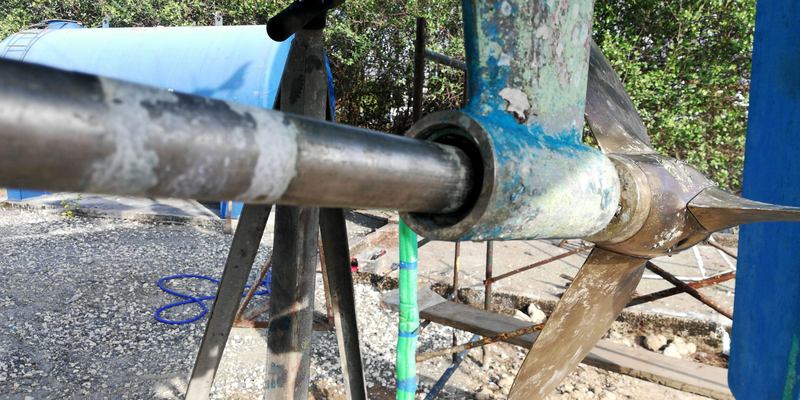
basis for change! On hauling out all initially looked well but on
closer inspection it was obvious that our Cutlass Rubber bearing in
the P bracket, the bracket that supports the propeller under the
hull, was well worn out. Our time in the aggressive marine growth of
Trinidad had taken its toll. A layer of calcium had built up on the
propeller shaft and effectively machined away the bearing. A new
bearing was needed which requires removing the shaft and that in turn
means changing the stern seal as well. Both were original to when I
bought Kurukulla in 2006 so they had lasted well. The problem now was
finding spares in Panama. The local chandlery, operated by Lloyd, has
a very limited stock and almost nothing in metric sizes. Lloyd
himself is a very willing guy and spent almost a whole day
researching all the suppliers in Colon and Panama City, to no avail.
 |
| Re anti-fouled and almost ready but ..... |
Ultimately I had to resort to inviting a very good friend, Mike, who
lives in London, to act as forwarding agent. I ordered the pieces via
the internet, from 3 different companies in UK, on Thursday 18th
of April; for them to be delivered to him and for him then to
consolidate them into one package and forward it to Panama by FedEx.
All of this over the Easter weekend! Our plan to transit the canal on
Sunday was obviously a non starter and very fortunately Erick, our
agent, managed to defer the transit, at no additional cost, to a date
yet to be confirmed. The advantage of using an agent!
In the ensuing days we
removed the prop shaft and old bearing plus the stern seal,
re-antifouled the hull, had the topsides polished and set about other
general maintenance onboard. We had plenty of time on our hands!
Fortunately the marina had a decent bar/restaurant and swimming pool.
There are some compensations! One slightly alarming aspect was
meeting up with a Canadian crew who had been set upon by
pirates/rogue fishermen, off the coast of Ecuador, as they sailed
south towards Panama. They were first approached by two small boats
30 miles off the coast; the boat crews requested beer and money
before departing, not an unusual event; only this lot came back with
two more boats some time later. Fortunately the yacht crew escaped
unharmed, if traumatised.
They had sent out a “Mayday” call on
Chanel 16 and fired off red distress flares but all to no avail. The
pirates rammed their boat several times, broke several windows but
were unable to get inside the boat, where the crew had taken refuge
behind metal grills fitted to the hatches (these they had had made
before leaving Canada). Eventually the pirates departed taking all
the upper deck electronics, which they had wrenched from their
housings, probably wrecking them in the process, and anything else of
value that they could find on the upper deck of the yacht.
Fortunately Ecuador is not on our route!
 |
| And we think we have problems! Their keel is completely rotten! |
Of the three different
suppliers; the two forwarded the parts via Royal Mail and these
arrived Easter Saturday; unfortunately the one piece forwarded by
FedEx arrived the Tuesday after (next “working day” service!).
Within 2 hours of the final piece arriving Mike had them consolidated
into a single package and back in the hands of the FedEx depot at
Feltham, London, it was now 1430 Tuesday. Via their tracking system
we received a forecast delivery in Panama of “Thursday 25th
April by 1800”. Needless to say Thursday 25th came and
went with no spares delivered. According to the tracking system it
took 24 hours to get the 4700 miles from UK to Panama, via Memphis
and Bogotá, and arrived in Panama at 1510 local on Wednesday. The
next 40 miles took 47 hours with the package finally arriving at 1430
on Friday; notwithstanding the fact that we had paid extra for “FedEx
International Priority, Express Package Service”! I am not sure
what our extra investment bought?
 |
| New bearing in and prop like new! |
With the parts in hand,
on Saturday, we set about fitting the new bearing and stern seal.
Bearing first. It was an excessively tight fit and after many hours
of sanding it down and using a puller to get it into the P bracket we
had it 70% in. The problem was, no matter what we did, it was neither
going in any further nor coming out! We and it were stuck! There had
to be a reason...and for a few hours it eluded me; no mention at all
of the P bracket in the Boat Handbook; then “the penny dropped”.
Although the shaft was 30mm diameter the bearing housing was not 45mm
diameter as we had measured, it was 1¾ inches, which equates to
44.45mm i.e. just over half a millimetre less. Hence the one we had
had delivered from UK was never going to fit! Why an Italian boat
builder installed a P bracket that requires a bearing in a mixture of
metric and imperial measurements goodness only knows but that is what
it is! Net result we were going to have to order another bearing, of
the correct dimensions, from UK, via a courier. Oh joy... I wont tell
you what I said but the air was blue!
 |
| On the move back in! |
At 0300 on the Monday
morning (0900 UK time) I was seated at the computer talking to Tom at
Exalto Bearings in Derby UK; he was very efficient and fully
understood my problem. Within 2 hours a second pair of bearings were
on their way via DHL; two in order to give me a spare; just in case!
DHL were forecasting delivery for Friday, four days hence, so not too
severe a delay. Now to sit and wait.... By 0130 local, on Wednesday,
DHL web tracking showed it was already in Panama awaiting clearance;
amazing; however, Wednesday was May 1st, a public holiday,
hence nothing was going to move again until start of the working day
on Thursday. “Every time a coconut” or should I say a public
holiday! Thursday came and went as did Friday … no bearings ….
“Clearance delays” being the excuse. The only entertaining part
of the day was sighting an alligator swimming silently around the
marina in between the boats. No swimming here then (other than in the
pool)!
First thing on Monday
morning I contacted the bearing suppliers and enlisted their help to
“kick” (their words not mine) DHL. Suddenly, an hour later, I
started to get messages from DHL saying it was on the move! Later in
the day the marina office also informed me they had received an
e-mail stating delivery would be Tuesday; eight days after collection
and six days after it arrived in Panama. Amazingly it actually
arrived, at 1230 Tuesday! Moral of the tale...for deliveries to
Panama use FedEx; never DHL. By 1600 we had the new bearing in (a
tight push fit) and decided to delay installing the new stern seal
until the following day when the light in the depths of the after
cabin would be better. By mid-day Wednesday all was back together
and ready for relaunch the following day, all that was needed now was
a new date for a transit!
 |
| Evening still in Shelter Bay Marina |
The relaunch went well
as did the sea trials, no leaks, no problems. 7 knots recorded under
engine where the minimum required for a canal transit is 5. Erick,
the agent, worked some sort of magic and got us a transit for the
Saturday, two days hence! By the time we came back from the sea
trials the fenders (8 large) and warps (4 x 120ft x 1”dia!) for the
transit were already awaiting us on the jetty! By close of play
Friday all was ready. Andrew, a member of the Canadian Coastguard,
had volunteered to act as a line handler and the agents provided the
other two ($100 a head), that with Christoph made the four necessary.
All was set.....
 |
| Canal advisor arrives. |
By midday Saturday our
two local line handlers had boarded and we set off for the Flats
anchorage where we had to anchor and await further instructions from
Port Control, plus the arrival of our Canal Adviser. From here it is
mandatory to call Cristobal Signal Station and report your readiness
to transit. In return you are given an arrival time for your Adviser,
ours was due at 1630, so no move before then.....
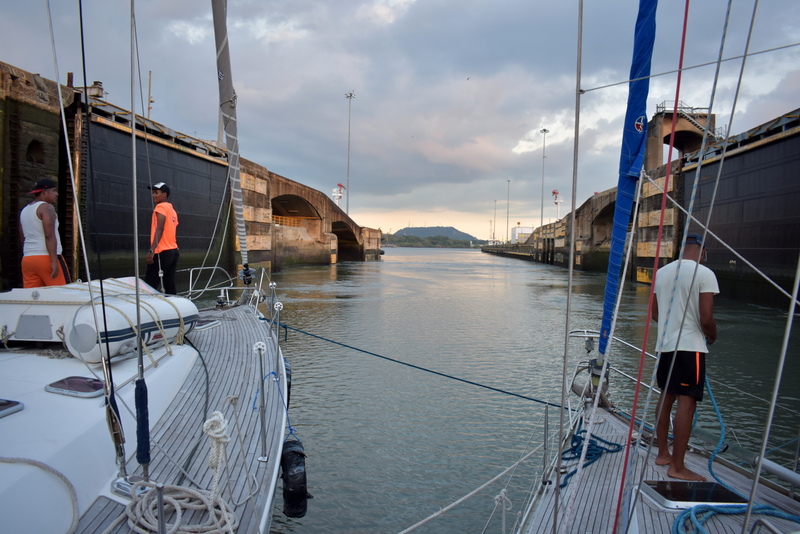
Good to their word the
“Advisor” arrived at 1630 and we were in the first lock by 1730,
out of the top lock at Gatún by 1915; after which we were required
to moor to a large (3m dia) mooring buoy for the night.
 |
| Our rafting partner comes alongside |
Fortunately
our “buddy” yacht, with whom we were rafting for the lock
transits, went alongside the buoy and were were able to go alongside
them, bow to stern. It saved us the worry of touching the buoy! Why
the canal authorities do not put in half a dozen yacht moorings I
cannot understand. Mooring to a 50 ton, circular, mooring buoy is far
from ideal for a yacht! Especially at £1000 a transit! Before
departure our “Advisor” for the following day (he was on our
buddy for the first section) instructed us to be ready for the off at
0730. I am sitting writing this at 0900 and still no sign of him! For
an organisation that needs to run like clockwork, if accidents are to
be avoided, their timekeeping sucks!
 |
| In the Gatun canal locks ... |
Once we had the adviser
onboard we set off at a very leisurely pace, 4kts, across Gatún Lake
towards the Pedro Miguel and Miraflores locks. As we approached the
Gaillard Cut (the canal created to connect the man made Gatún Lake
to the sea) we again had to drift for an hour plus to allow an LPG
carrier to clear the cut coming in the opposite direction. For
dangerous cargoes like LPG they do not allow other traffic to pass in
the opposite direction.
 |
| In the Gatun canal locks ... |
Eventually we reached the Pedro Miguel lock
and, after a relatively painless descent (other than me having to
kick the adviser responsible for the evolution to get him off his
mobile phone and overseeing what was going on),
 |
| In the Gatun canal locks ... |
we then moved to the
Miraflores locks where by 1815, and only two hours behind schedule,
we found ourselves back at sea level.
 |
| Gatun Lake.... |
By 1845 we were off the Balboa
Yacht Club where we were required to drop off the two agency line
handlers and the equipment they had provided.
It was also here where
the adviser was due to be collected by pilot launch, that took
another 40 minutes to arrive!
 |
| In the channel leading to Miafiores locks |
This was after I had threatened to land
the adviser at the yacht club if the launch did not arrive within the
next 5 minutes, it miraculously turned up.
 |
| Miafiores locks |
With no hint of apology
for delay he departed leaving us to head for the Flamenco Marina,
where we had pre booked a berth, some 3 miles away.
 |
| Exiting the last of the Miafiores locks |
Needless to say,
when we arrived in the marina, in the pitch dark, and after calling
three times on Ch10 (the marina frequency), there was no sign of the
promised boat that was supposed to meet us. We stooged around the
marina for 20 minutes and were just about to choose our own berth
when the boat finally turned up and guided us to an empty berth.
Safely alongside we settled down for a evening beer, Andrew then
departed and Christoph and I retired to our cabins for a well earned
rest.
 |
| Approaching Panama City |
Monday morning dawned
with the marina staff knocking on the hull inviting me to go and log
in at the marina office ASAP. Given their disinterest the night
before I was in no hurry! Later in the day we headed into Panama City
to collect a new outboard motor for the dinghy, its predecessor
having died in Jamaica and been sold to a mechanic in Shelter Bay.
The skyline of Panama is truly amazing, skyscrapers too numerous to
count, some housing offices and others apartments. That said there
are also very extensive and desperately dilapidated slums on the
outskirts of the skyscraper city; it is no wonder that Panama City
has a reputation as a dangerous place to be in at night; some of the
people here are living right on the edge.
 |
| Panama City skyline from the Uber |
Tuesday held a new
surprise. Part way through the morning I noticed that the batteries
were not charging despite it being a bright, sunny, day. It was
obvious our new'ish 160W solar panel was doing nothing. A quick
investigation with the multi meter showed that there was nothing
arriving at the regulator from the panel. My assumption was that,
being a new panel, the problem must lie with the wiring connecting
the two. Two hours later, having checked everything twice I was still
no closer to finding the root of the problem. Out of curiosity I
opened the waterproof connection box on the underside of the panel
and eureka, two of the three “soldered” connections were not
soldered but had only been touching for the past few weeks. A
combination of movement and age had broken the connection. So much
for Chinese quality control! Ten minutes with a soldering iron and
the problem was solved, 10 amps going into the battery! Unfortunately
the time this had taken put us back a day on our departure.
 |
| Departing Panama (the first time) |
On Wednesday we set
ourselves the task of getting at least a paper chart for the
Galapagos Islands so that if the opportunity arose we could sail
through the islands without stopping. That achieved we took our Uber
to the largest supermarket in town and stocked up on everything we
thought we would need for a month at sea; from fresh veg to
toothpaste! All of this was shipped back to the boat courtesy of a
charming and incredibly helpful Uber driver and was stowed in the
depths of Kurukulla. Thereafter it was a celebratory dinner ashore
and an early night.
The following morning
we watered ship, moved to the fuelling jetty to fill up with diesel
and then on Thursday, May 16th, we set off for the
Marquesas Islands about 4500 miles away.
 |
| The reason we came back! |
After two hours of motoring
in a flat calm we were at last blessed with some decent wind and at
times recorded 8kts on a close reach. Fantastic but it didn't last.
The night fell and the wind eased, by midnight we were doing 2-3kts
and that is how it stayed until morning. With Christoph sleeping down
below and trying to shake off the beginnings of what looked like a
flu bug I was on watch and trying to eke out the best speed possible
in the light wind conditions.
It was then I noticed that one of the
lower shrouds (wires that hold the mast straight), on the port side,
had failed; holding on by a few strands! Not a great situation!
Returning to Panama was a “no brainer” but to do so meant
motoring the 80 miles back over the ground we had already covered.
Not quite the start we had hoped for! To make matters worse, as we
motored back and just as the sun was setting, we found ourselves
negotiating our way through a very large field of floating debris. It
mostly consisted of baulks of timber and old tree trunks, some of
them large enough to do us significant damage. They seemed to be the
residue of logging operations, brought down river by the torrential
rain we had had 12 hours earlier and the thunderstorms that had been
going on all day and night. Fortunately by slaloming through we
managed to avoid all but a couple of smaller pieces which were semi
submerged. Not good to have one of those pass through the propeller,
damaging it; that would be all we needed!
By 0300 we were back in
the Flamenco Marina, tied up in the berth we had left 36 hours
before. No one noted our arrival and we settled for a night's sleep
before starting to resolve our problem. Later that morning, after
several hours of quizzing all and sundry, we had drawn a blank. There
was not a rigger or rigging company to be found anywhere in Panama,
notwithstanding the fact that it stands at one of the worlds major
crossroads.
 |
| Guess where? |
The only solution was to order the replacements from UK.
Sunday was a day when no progress could be made other than measuring
the rigging we needed to replace. I had decided to replace all four
lower shrouds and leave the intermediates and cap shrouds for when we
were in New Zealand or Australia where greater support could be
obtained. Monday morning, at 0300, again found me on the phone to UK,
this time calling rigging suppliers trying to find the company who
could respond the fastest. The winner of the competition was Jimmy
Green Marine in Seaton, Devon. Their senior rigger, Peter, and
salesman, Jason, could not have been more helpful; within 4 hours the
order had been placed and less than 24 hours later the new rigging
had been produced and was ready to consign to Panama via FedEx.
Impressive service!
 |
| View of Flamenco Marina from the masthead |
All that was left to do
now was to wait and track the package on FedEx. Wednesday dawned a
grey, rainy day, just the sort of weather to fill you with
enthusiasm! Thursday much the same. Friday morning I awoke to a
message from FedEx timed at 0902 telling me the package had reached
Panama but was now subject to “Clearance delays”. Nothing new
there then! What was new was the next message at 1347 telling me it
was now in Bogota, Columbia! Whatever they are doing it is not what
was intended! Three messages later, at 1700, I was informed that it
was again back in Panama, awaiting clearance but by now of course it
was too late for clearance on the Friday and so we will have to wait
for the weekend to pass. Goodness knows what news Monday will bring!
 |
| The new rigging + courtesy flags for the Pacific arrive.. |
Answer nothing! On Tuesday morning I was back on the phone at 0300 asking Jimmy Green to "kick" FedEx. It worked! Six and a half hours later, at 0930, the rigging arrived; after crossing the palm of the driver with $4.25 and customs with $10 it was mine to install. By mid day Tuesday we were back ready to go. All that was needed now was to top up with water, victuals and fuel. It is now 1100 Wednesday and we are ready to depart. More when we arrive in the Marquesas..........