Kurukulla

Kurukulla
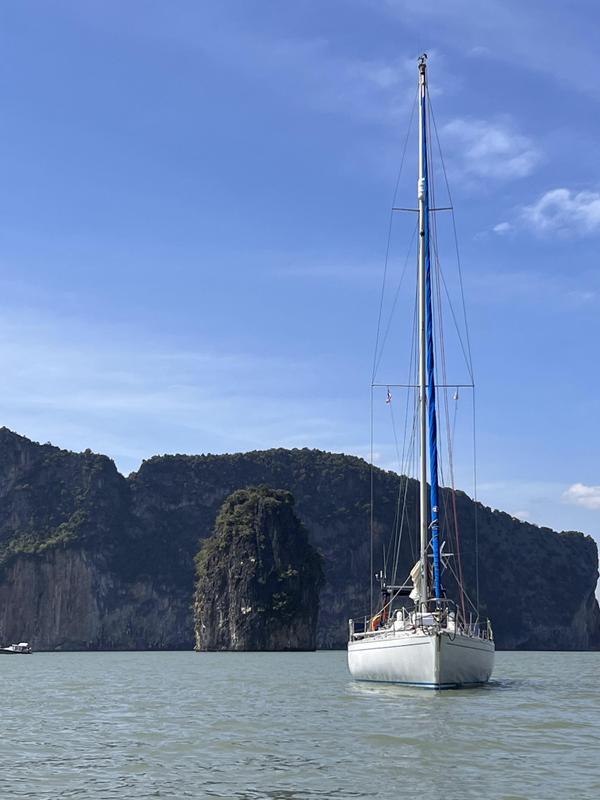
Kurukulla, anchored at James Bond Island, Thailand

Wednesday, 15 February 2023

Cruising Malaysia and Thailand

The AIS picture crossing the Malacca Straits

Having checked out of Indonesia on the 4th of October we departed Nongsa Point Marina in the early morning of the 5th. The marina were very nervous that the immigration authorities would notice that we hadn't left on the 4th, immediately after clearance; fortunately they didn't! Our aim was to make passage west and anchor in a bay on the north west side of the Indonesian island of Kepalajerih, some 26 miles from Nongsa, a point convenient for a crossing of the Malacca Straits to enter the western Johor Straits between Malaysia and Singapore. The passage was a motor all the way with no wind whatsoever hence the anchorage was calm and a pleasant final night was passed in Indonesia.


Approaching the new Western Johore bridge

Next day we motored, for lack of wind, across the crowded shipping lanes to enter the Johor Straits; destined to enter Malaysia at Puteri Harbour Marina, a government owned and operated marina in the midst of a large commercial development. The marina was in reasonable condition but it was obvious that it was underutilised; many of the boats there had not moved since before Covid and were suffering from long term neglect. In the surrounding commercial precinct it was also obvious that 50% of the available commercial premises had never been occupied and of those that had half of them had failed. A slightly depressing sight but one that was to be repeated in many areas of Malaysia.


Around Puteri Marina

By comparison with Indonesia the clearing in process was simplicity itself. The marina completed the necessary forms, we were escorted in a golf buggy to the adjacent ferry terminal where we were processed by Immigration and that was it! No costs and a 90 day visa..... After supper in a local “Bier kellar” we were set for an early night, or so we thought, not realising that the marina and the surrounding buildings were deemed to provide ideal acoustics by the local karaoke enthusiasts who turned up with their amplifiers and serenaded us for half of the night. Now, I have never been a fan of karaoke but this was painful in the extreme; sadly it was also repeated most nights we were there!


Departing Puteri Marina

Nine days later, after waiting for a spell of NW winds to pass, we set off northwards up the Malacca Straits. Our first stop was in the narrow passage between Pulau Kukup and mainland Malaysia. It is a narrow channel with a large population of fish farms and fishermen's houses on stilts on both sides. Our plan was to stay here two days but just before sunset on the second day we were visited by the local Marine Police who claimed that we were anchored in a restricted area! We pointed out that we were one of about 40 boats (all others were fishing boats) anchored in the area but that seemed not to matter (i.e. we were not local!). After a 15 minute debate we agreed to move, sunset was approaching and I preferred to move in daylight rather than prolong the argument. Their suggestion was that we should anchor out in the main Malacca channel along with the numerous tankers and freighters! We ignored this advice and chose a spot in the shallow waters just outside the souther end of the channel separating the island from the mainland, not ideal and it resulted in a rather uncomfortable, roly, night.

Pulau Kukup anchorage


The next day we sailed north to Pulau Pisang, only 15 miles away, and anchored on the south eastern side of the island. Although a quite pleasant anchorage we opted to spend only the one night here; the waters were still a muddy brown and somewhat uninviting to swim in and we were keen to get somewhere more like that seen in the tourist brochures! Early next morning we set off for an overnight sail to Muar the next sizeable town on this coast. Sailing by night is less risky than motoring and hence we made slow but steady progress in the light winds. Sailing you are much more likely to pass over the multitudinous fishing drift nets without problems, motoring risks getting them round the propeller. Many are lit with any variety of flashing, solar powered, LED lights of any colour from yellow and white through red, green, blue and purple but there are an equal number unlit! Even with those that are lit it is frequently impossible to distinguish which of the lights are attached to which nets. To compound our problems a thunderstorm caught us an hour before dawn, just as we closed the coast and approached the Muar landfall buoy. This resulted in us having to rapidly reef the genoa and a close call with a series of unlit/randomly lit fish traps. Fortunately we weathered the storm, passing the windward end of the fish traps, all without incident but it was an uncomfortable half hour!


Anchored near the bridge at Muar

We arrived off Muar almost exactly 24 hours after our departure from Pulau Pisang, a distance of 55 miles, slow going. The other reason for our reluctance to use the engine was a lack of fuel. We had taken sufficient before leaving Indonesia to get us to Malaysia without problem, knowing that diesel in Malaysia is about half the price it is in Indonesia. What we hadn't reckoned on was the fuel jetty at Puteri Harbour being out of commission and there being no vehicle petrol station anywhere in the area! Muar was to be our next opportunity to refuel but even sailing as we did we were very low on arrival.


Muar town

Muar is a tidally constrained estuary and hence we had to anchor and wait for the tide to rise before we could enter. What we did not know was that there was a large datum error (~250m) on the large scale chart of the area which almost put us aground in the approaches; fortunately we managed to find the channel despite the chart. At the entrance to the river there is a marina on the south bank but, as with so many of these grand projects in Malaysia, once constructed it failed to thrive. It had been abandoned almost immediately and left to silt up hence there were only a few local shallow draft boats (<1m) moored inside. We were aware of this before entry and had already decided to anchor just before the low the road bridge that connects the two halves of the town. The river mud was really good holding which was just as well as we were only 150m from the bridge, anchored in 10m of water, near the southern shore.

Floating island drifting past

Not only was there a strong tidal/river flow in and out but massive floating islands of vegetation came down river on every ebb tide, some returning on the flood a few hours later. Had we have picked up one of these I am not sure our anchor would have held. Muar proved to be a modern and interesting town with all facilities including an enormous shopping centre with large supermarket, ideal for re-victualling. It also had a fuel station only 100m from the Marine Police jetty and they were very happy for us to tie the dinghy up there. In fact before we departed we also went alongside their jetty, on the top of the tide, to replenish with water. They could not have been more accommodating.


Pulau Besar golf resort

After four days in Muar we made the short hop to Pulau Besar, a resort island only 15 miles to the NW. An early morning departure to catch the high tide meant that we arrived in our next anchorage before midday. Having anchored just SE of the main beach we settled down for a relaxing three days at anchor in cleaner, if not completely clear, waters. On going ashore it was obvious that the island was currently surviving on low level local tourism. It later became evident that Pulau Besar was another major project gone wrong. The entire centre of the island was dominated by a major 18 hole golf course, beautifully tended, but no golfers to be seen and there had obviously not been any for many years. On the north coast was a luxurious hotel complex, patently designed to accommodate wealthy golfers, but not a resident in sight, only security guards and maintenance workers. Signs at the back gates warned of “Armed Patrols” and the risk of being shot. I went in via the main entry road which had no such signs but was soon made to realise my presence was not welcome; I was escorted out again! All very strange and an extraordinary waste of government money.


Malaka city

From here it was another short hop to Pulau Upeh, another failed holiday complex on an island just off the town of Malaka (aka Malacca). Again there seemed to be maintenance staff ashore but nothing else and the condition of the buildings was such that they obviously had not been in use for many years. After 24 hours at anchor here we opted to try to get into the marina at Malaka, timing our entry for high tide. This is another abandoned marina but has some pontoons in place. Although we entered the marina, and probed gently for any suitable depths, it was soon evident that the marina was too heavily silted and the maximum depth at low water would be 1m or less; we need 2.1m minimum to match our draft. After a couple of fruitless attempts to find a more suitable depth near the river mouth, thus allowing us to get ashore, we were finally forced to opt for an anchorage well outside the river mouth near the major land reclamation work that is taking place to the north of the river; hardly a picturesque anchorage and hence we moved on again the next day never having set foot ashore.


Admiral Marina

Twenty eight miles later, after an enjoyable close reach, we were entering Admiral Marina, just short of Port Dickson. This is another part complete complex that is noticeably empty of residents. It boasts a luxurious country club with superb swimming pool, bar and restaurant but the two enormous accommodation complexes, one either side, appear almost deserted and the marina itself is in a parlous state having suffered severe damage in a storm a few years back. Some berths have power and water, many not, and several of the pontoons were barely attached to the base structure.

Alongside Admiral Marina

Overall it needs significant investment to bring it back to even a fair standard. That said we enjoyed our time here; we took full advantage of the pool/bar and the nearby town to sample Malaysian street food. After four days of “luxurious living” it was time to move on and we moved 5 miles up the coast to anchor off Port Dickson itself. Here the anchorage was well sheltered from all but the south and although Port Dickson didn't look tempting enough for us to bother blowing the dinghy up and going ashore we spent a pleasant 24 hours anchored here.


South Port, approaching Selangor.
Alongside RSYC

From Port Dickson it was an early morning, 0700, departure in order to reach the Royal Selangor Yacht Club in one day. As it turned out we had a brisk reach, 50 miles along the coast, and made the club easily by 1700 despite having to battle a foul tide through the Southport channel and Container Port on the way into Selangor. The club is delightful and very welcoming; the only downsides are that their pontoons look in need of a thorough refit (despite them being repainted bright yellow, along with out berthing warps, whilst we were there) and the tidal stream running past the pontoons is a vicious 5-6 knots (we used every fender we had onboard).

Tallest building in Malaysia

We had planned four days here in order to give us time to visit Kuala Lumpur which is a direct train journey away. Kuala Lumpur was impressive to say the least. Having seen so many failed projects in Malaysia it was a real pleasure to see a thriving and well maintained metropolis with some really spectacular buildings.

Impressive!


We did the very touristy thing of taking the circular bus tour in order to get our bearings and it was well worth it. We saw many aspects of the city we would not have visited otherwise.


 Whilst at the Royal Selangor we met up with Fabian, a Malaysian yacht owner that we had previously come across in the marina at Puteri Harbour. He was also about to embark on a circumnavigation and was keen to tap us as a source of experience. In return he provided us with extensive local knowledge and introduced us to the best street food so far!

With some not so modern!

We also looked into the possibility of hauling out at the RSYC, to re-antifoul, as Kurukulla had now been in the water 14 months since her last haul out at Sandringham Yacht Club, Melbourne, Australia. Unfortunately the trolley system at the RSYC was not available within out timescale but fortunately Fabian was able to recommended an alternative, at Pangkor Marina, only 90 miles further up the coast.


Sunset at Pangkor Island
Post polish and paint!

After an enjoyable sojourn at the RSYC we took our leave and set off northwards via the Northport channel (yet more container berths) and sailed through the night to the anchorage on the SW corner of Pangkor Island arriving at 1000 on the 8th of November. A very pleasant anchorage with restaurants ashore and a very upmarket resort on stilts on the island of Pangkor Laut. It was here we sat for two days whilst we negotiated our berth in Pangkor Marina and the lift out for 4 days on their hardstanding. Unfortunately our 4 day lift out turned into a 12 day stay. The first few days were disrupted by torrential rain storms which prevented progress on the hull painting. This, combined with the fact that the slipway where we were recovered and launched was too short to allow a 2.1m draft vessel to be lifted during neap tides (i.e. tides with lower than average rise and fall), meant that our 4 day spell on the hardstanding became a 12 day one whilst we waited for the high tide level to reach that at which we could be relaunched.

Street food at it's best

All was not lost however at the paint job was excellent and I took the opportunity to have the hull polished whilst we were waiting. Kurukulla went back in the water looking like a new yacht!


From Pangkor Marina we went back to the anchorage inside Pangkor Laut for a couple of days of relaxation before heading north again to Penang. As we sailed north, past Pangkor Island we passed yet another “white elephant” government owned marina, abandoned and silted, on the west coast of the island, complete in every sense but now left to go derelict!


The new Penang Bridge

Pangkor to Penang is 80 miles but we did rather more than that as some of the voyage was to windward, in light airs. We departed Pangkor in the late afternoon and 24 hours later we were anchoring off the NE tip of Penang having passed through the strait separating the island of Penang from the mainland and under both bridges which connect one to the other. We were too late to enter Straits Quay marina that day (the approach it tidally constrained) hence we anchored overnight and negotiated a berth from mid day the next day. To my surprise the General Manager of the marina turned out to be John Ferguson, an RNSA member and Ex Commanding Officer of HMS Rothesay,

Straits Quay Marina

Needless to say we spent some time reminiscing over our past careers! The marina itself is small but very well supplied with local facilities in the form of restaurants, shopping centres and an impressive Lotus's supermarket (ex Tesco Asia). One problem that John described was that post Covid not only did he have many yachts waiting for their owners to return but he also had two yachts where the owners had died of Covid, all of which were blocking berths in his already crowded marina!


Part of our reason for planning a few days in Penang was to allow us to visit the Thai Consulate and get Visitors Visas that would allow us to stay in Thailand for more than the 30 days allowed to visiting yachtsmen on a “ship crew” shore pass stamp in your passport, which is all that is issued if you opt for a visa on arrival. We had heard many inconsistent reports on how this system was being administered and decided to play safe with a full visa at a cost of 160 Ringgit (~£32) a head plus a further 240Rgt in taxi fares, not to mention two days of queueing and shuttling to and fro to the Consulate! Eventually, with visas in our passports we set sail north again for our final visit in Malaysia at Langkawi. It was here in this Duty Free port that we intended to stock up for our planned Christmas in Phuket with my daughter, Vanessa.


Fijord anchorage inside Pulau Gabang Darat

We departed Penang at 0700 on the 1st of December, partly to allow us to make Langkawi in daylight but more importantly to exit on the top of the tide. The sail northwards was pleasant and uneventful and we finally sailed onto the anchor in Ayer Taban bay at 1800. After a quiet night here we then motored through the “Fjord” between Pulau Gabang Darat and the main island of Pulau Dayang Bunting, stopping for lunch en route before anchoring again in the bay on the NE corner of Pulau Singa Besar. Again we stopped here one night before moving to the rather less quiet but commercially more alive anchorage at Pelangi Beach on the SW side of the main island of Pulau Langkawi.

Langkawi monuments!

After a brief call to the Royal Langkawi Yacht Club we were set for a four day stay in their marina to allow us to stock up for Christmas and time our arrival in Thailand so that, if all went “Pear shaped”, we could leave before our 30 days expired; not that I was feeling pessimistic, although perhaps I should have been!


"Long tails" at Ko Lepe

On the 8th of December we had cleared out of Malaysia and set off for Ko Lepe, the Thai island only 25 miles WNW of Langkawi and between which numerous ferries ply their trade. Ko Lepe is only a few square miles in total but it is a popular tourist island and has Customs and Immigration offices on the beach. It seemed the obvious place to clear into Thailand; we had been told they were very easygoing; hence, we decided to take the opportunity to formally enter here rather than be illegal entrants until we reached Ao Chalong in Phuket. This was a grave mistake! All appeared to be going swimmingly until I pointed out that we already had visas for entry in our passports; this did not compute! After several phone calls they explained that we could not enter on our visas as we were coming in as ships crew. No amount of explaining that we were sailing tourists would change their minds and they insisted on giving us a crew stamp in our passports rather than validating our visas for entry. (They very kindly suggested we could fly back and use the visas any time in the next 3 months!). The stamps were valid for maximum 30 days in Thailand! Eventually we were forced to accept the situation and I resolved to try to sort it out once we reached Phuket. During our stay in Phuket Yacht Haven Marina, some two weeks later, I queried our situation with the Marina Staff; they recommended a trip to the Immigration Office at Blue Tree, 15 miles (25 km) away, where they said the queues would be much smaller than at Ao Chalong. A 30 minute taxi ride later we were at the office and service was indeed relatively quick. It took them all of 5 minutes to decide it was not within their remit to change the situation, only Ko Lepe could amend their actions and what was worse still we would only be allowed to exit Thailand via Ko Lepe because, with a ship's crew stamp, you can only exit via your point of entry! This threw a complete “spanner in the works” as we were intending to leave via the Ao Chalong offices in Phuket once my daughter, Vanessa, had departed back to Australia after her Christmas/New Year visit. She was due to arrive on the 23rd and fly back out on the 5th of January, we now had to be out of Thailand by the 8th!


We stayed one night in the southern bay at Ko Lepe, it being a sheltered bay but littered with moorings and with a wide fringing reef off the beach. This meant that you were forced to anchor well out beyond the moored boats/ferries etc., in 25m of water, not ideal for a good nights sleep. Next day we moved round to the anchorage to the NW of the island in the strait between Ko Lepe and the larger but almost deserted island of Ko Adang; a better anchorage but much further from civilisation.


Nai Harn Bay

After this slightly rocky start to our time in Thailand we headed north looking forward to our time in Phuket. After departing in the morning of the 9th Dec we arrived in the bay at Nai Harn, on the SW tip of Phuket Island on the morning of the 10th. Against our expectations the bay was almost empty, there was only one yacht on a mooring below the Royal Phuket Yacht Club clubhouse. We had the rest of the bay to ourselves! Later that same day, after a rest to recover from our overnight passage, we headed round to Ao Chalong on the SE side of Phuket island and, after a search for a suitable space between the hundreds of moorings, we anchored not too far from the Phuket Cruising Yacht Club, a small but welcoming organisation run by Brent and his wife Yai.


We spent two nights here at anchor to re-victual and in the process also enjoyed an excellent curry lunch at the club. We also met up with an Australian, John in his yacht Bojangles, whom we had met several times along the way here, most recently in the yard at Pangkor where he had also lifted his boat out to resolve a water leak caused by a crack in the hull. John, wisely, had sailed to Phuket before checking into Thailand and had been given a 45 day stamp in his passport extendable by 30 days at Ao Chalong; how to rub salt in a wound! Moral, only clear in at Ao Chalong even if the opportunity arises earlier!


Bangla Road, Patong (Sin city)

From Ao Chalong we sailed around to the infamous beach at Patong, home of the craziest nightlife on the island. After two nights enjoying the sights and sounds of the resort and meeting up with David, my crew from the Gippsland to Sydney leg, who happened to be attending a wedding in Thailand at the same time, I went down with Covid ….. Uughh. Within 24 hours it felt as though I had swallowed a hedgehog. Fortunately my crew, Yiorgos, managed to steer clear of it. We were both triple vaccinated, the most recent being received in Darwin before departure from Australia. After 6 days of lying low onboard I had recovered enough to sail us back round to Ao Chalong where we hurriedly embarked sufficient victuals for Christmas before heading off two days later for our planned Christmas stopover at the Phuket Yacht Haven Marina on the north east tip of the island. This was not our first choice marina due to it's remote position, the Boat Lagoon marina and the Royal Phuket Yacht Club marina were both higher on our preference list but getting either of them to respond to e-mails proved impossible; telephone calls fared no better. They obviously had more demand than they could cope with.

Phuket Yacht Haven Marina

That said the Haven Marina was a great marina with excellent on site bar/restaurant facilities, the problem was that it and it's associated resort were almost in the middle of nowhere! That said we enjoyed our Christmas there and made good friends with one of the local restaurant owners, The Wood Fired Grill Bar.


James Bond Island

Vanessa had arrived on Dec 23rd , two days before Christmas, and came straight to the marina. We had debated getting her a room in the resort but she was convinced that having had Covid herself in the recent past she was not at risk of catching it again, from me. Fortunately, by the end of Christmas, although not fully recovered I was feeling much better; sufficiently recovered to take us off on Boxing Day to visit James Bond Island and do some of the tourist trail! We anchored for lunch in the shadow of James Bond Island (aka Ko Phing Kan) and made the mandatory trip to the beach in the dinghy. On discovering that they wanted to charge us the equivalent of £40 for landing from our inflatable we contented ourselves with a scenic dinghy ride, circumnavigating the island; which, on reflection, proved to be a better option than landing.


Later that afternoon we headed south again and anchored in the large but sheltered bay at Ao Son, on the west side of Ko Yao Yai. Wind that day had been in short supply hence we had motored for a large part of the trip. Next morning we had a leisurely swim in the bay before moving a few miles north to anchor between the small island of Ko Boi Yai and the larger Ko Yao Noi. The sand-spit at the eastern end of Ko Boi Yai provided a secure anchorage despite the strong tidal stream flowing between the two islands. From here we had intended to sail east between the islands of Ko Yao Noi and Ko Yao Yai but a quick calculation and reference to the chart showed that, even at high water, we were unlikely to find the necessary 2.1m plus to allow us through. Only at top spring tides would this be possible. Rather than risk a grounding we opted to retrace our steps and sail south down the west coast of Ko Yao Yai and across to Phi Phi island, the other “must do” on Vanessa's bucket list. It was on this leg that we managed, for the first time since leaving Turkey, to pick up a fishing net around the propeller, luckily 15 minutes later I had managed to cut it free and unravel the rope/net wound round the propeller; better by day than by night! For the first night we anchored in the hustle and bustle of Ton Sai Bay, adjacent to the main tourist town. Again the fringing reef and density of moorings resulted in us having to moor a long way from the beach but we managed to dinghy ashore for dinner in a local restaurant and a walk around the town. If we thought the southern shore bordering Ton Sai Bay was lively it was nothing compared with the other side of the isthmus separating Ton Sai from Ao Lohdalum bay. Although Ao Lohdalum is a much less viable anchorage, due to extensive coral heads and reef, it is decidedly the livelier part of the resort with deafening music from every bar and a very popular Ibiza Swimming complex that was heaving even at midnight! We were grateful to be anchored in Ton Sai despite the boat traffic.


Vanessa on NYE night out!

One day in Ton Sai was enough and the next day we headed up the east coast hoping to anchor off one of the resorts but an onshore wind (as forecast) prevented us from doing so and hence we rounded the northern tip of Phi Phi and anchored in the most north westerly bay, Ao Lanah. This was much more peaceful, less boat traffic, and the waters were clear blue, uncontaminated by stirred up sediment! After a night at anchor we then headed back to the main island of Phuket ready for the celebrations on New Year's Eve, anchoring off the beach at Ban Nit in the Ao Chalong bay. In the early part of the evening we took the dinghy ashore and booked a table at the local beach-front restaurant and enjoyed an evening of local food. After this we wandered along the beach and gatecrashed (well not quite; we did request entry which was granted provided we bought wine by the bottle! We bought several!) a very smart hotel who were holding their New Year's Eve party. By Midnight we were all very merry (I was taking it slightly carefully, still recovering from Covid) and I think we were amongst the last to leave the poolside bar at about 0130. A fun night was had by all!


Next day we opted for a quiet day at anchor; surprise, surprise! Later in the day we again meandered ashore, Vanessa opted for a massage near the beach and ultimately we all returned to the same restaurant to dine, just as the sun set. After a quiet night at anchor we set off for the anchorage at Ao Chalong itself in order to replenish our water stocks, which were running low, and to re-victual. After finding a suitable space between the moorings and anchoring we opted for a curry lunch at the Cruising Yacht Club before heading to the nearest supermarket where we bought the necessary. Our next task was water and the only suitable source at Ao Chalong is the fuelling jetty. Unfortunately this jetty is not designed for yachts or small craft, being constructed on vertical piles all of which are adorned with a vicious layer of large crustaceans. We were able to sneak in and go alongside a local boat, using him as a fender (fortunately they did not seem to mind and assisted us with the whole evolution). Fifteen minutes later we were away again having taken 220 litres of potable water.


Long tails anchored off Ko Lepe

From here it was a gentle motor back to our first anchorage in the Phuket area, at Nai Harn; this time it was much more heavily populated with boats! After 36 hours here we headed again to Patong. We couldn't let Vanessa leave without her seeing Bangla Road, the mecca of Phuket (aka Sin City!). After supper ashore and a few drinks we retired back onboard ready for Vanessa's departure the following day. Vanessa was due to depart in the late afternoon for a long flight back to Melbourne and hence we satisfied ourselves with a lazy day onboard, followed by an early supper ashore, before putting her in a taxi to the airport and Yiorgos and I returning to Kurukulla. The Thai visa saga meant that we to had to leave that night and sail overnight to reach Ko Lepe in time to log out of Thailand before our shore passes expired. I had decided that returning to Langkawi and departing from there for Sri Lanka was the best available option, thus it was that we anchored for two nights at Ko Lepe, checked out of Thailand just in time and then headed back to Langkawi anchoring just SE of Rebak Island, off the resort of the same name. The anchorage was sheltered and picturesque but slightly spoilt by the numerous ferry boats, storming past at high speed, taking passengers to and from the resort.


One of many deserted boats seen along the way

Next day we motored, in no wind, to the Royal Langkawi Yacht Club to prepare for departure to Sri Lanka. We were going to be subject to further delay as that I was awaiting delivery of three credit/debit card replacements that had been posted from UK to Vanessa in Australia for her to bring to Thailand. Needless to say, despite being posted from UK on the 28th of November they had not arrived in time for her departure for Thailand and indeed had not arrived by her return to Australia.

Langkawi Tower

Our plan now was to DFS them to the RLYC once they arrived. As I write this on the 21st of January we are still waiting. Despite being marked Air Mail they must have been despatched by Sea Mail! Notwithstanding, we have set our departure for Sri Lanka for 22nd of January latest allowing us to celebrate Chinese New Year before departure. The cards will simply have to catch up later! Delay beyond this date risks us losing the NE Monsoon before we reach Djibouti.


More when we are in Sri Lanka and the Maldives …......

Tuesday, 4 October 2022

Passage through Indonesia. From Darwin to Kupang, then via Bali and onwards to Nongsa Marina, Batam

Darwin to Bali

Having arrived in Darwin on the 22nd of June we had only 6 days to sort out the visa saga for my, potentially lapsing, Aged Parent Visa application (for which I had paid $A4200) and Yorgos' expiring Visitor Visa which was due to expire on the 28th June. With the insistence of the Aged Parent visa office in Perth, that they would only deal with a Bridging Visa B (BVB) application from me by post (of course, prior payment has to be made electronically!), we sent off all the necessary documentation by Australia Post Express Post. In normal times this is a fantastic 24 hour service but on arrival at the Post Office we were informed that post Covid it has reverted to a '5 working days' service. We couldn't win! 


Departing Darwin

It was obvious that my Bridging Visa B would not get issued prior to Yiorgos Visitor Visa expiring. When his visa was issued, for no explained reason, he had been “short changed” by his visa being issued for less time than he had requested hence we were now faced with applying for an extension just to cover an extra few days. Applying for an extension when in Australia is twice the cost of the original visa; they know when they have you over a barrel! My telephone call to the “Help Line” produced the answer that they issue Visas for the time that they see fit, not necessarily what the applicant applied for! With no alternative we fronted up with the $A340 for a visa extension.

To add insult to injurymy Bridging Visa B (which allows me to come and go to Australia without affecting my Aged Parent Visa application), when it did arrive, was also issued with a validity of one year, not the five I had requested; this was completely useless given that I would not even be back in UK by it's expiry! In a second protest phone call I was informed that they had recently stopped issuing 5 year BVB's, one year was now the maximum available; no public announcement had been made; really helpful!

Notwithstanding all of this hassle the visit to Darwin was otherwise really enjoyable. We made several new friends, through mutual contacts I had made back in Melbourne, and managed to visit much of the city whilst we were there. Although not an architecturally impressive city it does have a welcoming feel to it and the Darwin Sailing Club provided us with a home from home. On our last night we invited our two key contacts in Darwin, Peter and Robyn Bracken and David Woodhouse, to join us for a drink at the club. As luck would have it, as David arrived, he was announced as the winner of the weekly membership draw, a win of $A500 hence the drinks were then on him!

The following day we made our last dash to Woolworth's, the largest supermarket in town, to top up with all those things that would not be available in Indonesia. We then requested clearance from the ABF for departure that night, hoping that we could stay in the marina overnight and depart Saturday morning. It was not to be! The ABF politely insisted that we must depart the minute we had our papers in hand and that meant before 1600 Friday because they do not work weekends. Our next problem was to organise a locking out from the marina at no notice. They were really helpful and agreed to lock us out on the first opportunity after our clearance had been issued. 1600 came and went with no ABF. 30 minutes later there was a phone call asking where in the marina we were; I agreed to meet them at the gate and guide them to our berth. On arrival at the gate there was still no sign of the ABF.

Anchored off Kupang in the quarantine anchorage

A second phone call revealed that they were at the wrong marina, this was despite us having declared marina and berth number on our departure request! They were at least 40 minutes away on the other side of Darwin. We then agreed that we would lock out and they would come to the fueling pier on the seaward side of the lock and clear us from there. What we had not allowed for was that it was Territory night and half the world were currently locking out to view the major firework display from the bay! We had managed to get locked out and refueled before the ABF arrived, eventually berthing outboard of an American ketch on the pier. The ABF finally arrived, very contrite, and cleared us without difficulty. After clearance we moved out into Fanny Bay, anchored for the next 36 hours, watched the fireworks from our grandstand position, and departed for Indonesia on the Sunday morning.


Monkeys by the roadside, awaiting food! Kupang.

By 0700 on Sunday were were on our way, with the tidal stream under us, heading for Kupang, our port of entry in Indonesia, 470 miles away. Our voyage was simple. We soon settled into a watch-keeping routine and the days passed relatively quickly as we trickled downwind under full main and boomed out genoa for the majority of the time. Our average was 5 knots which was not bad given several periods of light to almost no wind. We only motored the once and that was to escape from the zero wind conditions off the coast of Australia.


Kupang harbour was destroyed some years back.

We arrived in Kupang at 0900, on July 6th, and anchored in the quarantine anchorage for yachts, just off the town, as directed by our agent. The anticipated visit by Customs, which we had been assured would take place on arrival, didn't materialise and by midday I was contacting the agent to try to get some movement. Our agent was in Bali, some 500 miles away hence their options were limited! We were recommended to contact Mathew, a local representative, and enlist his assistance. Mathew proved to be a great help (although he claimed not to know our agents!) and for a price he took on the task of organising our entry procedure into Indonesia, (He is contactable on +62-852-5324-3999). This was far from simple and without his assistance we would have expended much time and effort discovering the system. As it was Mathew knew where to go and who to see and for the majority did not need us to accompany him. The major factor that led to the three day delay was the failure of the system that allowed Kupang to print the stickers that needed to be stuck in our passports! 


Great fruits available in Kupang

This failure was nationwide and had brought travel into Indonesia to a standstill, not just at Kupang! By the end of day three Kurukulla had been inspected by Customs and Health departments, we had collected our papers from the Health offices ( I had to sign for them, a book full of pages with “not applicable” on every single line! But we had to have it!) and visited the Customs and Immigration offices to retrieve our yacht temporary entry permit and retrieve our passports, now with added stickers. After three days battling bureaucracy we were officially in!


Kupang itself is a bustling city with most facilities. The anchorage is far from clean with floating plastic everywhere but there are many worse places as we were later to find out. We were able to get most things that we required in the vicinity of the anchorage and were introduced to Bintang, the local beer, and Bintang Zero, their zero alcohol version which is halfway between beer and cider!

Kupang river waterfront

Initially it comes as a bit of a shock if you are expecting a 0% alcohol beer but once you realise that that is not what it is it is fantastic; the most refreshing and enjoyable drink we have found to date.


After 5 days in Kupang we set off west heading initially for Pulau (Island) Semau but on finding the anchorage untenable we opted to press on for the anchorage at Ba'a on Pulau Roti, 50 miles from Kupang. Inevitably we reached Ba'a in darkness and on a moonless night. Having picked our way through innumerable unlit fishermen and their drifting nets, (they have a habit of turning a torch on you if you get too close to their net or to themselves; unfortunately this doesn't help much as it blinds you and you still have no idea where the net is!); fortunately we made it through without incident. Once near the harbour jetty we anchored in exactly the position that we had taken from one of the online cruising guides;

Anchorage at Ba'a and the submerged, ruined, jetty

this was just as well as the following morning we found ourselves 75m from the remains of a destroyed arm of the jetty, most of which was underwater and unmarked! If we had pressed on and gone in further we would certainly have found it, the hard way!


Strange moonlight at Pulau Doo Kecil

Next morning we set off for an anchorage off Pulau Doo Kecil, a small island at the western extremity of Pulau Rote. Here we anchored in 8m, on sand, in idyllic surroundings just off the long sandy beach. Sadly we were only to spend one night here before setting off again to make ground towards Bali.


Our next stop was at Seba, on Pulau Sawu, our last stop in this part of Indonesia. Seba is a small village with a huge expanse of tidal beach.

The persistent sales woman, Sawu

We anchored on sand, as close in as we could get, but it was still a fair dinghy ride to get ashore and difficult to pick your way over the fringing reef. The nightmare scenario was ripping the fabric of the inflatable by grounding it on coral! The village was small but we were able to find a few fresh vegetables for sale and endless “kiosks” selling similar varieties of minor items such as cigarettes, single sachets of instant drinks and candy for children! On the beach we were accosted by an elderly lady who, despite us not having a word in any common language, was determined to sell us sarongs or other accoutrements. We politely declined but not to be deterred she remained by our dinghy to make a second attempt on our return. Although her goods were tempting her prices were not! She had patently decided we were “rich” tourists! We departed without buying.


From Seba it was a late afternoon, Thursday July 14th, departure for a two night crossing to Ende arriving Saturday in the late morning. The waterfront at Ende is jet black sand with numerous boats on moorings in the bay.

Ende anchorage

The recommended anchorage was fully occupied by moorings and hence we anchored just north of the ferry jetty, just outside the ferry turning area. Although deep it was a relatively comfortable anchorage with one major drawback; the send into the bay was such that any attempt to go ashore and land on the beach would have been a very wet and risky experience! Eventually, after being at anchor for almost 24 hours we gave up and moved on without ever setting foot ashore. That said, I'm not sure we missed much, the town did not look very inviting!


Pulau Gelinta, aka Mules

Our disappointment was short lived. Our next stop was 82 miles west at Pulau Gelinta (aka Mules Island – Pronounced Moo-les). This was to be our favourite place to date. We arrived after another overnight sail and initially anchored just to the west of the local moorings, off the pure white sand beach at the NW tip of the island. Later that afternoon we realised that, at low tide and with the strong current running between the island and the main island of Flores, we were too close to the breaking surf at the edge of the reef for comfort. To avoid the risk we moved and for the rest of our stay we occupied a new anchorage, outside the moored craft, in much deeper water (20m) but a much safer position.

Boatbuilding - Pulau Mules

Mules is a small community, split between two villages which are connected by a narrow concrete pathway along which the only transport, the ever present mopeds/scooters, compete for space with pedestrians; there are never many of either! The total population of the island is less than 300 people. The main occupations of the villagers seemed to be boatbuilding and fishing. The quality of the boat-building was amazing, all from hardwood and mostly without modern fasteners, just wooden dowels. Their one concession to modernity was modern adhesives!


View of Mules from the anchorage

Whilst returning from a walk to the furthest village on the island we were stopped by a local who invited us to take coffee with him and his brother on the terrace of their house. Without much common language (we had no Indonesian and their English was thin) it developed into a conversation via “Google Translate” in which we each passed our phones around answering the questions asked.

It transpired that the two twin brothers were both teachers, one at the local school and the other teaching the Koran at the Mosque. By the end of the first hour the entire family had gathered to join the conversation! We were sad to break up the party but decided, after 2 hours, it was time to depart.


Komodo Park entrance

The beauty of Mules Island was such that we stayed two days anchored off, departing in the early morning of Tuesday, 19th July. Our next leg was a day hop to the islands off the western end of Flores, in the Komodo national park.


By 1400 we were safely anchored in the well protected bay at the southern end of Pulau Rinca. The best anchorage we found was on the NW shore of the small island of Pulau Nusakode; this island effectively closes the bay creating a very well sheltered anchorage. After a calm night at anchor we sailed at 0800 for Komodo Island itself to get our park permit and to see the Komodo Dragons which are native to only two islands in the park area.

Komodo, nature and endless plastic rubbish!

The passage to Komodo, although only 12 miles, took almost 6 hours. Light winds and a strong south going stream meant that we made very slow progress. Eventually we sailed onto the anchor at 1400, after which we headed ashore to pay for the boat permit and book a guided tour for the next day. Komodo is a tourist Mecca! The nett result is that it is rapidly burying itself in plastic debris. The National Park offices and the adjacent tourist market are blatantly tourist traps. The following morning we took the guided tour but in truth it was a waste of money. We saw more and larger dragons wandering on the beach, near the park offices, than we saw on the tour.


The longest trail was closed and the available ones took you through what were well trodden paths via a man made watering hole where they hoped to show you dragons (only one small dragon was present whilst we were there).

The famous Komodo Dragon, on the beach!

Our guide, a student on summer vacation work, was informative but not keen to go too far. They are paid by the number of tour tickets they collect in a day!


Our overall impression of Komodo was deeply disappointing. The plastic problem is enormous (as it is in much of Indonesia) and the commercialisation is ubiquitous. Compared with the quiet simplicity of Mules Island it came off a very definite second best. Later that afternoon we moved to a very much quieter and more sheltered anchorage just inside the southern arm protecting the bay, just to the west of Pulau Niti.


Swimming at Pulau Niti anchorage


The following morning our early morning swim was interrupted by a small local boat whose owner was offering to get us anything we required from Komodo village, sadly, despite his persistence, we were not able to take advantage of his “delivery service” for lack of time available; we wanted to be on our way and heading north before the tide turned against us again. By 1300 we were moored north of Pulau Komodo at Pulau Laut, a small island and anchorage where there were reputedly several moorings available; in reality there was only one but as we were the only boat around it was not a problem.


Anchorage NE Pulau Banta

After an overnight stop we set off, July 23rd, for a leisurely sail to Pulau Banta (seen elsewhere as Banka), another island anchorage 12 miles further along our route west. The next few days were to be a succession of day hops en route Bali.

Major boat construction at Wera

Our first stop was Wera, a large open bay but with a beach on which they build large local boats, some over 30m long. Watching these wooden Leviathans take shape was fascinating. They use a combination of traditional tools such as an adze with modern power tools such as jig saws and power planes, very interesting to see.


From Wera it was a 35 mile hop on to Kilo, an unremarkable village but a safe anchorage for the night. The people were as friendly as everywhere else in Indonesia.
The storm drains at Wera!

The beach at Wera

It is rare to pass a local without receiving a “Halo Mister” or at minimum a friendly wave (Halo being Indonesian for Hello), even from passing motorcyclists and drivers!


From Kilo it was a further 45 miles to Kananga, an open anchorage but it's attraction is that it is only 2 miles across from the Kananga anchorage to the volcanic island of Satonda which has a magnificent lake in the crater of the now extinct volcano.
The Kananga local carwash...!

We could find no reference to a suitable anchorage off Satonda and hence decided to visit it by dinghy (yes, I know, 2 miles across open water is not a great idea in a 3m inflatable!).


The raiding party at Kilo, Sumbawa Besar

On landing we were greeted by the warden who collected the landing fees and gave us advice on which trails to follow.

The crater at Pulau Satonda

It was evident that the island was not immune to the plastic rubbish epidemic but at least some effort was being made to collect it and burn it. What that does for global warming I'm not quite sure? The 2 hours we spent walking the island were great and our return voyage also passed without incident, thankfully.


After spending the nights of 27th and 28th July anchored here we made an early morning start for our next anchorage on the NW side of Pulau Medang.

The locals are so friendly......

The reported sand patch to anchor on was easily found and the deserted beach was delightful. As we rounded the north of the island we spotted a local dugout canoe sailing along the coast parallel to our course. Not long after we had anchored he came alongside us bringing “gifts” of eggs and coconuts.


Sunset at Kilo

In exchange he asked whether we had any surplus masks and flippers and any reading glasses we no longer required. He departed with both! For a local, living on an isolated island, his English was amazing, it put us to shame with our lack of more than a few words of Indonesian!

He comes bearing gifts,  at Pulau Medang


Sunset at Kananga

From here it was 45 miles to Pulau Lawang, a small island lying a mile to the north-east of Lombok. The anchorage here was an interesting one. To enter the lagoon you had first to find the gap in the reef. Fortunately we arrived in bright sunshine and the gap was easily identified.

Visitor departs, Pulau Medang.

Some locals who decided to join us later in the evening were not so lucky. They grounded their locally built power boat on the reef and spent 30 minutes trying to push it off again; eventually they succeeded! At high water it looked as if there was nothing between you and Lombok; however, at low water you were surrounded by the reef with just the one gap to escape through.


Our next stop was Medana Bay Marina where we arrived July 31st. The marina is actually a pair of dinghy pontoons and a selection of moorings; that said it was very well organised and the staff were delightful.

RAS water at Medana marina

Having not filled up since Darwin we were now very low on fresh water and therefore decided to take advantage of their system for embarking fresh water. This consisted of 10 x 19 litre plastic bottles (confusingly, locally, they are called gallons!) which we duly ferried out and siphoned into our tanks. There were several other yachts in the marina, one of which was owned by four Danish students on their gap year.

Medana Bay Marina

They had purchased a bargain priced, ferro-cement, yacht in Indonesia; refurbished it, and then spent their gap year sailing it all around Indonesia. Medana had been their first and was to be their last port of call. It reminded me of my own youth cruising the Bay of Biscay every year during the long summer leave periods from the Naval University. The attraction of the bar and restaurant at Medana meant that our intended one day stay turned into two nights but eventually the pull of Bali persuaded us to leave.


Our moped at Medana

We departed Medana at first light on 2nd August to gain the best advantage from the south going tides between Lombok and Bali. As we passed Pulau Gili Air, at 0630, an hour after departure, we registered 9.5 knots on the GPS with only 5 on the ships log. We had definitely timed it right!

One of the racing canoes seen en route Bali

Further down the track we passed through a fleet of at least 75 outrigger canoes, sailing northwards towards Medana. It seemed an awful long way offshore to be sailing such small craft through the night, as they must have done. It was obviously a keen racing fleet based on the variety and colourfulness of their sails.


By 1500 we were entering Serangan harbour where we had pre-booked our mooring through the agency. True to their word the moorings reps came out to welcome us and guide us to our pre-booked mooring.

The menu at the dinghy landing...

We were fore and aft moored in the middle of a batch of vessels that looked as though they had not been to sea since Covid struck. I was slightly concerned at the proximity of one of them, a laid up pleasure boat, but the moorings owner assured us it would be OK. It was until 0300 when we touched! I was out of my bunk and up on deck quickly enough that we only touched once. By shortening the lines on the other boat and bringing ours tight home I prevented further contact, action sufficient for us to await the mooring guys attention next morning.

The Bali moorings at sunset

Ketut, the moorings owner (Ketut Mooring Services, +62 859-5967-3187; not the Ketut of the agency, Eighth Degree South), was most apologetic and dealt with the errant boat such that it could not happen again, much to my relief. The only damage was a small rub of red paint on our hull which came off easily.


Ketut (moorings) worked from a small waterside bar/cafe which was also the dinghy landing for the moorings. The bar owner and family could not have been more helpful and Gede, one of the younger members of the team, became our “Mister Fix It” for anything we wanted from oil filters to foodstuffs. He was amazing! We also took the opportunity to get the bathing ladder, on Kurukulla's stern, repaired by the local boat yard; the top rung had failed under Yiorgos's weight. Gede was also the provider of motor scooters which we hired for three days.


I took my life in my hands by agreeing to ride pillion with Yiorgos driving. The traffic was horrendous, there are no rules (up and along pavements for hundreds of metres at any hold up – of which there were lots) and it was the first time Yiorgos had ridden in a country where they drive on the left, (I had to repeatedly remind him which way to look!). I have always marvelled at the stupidity of people who ride motorbikes in flip-flops, shorts and tea-shirts, now here I was doing exactly that!


The best of Bali's uncrowded beaches

Whilst at Serangang we also met up with the owner of the agency who had dealt with our original visas and paperwork to bring us to Indonesia, Eighth Degree South ( www.eighthdegreesouth.com ). Thomas, is an American who has relocated to Indonesia. Ketut, his manager at the agency, was excellent offering his assistance at every turn and always responding to any enquiry, day or night, within the hour. Sadly we never got to meet him.

The alternative, Bali's crowded beaches


On day three we hired Ketut (moorings) and his car to take us on an extended tour of the island finishing up with a major shop in the nearest thing to a western standard supermarket, “Grand Lucky”. Until recently this title had been held by Carrefour but, when we visited, we found to our dismay that it appeared it had been sold on to an Indonesian company and the majority of the items on the shelves were the remnants of the Carrefour stock, all the things that nobody wanted to buy! Grand Lucky was a good second best!


Although we enjoyed Bali and had discovered some pleasant, uncrowded, beaches and had found the people absolutely delightful, we were both ready to leave after 6 days. Bali has some amazing attractions but it is also very heavily commercialised. The constant traffic and the overpowering exploitation of their Hindu culture wears thin very quickly. It feels as if every tourist destination, from restaurants to hotels, is mocked up to resemble a Hindu Temple. 


Bali to Nongsa Marina

On the 8th of August we said our goodbyes to the team at the landing and departed our mooring at 1400 to catch the first of the north-going tidal stream outside the entrance to the bay. Ketut and Gede came out to wish us well and to pilot us out despite us having previously declined their offer to do so. It is not a difficult harbour to navigate out of! At 1430 we waved them goodbye and set sail for the north side of Pulau Bali. By 0900 the following morning we were dropping anchor in 5m of water, on sand, off Lovina Beach, one of the quieter resorts on the NW side of Pulau Bali. In the late afternoon we took the dinghy ashore for a leg stretch but there was little potential nightlife to be seen. Notwithstanding that, the music went on late into the night!


Our landing beach at Tanjung Kelayang

From Bali were were determined to make good some distance to the west. If we didn't do so we were in danger of our 60 day visas expiring before we have cleared out of Indonesia. For this reason we sailed direct from Bali to the north coast of Pulau Bawean, a small island 200 miles NW of Bali. We didn't stop in the islands we passed through to the east of Java and Pulau Madura, all of which were roughly halfway. We arrived in Bawean in the early hours of 12th of August just under 2 days after departing Bali. Winds were light and about to get lighter! After a days break we again set off in the early hours of the 13th of August for Pulau Belitung, 350 miles to the west. This was to take three and a half days with long periods of very light or no wind. Overall we averaged 4 kts only to arrive in a thunderstorm with 25kt winds from the north west! We motored the final three hours in torrential rain, directly into wind. The prospect of a fourth night at sea did not really appeal, especially in those conditions! By 1830, just as darkness fell, on the 16th of August, we anchored in the large bay just to the west of Tanjung Siantu, in 6m on sand. It was well sheltered from the winds that had now reverted to the south east and we spent a pleasant night at anchor recovering from the transit.


Beachfront dining at Tanjung Kelayang

Next day we made the short, 10 mile, transit to Tanjung Kelayang, the more popular anchorage on Pulau Belitung. Here we anchored to the west of the main island, in amongst the rocky outcrops which punctuate this coastline. Most charts of the area are insufficiently accurate to navigate close inshore and avoid the randomly scattered rocky outcrops; for this reason we used the Google maps satellite image, and superimposed our GPS position. By this means we were able to navigate safely between the outcrops and to get to the best patch of sand available to anchor on. We finally dropped anchor in 5m in our selected position and breathed a sigh of relief. What we had not realised was that we were also in the centre of the channel used by the local fishing fleet for their daily commute, north – south, to and from their fishing grounds! Each day we were treated to a “Beauty Parade” of fishing vessels; at dusk as the departed and at dawn as they returned! Most passed within 25m and gave us a friendly wave as they passed! Ultimately we were to stay here for 12 days hence we got to know them quite well!


We had been referred to Ervan Amir as a point of contact/assistance by our agents in Bali, those of “Eighth Degree South”; he was contactable via Mobile/WhatsApp via +62 819 7778 1455, and was worth every penny of his Rupia 15 million daily rate; (At £75 it equates to less than an hours labour for a motor mechanic in UK!). For this he provided an all day taxi service, collected and delivered water and fuel and although not an official agent he organised and facilitated our visa extensions whilst we were in Belitung.

Kaolin mining in Belitung reminiscent of Cornwall

This was no small feat! We had decided to take the pressure off the programme by not going into the Gulf of Siam to visit Bangkok and to head straight up the western side of the Malay peninsula instead. This meant that we could afford to spend another month in Indonesia, for which we needed a 30 day visa extension.


Without any input from us Ervan arranged all of the necessary sponsorship paperwork to be forwarded on from the Agents, and then took us to the Immigration offices in the main town of Tanjungpandan, some 10 miles south of our anchorage.

Sad sight in Belitung museum/zoo

After some debate with the officials we were told that it would not be possible to extend our visas until they were within 7 days of expiry. Having researched the subject I knew this to be wrong. The limit is 14 days (our present situation) and even then you can do it earlier, but you only get a maximum of 14 days credit for the unexpired period. After 30 minutes of discussion we were going backwards! In response to our statement that we would return in 7 days time, El Capo, in her official sash, then changed the rules again, it was now a requirement that you had to be within 3 days of expiry! She was patently trying to make it as difficult as possible. We recovered our paperwork and departed. Unfortunately I did not have with me the telephone number of the anti corruption department of government. You are encouraged to ring them in such situations (081-1804-7000 or by Twitter to @RONNFSOMPIE). That night our agents and Ervan both rang the HQ in Jakarta and complained. They were assured we were right in our interpretation of the rules and we were invited to re-attend the following day when, all of a sudden, there was no problem, no Capo to be seen, and would we like to return in three days time to receive our passports and extended visas. It takes 3 days to print the sticker, as we had previously found out in Kupang! Sure enough, 3 days later, a smiling official returned our passports with the necessary stickers inserted. Slightly amusingly, and I think coincidentally, Immigration officials came to visit the anchorage on the day before our passports were returned. According to Ervan this was the first time in living memory they had done so! The official initially asked for our passports before realising that he recognised me from his office the day before. He departed shortly afterwards, more than slightly embarrassed, having taken a photograph of the crew list, a copy of which they already held!


Beauty parade at Tanjung Kelayang

Ultimately we spent twelve days anchored off Tanjung Kelayang. It was a fabulous beach with the added advantage that it hosted a selection of local eateries; this included the Rock and Wreck, a dive Resort run by an Ex-pat American, Jeff, and his Indonesian wife, Linda, which we visited almost daily! This was conveniently next door to Ervan's bar which was sadly not yet recovered enough from the Covid lock-down to be offering food; notwithstanding that, beer was plentiful! The only downside of the beach was that our nearest landing spot was infested with sand flies and mosquitoes. On day one, not aware of the risk, I had gotten eaten alive; 40 or more very itchy bites which took 5 days to ease up! I never went ashore again without a tropical strength Deet Spray! Otherwise Tanjung Kelayang had everything to recommend it which might explain why the local 5* hotel has been selected as one of the G20 venues for the upcoming meeting in Indonesia.


In the early morning of Monday 29th of August, we edged our way out of the anchorage using the same technique as we had for entry. Ahead of us was a 40 mile transit to Pulau Gelasa where we planned to overnight before heading on westwards.

One of the endless fishing platforms

The anchorage was not well protected but adequate for an overnight stay in the prevailing light SE wind conditions. Next morning we were off again at 0600 to make the anchorage at Pulau Ketawi some 45miles to the west. Ketawi was small but beautiful, so much so that we opted to spend an extra day there. On day two we walked around the island following the white sand beach all the way. En route we met up with several local fishermen and surprised one giant lizard (~2m long) on the beach. As we competed our circumnavigation, which took all of 30 minutes, we met up with a group of trainee SAR divers who were camping on the beach as part of a training camp.

The trainee coastguard divers at Pulau Ketawi

They kindly offered coffee and an invitation to eat with them that evening; the coffee we accepted but we decided that there was a limit as to how long we could keep the conversation going using Google Translate, hence we declined the invite to supper!


By first light next morning, 1st September, we were weaving our way through the reefs, navigating northwards, using the same technique with Google Maps. Charts of this area have major datum errors hence using GPS positions on a chart surveyed goodness knows when can be a recipe for disaster. Ahead of us was a 55 mile passage to the northern tip of Pulau Banka, where we anchored, just as the sun was setting, in the bay just to the west of the headland at Menkudu.

Shoreline at Bangka

It had been a relatively slow passage in light airs but fortunately the wind had stayed more or less on the beam, meaning that we could make reasonable speed without resorting to the engine.


We had decided to spend 48 hours in this anchorage and depart for the next leg in the late afternoon of 3rd September. The very small village was some distance to the west of us along Pesaren Beach hence we headed ashore next day and set off to walk to the village. One of the challenges of sailing in Indonesia is victualling. In remote areas there are very few shops that sell food. Most villages have a few “kiosks” selling an eclectic variety of items from baby food to cigarettes via a selection of candies and instant drinks but no fresh foodstuffs beyond eggs and little in the way of tinned or dried. In the village at Pesaren Beach we found two such kiosks and a small “hotel”. After searching the place twice we found the hotel owners who confirmed they could provide drinks (non alcoholic) and supper. As ever the extensive, shiny, menu bore little relationship to what was actually available. Ayam (Chicken) with Nasi Goreng (fried rice) or Spicy Chicken wings. Yiorgos opted for the Nasi Goreng and I opted for the wings with a steamed rice side. I reflected on my poor choice only 30 minutes later as we walked back along the beach. An escalating wave of nausea finally overtook me and I deposited my supper in the sea. Beware of rice which has been cooked and stored for too long. I have eaten street food and bought drinks in all of the numerous countries I have visited in the past 5 years and never had a problem; now hotel food turned me inside out for an hour; just my luck!


Abandoned dwelling at Lingga

By later that evening I had recovered and the following day there were no after effects. We passed the earlier part of the day with Yiorgos baking bread and me servicing the dinghy outboard motor which had been running erratically, I suspected due to fuel starvation. Later in the afternoon, a couple of hours before sunset, we set off for our next, 91 mile, leg to the south east tip of Lingga Island, tucked inside the small island of Sunsa. We motored for the first two hours of the trip due to lack of wind and again for the final hour. The final 6 hours sailing were frustrating, directly down wind doing less than 3 knots average with only a couple of knots of wind over the deck to keep temperatures down. Even with the motoring we only averaged 3.7kts for the leg overall!

A variation on the fish trap design, offshore.

The anchorage at at Lingga was not particularly picturesque but well sheltered from the SE and ideal for a 24 hour respite. It was an overcast day with frequent rain clouds, most of which passed close to the west of us but in the main they missed us. As ever there were numerous local boats passing us but it did seem that the folks here, further north, are a bit less welcoming than their fellow Indonesians down south. I hope we are proved wrong as we press north, ready to depart Indonesia in a month's time.


The village at Kongka Besar

At 1030 on the 6th of September we set off again northwards, heading for the anchorage at Kongkar Besar some 20 miles NW. As We headed out to the east, retracing our steps out of the anchorage, we realised I might have mistimed our departure. We had to round Merati Island to port before turning NW and as we approached it the tidal stream was running at 2.5kts SE, we were going to have to battle it for most of the next leg!

My little admirer at Kongka Besar

We motor-sailed downwind for the next few hours partly for lack of wind but mostly to compensate for my miscalculation; not that I had much choice, the tidal stream was against us from 0400 to 1600 on the day in question. The penalty of this part of the world where you only get one high and one low water per day!

Fish traps at Kongka Besar

At 1330 the wind came up from ahead but sufficiently off the starboard bow to allow us to sail close hauled, on the wind. With this wind we just laid the anchorage off Penoh Island and dropped anchor, under sail, in 12 m just off the village on stilts.

The village at Kongka Besar

The following day we set off in the dinghy to research the island and, after landing between houses near the mosque, it took us 25 minutes to walk around the entire island! The people were very friendly and we nearly inherited a young baby who, having been passed to me for a photo (everyone in Indonesia wants a selfie with strangers) refused to be passed back to his father! After wandering for a pair of hours, buying a few items from the local kiosk and photographing all there was to see we headed back to Kurukulla and spent the remainder of the afternoon relaxing.


The following day we had intended to depart in the early morning but lack of wind persuaded us to delay. Fortunately the wind came up in the afternoon sufficient for the short, 10 mile, passage to the north end of Kentar island where we were planning to spend the next two days at anchor in a large bay, sheltered from the predominant SE winds of this season. At 1544 that afternoon we sailed across the line from southern to northern hemispheres.

The village Main Street at Kongka Besar

For Yiorgos this was the first time he had crossed the line under sail and so we toasted the event with a tot of whisky and a toast to King Neptune. That evening we had a local fisherman come alongside to try to sell us fish (sadly, Yiorgos, my crewman, doesn't eat fish!). With his limited English we spent a pleasant hour conversing and explaining what we were doing and where we were going.


Eventually he departed taking a spare pair of swimming goggles with him. There is always a reason why you get a visit; that said they are delightfully welcoming people!


The down side of this anchorage was that there was next to no internet connectivity available; or what there was was very, very, intermittent. The following morning, in the few moments of connectivity we did manage, we were deluged with messages informing us that Her Majesty Queen Elizabeth II had passed away, whilst at Balmoral; hence we started our day, September 9th, in very sombre mood.

Pressure cooker bread - Getting better at this!

After drinking a tot of whisky and toasting Her memory we half masted the ensign as a mark of respect and mourning. For me it was an especially sad day. I was lucky enough to have enjoyed a personal audience with Her Majesty and her husband during Her visit to Malta in 2006; an absolute delight! Although I was born in the reign of King George VI, during my lifetime I cannot remember any other British Monarch other than Queen Elizabeth II. May she rest in peace after 70 years of devoted service to all of the countries of which she was Head of State and to all the member countries of the Commonwealth.


Pulau Mesanak

After 36 hours at anchor at Pulau Kentar we set sail in the early morning for the anchorage at Pulau Mesanak, only 30 miles north of us. Initially we had a decent following wind but sadly that died away only a couple of hours into the journey resulting in us motoring the final three hours and giving the batteries a thoroughly good charge. The northern bay at Mesanak is another one with an extensive reef bordering the beach which means that although you can anchor on sand in 6-7m of water the beach is still 500m away and only accessible with care at anything other than high water. The following day we took the dinghy ashore to research the island and to discover if there were any food outlets available on the island. We were by now getting low on essentials! After walking well over 50% of the concrete pathways (there are no roads) of the island we had found only one kiosk and even for that we had to ask for directions despite the fact it was the next door building! Once the door was opened (no window display) we saw it was stocked with the usual eclectic array of goods from baby nappies to instant drinks but the only two items of interest to us were eggs and biscuits. We left having bought both plus a cold drink each!

Our salvation from the rain, in the Mosque at Mesanak

From here we headed to the major village on the island, adjacent to the ferry landing in the SE facing bay. By now we had become accustomed to the usual “Hello Mister” from almost everyone we passed including the local Imam. Today we were caught out by the tropical afternoon deluge and thunder storm. It started whilst we were on the landing pier and fortunately one of the house owners invited us to shelter on his terrace above the water; were it not for his invitation we would have been drenched to the skin in seconds! We spent an enjoyable 30 minutes conversing with him and his daughter, via Google translate, before taking our leave believing the storm had passed; it had not! Only 10 minutes later the heavens opened again and we took shelter under the eaves of a house at the side of the path opposite the local Mosque. Having declined an invitation to join the family inside their house (we concluded that would be taking their generous hospitality too far) we were then invited to shelter inside the Mosque and the Imam was not taking no for an answer! We were made thoroughly welcome, chatting through one of those present who had some English and of course Google again, and enjoyed coffee with them until the storm passed. Fortunately the rain stopped just as the next call to prayer was sounding; we took it as a sign that this was the moment to make our excuses and to leave. Back on the beach, 30 minutes walking later, the dinghy was half full of water; 3” of rain in 60 minutes! Not long after we were back onboard and drying out our belongings most of which had survived unscathed.


After five days anchored off Mesanak we decided we had been there long enough. At 0600 on Thursday, 15th September we set off north again in a gentle southerly breeze; just enough to give us 4 kts of boat speed.

Endless plastic debris, Tanjung Pinang, Pulau Bintan

Our next stop was 40 miles away in the harbour at Tanjung Pinang, on the island of Bintan. The channel into the river at Tanjung Pinang involves a dog leg as the channel runs parallel and close to the shore for almost two miles before you turn into the river mouth; this necessitated us using the engine to make the entry.


For a couple of weeks now I had been concerned that the engine was underperforming, as opposed to a maximum of 2800 rpm when motoring we were barely achieving 1800 rpm. Initially I put the lack of power down to the quality of the fuel in Indonesia; it is heavily dosed with palm oil; but it was becoming evident that there was something more serious going wrong. With a visit to Nongsa marina in prospect in the next week I decided to investigate the problem once we were there where there was some chance of sourcing spare parts, if needed.

Tanjung Pinang, Pulau Bintan


To get ashore we used the dinghy and berthed it on the local Police jetty where they seemed very happy to accommodate us. The river at Tanjung Pinang was filthy, full of floating debris and the shores covered in an amalgam of thick black mud and plastic waste. Twice we picked up plastic in the outboard cooling suction and had to clear it hence we avoided coming offshore in the dark if at all possible; hitting floating debris, big enough to hole the inflatable dinghy, was not a prospect I was prepared to risk! The town itself was busy and full of small shops selling anything and everything, typical Chinese traders.


The market, Tanjung Pinang, Pulau Bintan

Although the aroma in the local market was not for the faint hearted the quality of the fruit and vegetables for sale there were the best we had seen in Indonesia; we declined the opportunity to buy meat and fish though!


After five days at anchor in Tanjung Pinang we decided we had had enough of town life; we needed to find an anchorage where we could enjoy the scenery and with water clean enough to swim.


At 1030 on Tuesday 20th of September we set off for the anchorage at Sembulang only 12 miles to the west. With no wind we were forced to motor and it was very soon apparent that our engine problem was rapidly getting worse. We were now limited to 1400 rpm which equated to 3-4kts, any attempt to go faster simply resulted in excessive amounts of black smoke! Fortunately the wind came up and we were able to sail the majority of the way and anchor under sail. My plans to address the problem in the forthcoming marina visit were going to have to be rethought. With strong tides and the shipping density in the Malacca Strait going to Nongsa without an engine would be more risky than addressing the problem whilst at anchor.

The blocked exhaust !

Next day I got the tools out and started ripping into it! First option was the fuel filters; only because they were the easier option and there are endless horror stories in the cruising guides about bad Indonesian fuel. With the water separator cleaned, both off and on engine fuel filters replaced and the system bled to remove all air we restarted the engine; no change, 1400 rpm and smoke! My next target was the exhaust where engine exhaust gas and cooling water are mixed before being discharged overboard, I had known this to be partially blocked on a previous engine of the same make. I had discovered this when the engine was changed in Mykonos after a failure there...... Bingo! …. On removing the elbow, where the mixing takes place, from the back of the engine, it was evident that it was almost completely blocked with a mixture of carbon and salts. An hour spent chipping away at the blockage and it was clear again; once reassembled the engine ran normally and achieved 3000 rpm, the best that had been seen for some months! Phew.....


With this success behind us and after three nights at anchor we set sail, in the mid morning of Friday 23rd of September, for the marina at Nongsa Point, some 24 miles away. To get there we had to negotiate the strait between Pulau Batan and Pulau Bintan which is some 2.5 miles wide at it's narrowest and through which the tidal stream flows rapidly. Initially the tide was against us, hence not leaving earlier, but by mid day we were being assisted by a following tidal stream of up to 2 kts making the journey much easier and allowing us to reach Nongsa Point Marina by 1700, under sail, despite the light winds.

Nongsa Marina

Nongsa Point is reputedly the most modern and well organised marina facility in Indonesia (which might have something to do with its proximity to Singapore) we have certainly not seen it's like before in our travels through the country. The marina is accessed by a well marked, dredged, channel which is one of two parallel channels across the sandbanks, the other leads into the adjacent river which contains the ferry terminal for direct services to Singapore. The marina itself is backed by a resort which is part of the same complex and seems very well tended. It has it's own restaurant, bar, swimming pool and good security. We were greeted on arrival by two marinaios who took our lines and very efficiently secured us. They are obviously not used to boat owners who do this for themselves...LOL.


Nongsa Marina development

Next morning I went to do the paperwork associated with our stay. After a brief discussion it became clear that to exit again and then come back in time for our departure from Indonesia, as we had planned, was going to cause all sorts of problems. Questions were already being asked as to why we had not reported our movements, in and out, to each Harbour-master along the way, since our arrival in Indonesia!

Nongsa Point marina pool, not bad!

This legal requirement lapsed some years ago, when mandatory AIS transmit was introduced, but the message apparently hadn't gotten this far north!


Given the quality of the facilities and the security of the marina it was not a difficult decision for us to remain here for the intervening twelve days before we leave Indonesia for good. We booked or final departure for the 5th of October and settled into a relaxing alongside routine as had several other residents of the marina!

Indonesian 'supermarket'!

Over the days in the marina we have given Kurukulla an internal spring clean, washed all the upholstery covers (the marina has free, large capacity, laundry machines) undertaken several items of minor maintenance, stocked up on victuals (Batan town has supermarkets, of sorts!); all that remains now is to top up on fuel and water and we are ready for the next leg of our journey.


More when we arrive in Malaysia ….............