Kurukulla

Kurukulla
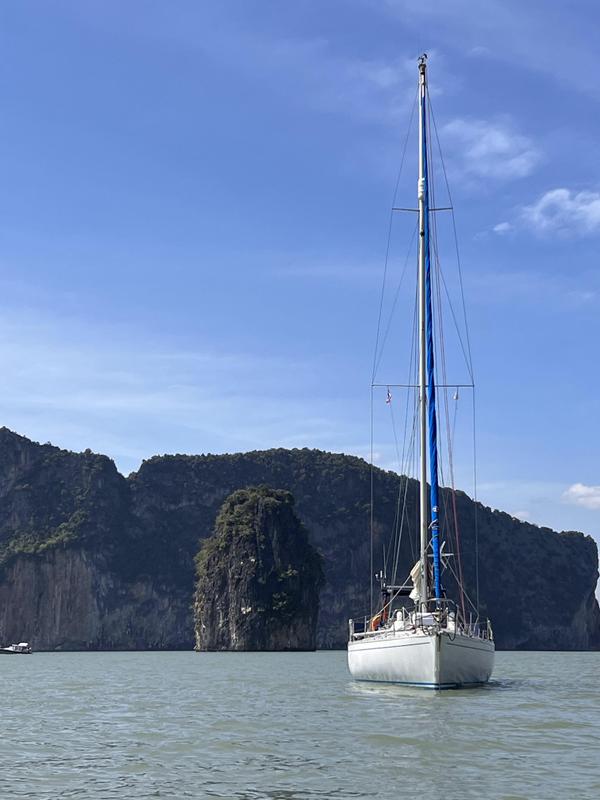
Kurukulla, anchored at James Bond Island, Thailand

Saturday, 21 May 2011

Ithaca to Zakinthos

Anchored at Skhoinos

On arrival in Vathi we were welcomed by a smiling local inviting us to berth on the end of the ferry berth as there was no room on the quay adjacent to the other yachts in that section. We backed in, dropping the anchor 3-4 boat lengths out, thanked him and passed him our shore lines. The fendering was large but not impossible to bridge with the onboard passareile (gangway) and we set about ordering a pair of beers from the waterfront café. Only then did we discover that the local forecast was for winds down the length of the harbour and we were beam on! The smiling face had been the water vendor and as this jetty was his last call of the day, he was determined that we berth there in order that he could sell us water.
Vathi
He wasted his time, we declined his offer and moved berth after our beer! Safely berthed, head to expected wind and on a more central section of the town quay, we set out on a stroll to discover what delights Vathi had to offer. It is a small but nonetheless pleasant town with a busy waterfront and several attractive looking restaurants. We chose a fish taverna, right on the waterfront, and ate very well. Best food so far! Taverna Kantouni, Tel: 0030 2674033405. I had been to Vathi once before on a family charter holiday but on that occasion the anchor had steadfastly refused to hold in the strong winds and we had passed the night cruising up and down the harbour resetting the anchor every hour or so! This time we were luckier and I had an efficient anchor!
The berth near the Coast Guard offices
Next morning dawned with the predicted wind blowing us directly onto the wall but with 50m of chain out in 5m of water we were not going anywhere despite the choppy waters of the harbour. After the mandatory visit to the Coast Guard, to pay our dues and fill in yet more forms, we were off on another tour of the town to visit the local museum and purchase some food essentials, bread, steaks for a BBQ etc. This done we came to the decision that the weather was improving and sailing south was the best bet, either to the anchorage to the south of Pighadi Island or to the inlet called Ay Andreas right on the southern tip of the island. In the event we did both. The anchorage at Pighadi looked so inviting that we decided to anchor and have an afternoon BBQ, a sort of late lunch. In intermittent but glorious sunshine we ferried the gear ashore, collected wood for the fire and duly lit it. That was the sign for the heavens to open and open they did. A torrential downpour started lasting over half an hour with a not unspectacular thunder and lightening show! By the time it finished we were drenched, the fire was all but out and the dinghy full of water! Every cloud has a silver lining though, at least it washed the last of the Brindisi grime off of the decks of Kurukulla! Fortunately we had squirrelled away some more wood under cover and, not to be defeated, we rekindled the fire and finished lunch. It tasted all the better for the delay! Thereafter we motored down the coast, in a still calm, to reach Ay Andreas an hour or so before sunset. One other boat, live-aboard Germans, had occupied the prime anchorage but we were able to anchor slightly further out without difficulty. This done a quick recce of the beach, a swim and shower, and then supper. Next morning, over breakfast, we were serenaded by the German frau playing the flute, and very good she was too (well to my ears anyway!). We were offered everything from the UK and Greek national anthems through Greensleeves to Jerusalem! A good way to start the day! After passing on our thanks, and a swim, it was off to a yet to be decided destination on the southern end of Cephalonia. Yet to be decided because we were on the wind and unsure how much progress we would make.
The harbour at Ag Nikolaous
Berthed next to Dimitri's powerboat
Four and a half hours later we had passed Poros and had more or less decided to bear away at Ak Mounda (the SE tip of Cefallonia) and reach across to Argostoli, arriving about sunset. The wind had other ideas! As we arrived at Ak Mounda the wind shifted by 100 degrees placing Argostoli upwind again and making the southern shore of Cephalonia untenable for anchoring as there are no sheltered spots on this coast in a SW wind. The nearest shelter was Ay Nikolaous in Zakynthos, thus it was that we missed out Cephalonia and headed straight to Zakinthos arriving at 1800. A very cheerful Dimitri took our lines, offered water and power (both declined) and proffered the card of his taverna. On our first stroll ashore we visited the taverna, enjoyed a small aperitivo and were informed it was on the house! We were trapped, after such generosity how could we eat elsewhere even if it was a public jetty. The food was OK, somewhat touristy, but there was also not a lot of choice in the small village hence we could have done worse.
Wreck Bay
Next morning we slipped our moorings at 1100 and headed for the most photographed beach in Greece, Wreck Bay, (what it was called before the wreck of the “Panagiotis”, in October 1980 I have no idea. She was originally the St Bedan and built in 1937 in Glasgow!). En route we were overtaken by Dimitri in his speedboat which was full of tourists!
From here it was southwards, goose-winged and doing 7 knots, to reach Keri for the night. Keri is in a bay at the western end of the famous turtle and lager lout breeding beech at Lagana and is the only area of the whole bay where anchoring is still permitted. A stroll ashore, another aperitivo and a small amount of shopping and we were back onboard for supper and a game of scrabble.
The following morning dawned stunningly bright and still. Breakfast, a swim, and then it was off to Zakinthos town with a stop for lunch and a swim in an anchorage on the way. This part of the coast of Zakinthos is either banned to boats wishing to anchor or a succession of heavily commercialised beaches. We found the only nearly civilised beach at the southern end of Porto Roma but even this rang to the sound of construction gangs working on a part completed taverna and had two hotels in the vicinity.
Cathedral of St Dhionisos

The view inside
Friday night we were safely berthed on Zakinthos town quay. The project to build a marina here seems to have been all but abandoned, the outer moles exist but nothing else. During our now habitual walking tour of the town we first visited the bus station to purchase tickets for Stephanos's impending departure (who builds a bus station out at the back of town, remote from all other transport links?) and then headed for the Cathedral of St Dhionisos. This was built to replace an earlier cathedral destroyed by an earthquake in the late 19th century.
View from the fortress
Final drink before departure
View down on our berth below
For this reason it was built to survive earthquakes and it did so, in 1953, 2 years after completion when the rest of the town was destroyed! This being Stephanos's last night aboard we set of to find a good restaurant for supper and succeeded in finding the “Thymalos Fish Taverna” Tel: 0030 2695026732, right on the waterfront, where we enjoyed the best meal of the trip so far. This morning we decided to climb the escarpment behind Zakinthos town and tour the fortress, well worth the daunting climb but not for the faint hearted. All this before Stefanos caught the 1400 bus departure to initiate his bus-ferry-bus-ferry journey back to Corfu. I plan to stay here another day at least and catch up on some maintenance, not least of which is curing a leak on the dinghy! After that it is the first single handed passage of the season round the Peloponnese. A quiet week or so on my own before Simon, my nephew, arrives via Athens and Spetses on 1 June.

Monday, 16 May 2011

Corfu to Ithaca.

The next morning dawned bright and clear and after a brief pause to do some admin using the Blue Cafe WiFi, Stephanos (Steve) and I set off for Paxos. The previous evening we had succeeded in getting Greek SIM cards for both my mobile and mobile broadband dongle however Vodafone Greece does not allow VOIP telephone calls over their network unless you pay by the highest level of monthly subscription! Even to get a data SIM at a sensible price I had to enter into a three month contract. Nothing in Greece is simple.
Corfu from seaward
Motoring south along the coast of Corfu we decided that we were making such good progress that we would head direct to Paxos and, as we would arrive at dusk, we chose the well sheltered bay Mongonisi for our overnight anchorage. On arrival we discovered that eighteen Sunsail charter yachts had made the same choice! Fortunately we heard little of them!
Paxos waterfront
Next morning we set off early to do battle with the Greek authorities and to get myself and Kurukulla officially into Greece. I had been recommended to do this in Paxos as all of the functions are performed by the same small waterfront office. We entered the delightful village of Paxos via the north entrance (it is sheltered between a small island and the island of Paxos itself) and found a berth in which to med-moor, very near the Port Police office. Full of confidence and with my Greek speaking friend in attendance I set off to do battle! The battle lasted 30 seconds; they were unable to log me in to Greece as they did not have the new version of the necessary form! I would have to go to Levkas.

Thus it was that after a brief tour of the waterfront and a coffee in a bar we set off for Levkas. Leaving via the southern entrance (slightly heart in mouth as it is charted at 2m but seemed to be being used by yachts of the same size as Kurukulla and was in fact 2.4m min.) we set course for the entrance of the Levkas canal. Normally difficult to see from seaward we were assisted in identifying it by the sight of the British registered yacht “Gatto Pardo” being hauled off the sandbank on the far side of the entrance by a local powerboat. With 30 minutes to wait for the floating swing-bridge to open we stemmed the wind and current and finally entered the canal at 1800. From here it was a short leg to Levkas town and a berth, med-moored, on the town quay.
Levkas canal
An hour later we set off to explore the town and find a local restaurant. The town was almost completely destroyed in the 1953 earthquake; it has been rebuilt but in a rather temporary fashion, the buildings are mostly of wooden frame construction with metal cladding of one sort or other. Only the churches seem to have been rebuilt as original! After enduring a torrential downpour, lasting 30 minutes, we finally arrived at a restaurant called “Seven Islands” where we were greeted warmly and given a conducted tour of the kitchen so that we might choose our food based on first hand experience. Armed with a half litre of their best house red we sat down to platefuls of good traditional Greek food; just what was needed!
Next morning we set off again to do battle with the authorities and get me legally into Greece. We had been warned by other yachtsmen not to admit to having been in any other Greek port previously and so Levkas was Kuruklla's first “official” port of call. The process took nearly two hours and involved a mile long walk in the middle to pay the entry tax that has to be paid at the local tax office which, of course, is not co-located. Taxes paid, cruising permit issued, we were in. All we have to do now is get it stamped at every port we enter! The Greek philosophy seems to be that “if you make the simple things difficult then you will never have time to deal with difficult things and your life is therefore made simpler!” When departing I was told by a sympathetic Port Police woman that one stamp a month is the bare minimum!
Sunsail flotilla
That achieved it was off to complete the canal transit and head south to Meganisi. We anchored in one of the northern bays for an afternoon swim and then moved to a more sheltered spot, in an adjacent bay, for the night. Who should be there, Sunsail, having their beach BBQ night! Fortunately we were far enough away not hear much of the singing!
Evening drinks at Sivota
After breakfast and a swim we transited the Meganisi Channel and headed for the anchorage at Sivota, on Levkas, for another leisurely afternoon swim and dinner in a taverna. Sivota is a change over port for Sailing Holidays and so it was again crowded with charter yachts, all berthed in neat rows around the harbour, but none the less pleasant for that. Dinner was fresh seafood in the Spiridoula taverna and very good it was too.

Sunday morning dawned sunny and windless and so we motored round to the anchorage at Ammousa on the south coast of Levkas. Not a great anchorage but a pretty enough small beach which shelved steeply into the sea, resulting in care needing to be taken not to anchor too close whilst having enough scope out for the anchor to hold. A delicate balance with no consistent wind to hold the boat in a given direction. After lunch and a spell on the beach we set off for Atokos on a brisk beam reach and doing 6.5 knots. Two hours later and we were anchored in Cliff Bay, not an ideal anchorage but pleasant for an early evening swim.
One house bay
On completion we moved round to One House Bay for the night. An almost deserted bay as the name suggests. We anchored near the beach in 6m of water and set about cooking supper!
Monday dawned cloudy with a slight easterly wind, hence we made an early departure from One House, reached across to Ithaca and anchored for a lazy day in Ornos Skhoinos, a beautiful anchorage near Vathi. Tonight we head to Vathi itself for a night in town.

Tuesday, 10 May 2011

Under-way at last


After getting in the water a day late it was full steam ahead to get under-way. After a brief engine trial around the harbour to confirm the accuracy of the new propeller pitch setting (to match the new engine installed last year) and to warm up the oil for the first oil change since installation, it was a stern-board on the end of the Balsamo jetty to do the oil change and attend to the final details like putting on sails (No 1 genoa and main) and storing ship.
All this completed, Derek Lambert embarked (he is the owner of Tranquillo, see first entry this year) and we set off the next morning at 1000 in a brisk NE wind to beam reach down to Otranto. Derek, having decided to leave his boat ashore this year, was keen to do a bit of sailing in the interim. Otranto was reached in good time; seven hours to do 45 miles, not bad for a first sail of the season. Keen to be away early the next day and without a great deal of choice, we picked up one of the large mooring buoys in the middle of the harbour and settled down to prepare a chicken supper and get a good night sleep.
0800 next morning found us under-way, on another good reach but this time in somewhat less wind and what there was was failing. By 1400 we were doing less than 3kts in a flat sea and decided to motor for a while, suffice to say other than a few brief periods we motored until our arrival in Errikoussa at 1915 (Greek time, 1815 Italian). This was followed by the first swim of the season (warmer than Brighton on the Royal Wedding weekend but not much!) and a smoked salmon pasta supper.
Saturday dawned bright, sunny and with a gentle breeze. Under-way at 1030 we set off for the Corfu channel and Gouvia marina arriving at 1600. the early sailing breeze did not last long but we had a spectacular sail through the Corfu channel, 8kts, goose-winged, and enjoying the first views of the Corfu coastline. On arrival we met up with Yacht Camilla, David Ashby and his crew, plus two other members of the RNSA, and enjoyed a few beers to celebrate our arrival. The plan is that David and I will cruise in company for part of this season, as we did for part of last year.
The two days in Gouvia have passed quickly, spent sorting out minor items and doing a bit of tourism, aided by the next crew member to join, Stephanos (Steve), who lives here in Corfu. Last night he took Derek and I for supper in the oldest village in Corfu, Old Perithia, up in the mountainous north; sadly the whole village was closed on out of season Mondays but we still managed to find a good local taverna to eat in.
This morning (Tuesday) Derek made a slightly earlier than planned departure having discovered that his flight from Corfu to UK on Wednesday had been cancelled due to an air traffic controllers strike. He was fortunate to get to know about it before his actual departure and even more fortunate to get a flight on the day before! Tomorrow Stephanos joins and we set off down to the southern tip of Corfu and then on to Paxos and Levkas.
More from there …...................

Wednesday, 4 May 2011

The start of another season - 2011

Sitting here, listening to the pouring rain and waiting to get to grips with the final elements of the recommissioning of Kurukulla for this year, is very frustrating! Even more so when the news from UK is of high temperatures and sunshine!
The frustration is not helped by the marked lack of organisation in the boatyard; today was to be the day when Kurukulla went in the water first thing; at present it is gone mid-day, I am still in the cradle on the hard and there is not much sign of progress! At times one has to restrain ones-self and remember this is Italy! The arrangements were only made six months ago and confirmed three times since ........... the compensation is that their winter storage prices are good.
Having taken the opportunity to drive down to Brindisi in March and do the winter refit, re anti-foul etc., there is not a lot to do before getting under way. What there is though is mostly re-rigging and therefore out in the weather. Ugh!
The plan now is to put Kurukulla in the water tomorrow morning, store and victual her over the day and to leave Brindisi on Friday next. We then head down to Otranto for the night and follow that by a crossing to Corfu over the weekend. I am joined on this trip by Derek Lambert, the owner of Tranquillo, another British registered boat here in Brindisi. Derek has decided not to put his boat in the water this season and is therefore keen to do some sailing in Kurukulla. We met in the yard last year and the adjacent photo (Self, Awilda (Derek's girlfriend, sailing with him at the time) and Derek) was taken in a local Trattoria, Luigi's, where we still dine frequently; a copy of this photo now adorns the wall of the trattoria which, as a place to eat, is simple but good.
The forecast is good, northerly winds and sunshine, it just needs to arrive and displace the weather system we have at the moment. The next post will be once we are under-way, that is unless something goes horribly awry!

Wednesday, 20 October 2010

The final days.

My next guests were to be Guido and Jane Cervone and their four year old son Alberto; all of whom duly arrived in Kolocep, on the passenger ferry from Gruz harbour, on the Thursday morning. After a swift coffee ashore, the purchase of some essential items from the only local store and a swim, we set off northwards for my second visit to Ston. The sail up the inland sea was gentle, flat calm and just what was needed to settle Alberto in onboard; Guido and Jane own a small yacht in Chesapeake Bay in the US and so he is used to life in a boat.

We arrived in Ston an hour before sunset and having paid our dues to the harbour authority (you pay £20 just to tie up, there are no facilities!) we went ashore for a brief stroll, a quick drink and to buy some other minor foodstuffs. That completed we returned onboard for supper and an early night; Guido and Jane had not slept well onboard the ferry from Bari to Dubrovnik the night before, the comforts of Jadrolinja ferries are not that great!

Next day we wandered ashore for a better look at Ston, in full daylight, and then set sail down the canal again to revisit Sobra in Miljet. En route we stopped for a swim in the bay at Uvala Prijezba (suitable for short stops only).

In Sobra we took the holding off line in front of the Konoba Lanterna again and moored up for the night. As the evening progressed, after our return from supper in the restaurant, the weather started to deteriorate with the onset of a stronger than forecast NE wind. The result was that we spent a rather uncomfortable night rolling about on the sea that was reflecting off the steep sides of the bay.

The following morning the wind had dropped to zero; thus we departed Sobra under engine and motored the majority of the way to the island of Lopud for a swim. Unfortunately Lopud was also suffering from the swell; hence, after a brief swim, we continued to Kolocep for the night. Next morning, after another refreshing dip, we went for a walking tour of Kolocep and followed our exertions with a pizza lunch in the waterfront restaurant.

In the early afternoon we set off for Dubrovnik marina where we intended to make the preparations for the crossing back to Italy and to spend our last night in Croatia. Guido and Jane had been intending to pay a visit to the old town of Dubrovnik but given the inclement weather they finally decided against it. Thus it was that at 1300 on Monday we set off to check out of Croatia and return to Brindisi. To check out we either had to go to Gruz or Cavtat. To save time and against my better judgement I decided to break my self imposed rule of never returning to Gruz to complete formalities; the officials there are always completely unhelpful and you end up berthed on a totally unsuitable quarantine jetty which is designed for cruise liners. I was not to be disappointed!

On arrival we chose the very small berth at the end of the jetty which was the one most suited to yachts and well away from the big ships. Result, we were immediately and unceremoniously thrown off that one with no courtesy, not even advice on where we could berth! Finally we berthed at the opposite end of the quarantine quay, 150m from the offices and I braved the pouring rain to go and do the paperwork. Next problem; Guido and Jane had entered Croatia on a ferry and had their passports stamped by immigration on arrival, this however was not enough in the eyes of Croatian bureaucracy to prove that they were legally in Croatia. A very pretty, but none the less officious, blonde policewoman explained to me that it was my responsibility as skipper to register their residence when in Croatia and that having failed to do so I would be fined €80. My response was polite but firm, “over my dead body! Show me where this requirement is published!”. She reached for the appropriate book from the shelf full of Immigration Police Regulations and opened it at the appropriate page; all of course in Croatian! “And for someone who does not speak Croatian, does not live in the country, does not have access to the books of Police Regulations and was not informed of the requirement on arrival?” Silence! … I then enquired where I was supposed to have registered their presence in Croatia to which the reply was “at the tourist office” and so, keen to show my willingness to comply I asked “is there a tourist office in Sobra?” answer “no”, in Kolocep?” answer “no” “So where am I supposed to have registered them if this is the first place we have visited where it would be possible to do so?” No answer other than “you must pay!”.

I now made what I thought was a quite reasonable suggestion. “Why don't you register them into Croatia now, I will then go next door and have a coffee and return in five minutes and then we can check them out”; answer “No you must pay or you can argue your case in front of a magistrate”, accordingly I enquired when this might be possible. “Sometime next week”. By now my patience was wearing thin but I again, as politely as possible, firmly declined their offer to pay. Finally she got the hint that I was not going to be a pushover and decided to consult her superiors, By this time her colleagues were already giving me knowing grins of sympathy! It was obvious I was not the first victim to undergo this process. Fifteen minutes later and after a long lecture, to which of course I paid rapt attention and with all forms stamped I was free to go ... onwards to the next hurdle, Capitanija. They, fortunately, were much less enthusiastic (aka officious) and stamped the forms without question after I had waited the mandatory 10 minutes whilst they finished their conversations between themselves, a delay imposed just to prove their importance of course! Next came the customs. Fortunately the elderly, rather portly, official was totally disinterested and objected to the interruption to the watching of his TV programme, he filled out the form, in longhand, in triplicate and passed me my copy without looking in my direction once! From here it was back to the immigration Police, collect the passports and go … never again to return to Gruz!

We sailed out of Gruz, set course for Brindisi and enjoyed a brisk reach at 6 – 7 knots with the easterly wind on the beam, just as forecast for the crossing; however, unfortunately it only lasted the first six hours; from then on the wind died leaving a foul sea and us motoring at 6 knots rolling our hearts out all night. Poor Guido felt awful but managed an hour here and there, on deck, to give me a break; Alberto was fine and kept me company for much of the evening, trying to spot the occasional star that peeped through the gloom, before retiring to bed. We finally motored into Brindisi at 1300 the next day all feeling tired after a very un-enjoyable crossing.

From here on my task was to prepare Kurukulla for her winter sojourn in Brindisi. The next day I dropped Guido at the airport to pick up a hire car that was to take them to Naples; we then returned to the boatyard from where they were to set off and I wave them good bye 30 minutes later. The next task was to get the boat lifted out, stripped of all running rigging etc. and winterised; after which I too departed for the drive back to UK. At present; having stopped overnight in Fano, on the east coast of Italy; Munich for a pair of nights and finally Dieppe for the pause before catching the 0500 ferry to Newhaven this morning; I am now back in UK for the winter and starting to plan next years itinerary!

Next BLOG next year!

Monday, 4 October 2010

Back, back to normal (or almost).

I departed Necujam the day after the last blog entry and started heading south-eastwards towards my rendezvous with my next guest, Steph, at Makarska, thirty miles from Split. The first night I anchored at Uvala Luca, (the one in Brac, there are several!) with the usual anchor laid off the shore and a line swum ashore, tied to a rock. Uvala Luca offer several options for anchoring but I chose the quietest, furthest from the one and only restaurant. Next morning dawned bright and clear and so after a brief swim and breakfast I decided to depart. The line ashore was looped over the rock and looked easy to dislodge by flicking it off rather than take another swim. Mistake! The process of flicking it off aggravated my back to the extent that it has taken a week to recover fully. Moral of the story, “Lazy men suffer the most pain!” I should have just accepted the need for a second swim!

An hour and a half later I dropped anchor in Makarska and checked my e-mails and texts only to find a text from Steph to say that she too had put her back out the W/E before and had had to cancel her trip out to join me. Just my luck, I thought she would assist me through my back problem!

I had already arranged for my friend, Velko, to pick her up from the airport at Split and transport her to Mkarska, this was obviously not now necessary and I telephoned Velko to offer my apologies. Not to be defeated he said, without hesitation, that he was leaving immediately and coming to Makarska, this afternoon, to wish me farewell; true to his word he arrived two and a half hours later and we shared several (I lost count how many) G&Ts' in the following three hours before he set off to drive back to Kastella, near Split. I was sad to see him go, he has been such a help in so many ways, not least in fixing the new engine and negotiating a “local” not tourist price.

The next joiner was to be Simon, my nephew, joining at Sobra on Mljet in two days time so the next morning it was a refuel and then onwards ever southwards towards Mljet. That night I anchored at the eastern end of Korculla, near the ex Convent that is now being converted into a sports academy. A beautiful anchorage but only suitable in settled weather. The following morning I set off again, this time for Polace, in Mljet, a very secure anchorage and suitable for that night's forecast of strong NE winds. The only problem is that it falls within the Mljet National Park and as a consequence the unfortunate (i.e. me, they don't get round everyone) get hit for 90Kn for a park entry ticket which includes a mandatory return bus fare to the inland lake and a boat trip round the lake, none of which is of the slightest use to someone anchored for one night in Polace! Another Croatian, government sponsored, rip off!

From Polace it was an easy, early afternoon, potter to Sobra. Sobra is a very deep inlet with almost no options on anchoring. As a consequence I was forced to take a berth in front of the only restaurant with such facilities and enjoy a plate of calamari frites as my late lunch! The catamaran bringing Simon from Dubrovnik was due to berth on the other half of the jetty so it all seemed ideal. That was until I received a call from Simon saying he had disembarked the catamaran at Sobra, it was a pitch black night and where was I? Answer in Sobra where the catamaran should have berthed! Unbeknown to myself, or the locals, as this was the last day of the catamaran service for this year they had decided to berth it at the car ferry terminal, two kilometres away and in the middle of nowhere! Fortunately the restaurateur came to the rescue and after a terrifying 5 minute drive along the coast road, no speed limits, no lights and no obvious brakes, we arrived to pick up Simon from his remote outpost, from where we returned to the restaurant for supper. I can recommend the Konoba (restaurant) Lanterna, not just for their food but also their all encompassing customer service!

Next morning we sailed from Sobra across to the mainland, anchored in a bay for a swim and lunch, and then worked our way up to Ston for the night. Ston is at the head of the Stonsky Kanal and depths in the final approach are somewhat shallow, we recorded 2.2m before realising the channel had moved towards the north since the chart we were using was surveyed. Ston is an outpost of the Dubrovnik republic and boasts the oldest working salt pans in Europe and also the longest defensive wall in Europe (or so they say, Hadrian's wall gets my vote!). A very quaint town almost totally contained within the original walls. We wandered ashore after supper to sample the local brew and again the next morning for a decent cappuccino before departure.


From Ston we sailed south to an anchorage on the NE tip of Otok Sipan for a lunchtime swim and then drifted slowly south to Otok Sunj on Lopud where we anchored for the night. We revelled in the fact that we were the only yacht there as the sun dropped towards the horizon and then …......... the charter flotilla arrived! All of whom seemed to compete to anchor closest to us. Fortunately none too close and they were reasonably quiet and considerate.

Next morning, after a lazy start, we headed off for Cavtat from where Simon was to head off to the airport and UK the next day. At Cavtat we dined ashore for Simon's final night and enjoyed an excellent meal on the waterfront of the western harbour. This morning I dropped Simon ashore to meet his taxi, did some minor victualling, and then sailed for Kolocep, a well protected anchorage in the SE winds that are forecast for the next three days.

More when I sail from here!

Friday, 24 September 2010

OPDEF RECTIFIED – Sea trials successful!

By Friday evening the new engine was in place, set to work and all the paperwork for its export from Croatia was complete. What a bureaucratic nightmare, but that is another story! That done a short sea trial was conducted whilst moving from one section of the marina to another to make way for the returning charter hoards. If you need engineering support in this part of Croatia I can recommend Petar Vrvilo, at Kastella Auto, agents for Volvo Penta, Sole and Steyr but not limited to those marques. +385(0)21 238467, excellent service and ever willing.

Friday night was yet another end of charter dinner with the other boat crews, this time at a restaurant called “The Ballet School”! Nothing to do with the diners but a reference to the previous use of the building. Then on Saturday all went their separate ways including David Ashby in Camilla, who set off on a rapid transit to Brindisi to lay up and then travel onwards to UK by air.

In the meantime I set off for the western anchorage at Trogir for a single night; I had to remain near the airhead as I had inherited two of Davids' crew who were not departing until the Saturday night and Sunday morning. Once they were landed I headed off for the anchorage at Uvala Razetinovac, one of the best sheltered anchorages in the area. Just as well; after arriving I decided to install the replacement inverter under the chart table, awkward but do-able; that is until I put my back out for a second time! This time I felt it going and although painful I was able to shift position quickly and persuade whatever it was trying to make a bid for freedom to go back into place. Two days rest and it was on the mend.

On Tuesday afternoon I was joined in the anchorage by Michael Forest, and his crew Pablo, in his new boat Mitigator, (AKA Contessa Maria II) a Contessa 32. We dined onboard Kurukulla, breakfasted onboard Mitigator, (during which time we serviced Mitigator's primary winches which had been giving trouble) and then set off for an early afternoon cruise in company to Necujam in Solta. I arrived first, anchored Kurukulla with stern line ashore, and then welcomed Mitigator alongside. This morning, with a forecast of gale force southerly winds, I decided to stay put and not put my back to the test. Michael and Pablo needed to renew Mitigator's cruising permit and therefore had no choice but to set off to cruise southwards. Before departing we agreed to meet up in Mljet where my nephew is joining and has agreed to bring out some spares for Michael.

Tuesday, 14 September 2010

What is history?

The BBQ was a great success despite the need to try to find all the gear we had taken ashore in the pitch black of a moonless night. Next day we Sailed off the anchor and headed into the eastern anchorage at Trogir to pick up three of the following week's crew, Melvin, Mike and Tim, and four of David Ashby's joiners, Mike, Steve, Kelsey and Julian. With this crowd onboard (excluding Tim who was scheduled to arrive later in the afternoon) we waited for David and Francesco to arrive. David was returning to Croatia from the UK via Brindisi where he had left Camilla.

Camilla duly arrived at about 1500 and Tim by 1630. From here we all (14 of us) set off for Necujam, in Solta for a departure/arrival celebration supper in the restaurant there. With the large number of people to land and only two 4/5 man dinghies it was always going to be a logistical challenge; when David's outboard decided to refuse to participate, the challenge turned into a nightmare. Suffice to say we made very few friends in the anchorage with the number times we passed to and fro with Kurukulla's dinghy towing Camilla's. With all back on board, by midnight'ish, the late night revellers decided that the night was still young. Next morning however we all felt our age! A swim in the cool waters of the anchorage was the only cure.

From here we had to be in Rogac, only one mile away, for the 1530 ferry departure; to dispatch Chris, Martin, Dom and Pete back via Split to UK. We arrived at 1200, refuelled, watered and the enjoyed a final goodbye lunch at the local restaurant before seeing them off on the ferry. The remainder of us set off for Luka Tiha where we planned to meet up with a large group of sailing friends who had chartered several boats from Kastela Marina near Split. Kastela was a place I was to get to know very well before many days had passed! Another late night party ensued and another early morning swim to clear the head!

Next morning we set off for Viz via a lunchtime swim stop in the St Klement Islands. Jerolim is slowly recovering from last year's fire. Amazingly, whilst at anchor, who should turn up but Michael Forest, a sailing friend from UK, in his newly acquired Contessa 32; this summer has been full of such co-incidences. Following lunch onboard Kurukulla, with Michael and his crew Pablo as guests, we were forced to leave them and set off for our overnight venue of Viz; they were destined for Split.

Viz has never been a favourite with David and Camilla and after this visit I doubt he will ever set foot on the island again. Having squeezed himself into a tight anchorage, requiring a line ashore to arrest the swing, a local fisherman took exception to the arrangement and cut David's shore line. Not surprisingly an altercation ensued between David, who is of not insignificant proportions, and the one armed local fisherman. Following interventions by harbour authorities and local police peace was restored but due to the low value of a mooring line (and one suspects the fact the fisherman was local) no further action was taken despite the potential for extensive damage to be caused by such recklessness!

By our arrival in Viz I was becoming increasingly concerned by the volume of oil appearing in Kurukulla's wake. Not unburned fuel but lub oil! Up until this season her engine has never consumed excessive oil. We were pinned down in Viz for two days by the Scirocco (strong south-easterly wind) but eventually left in a boisterous east wind and very lumpy sea to head for the eastern end of Brac. Departure was accompanied by the usual oily wake and I decided that over the next two days I would have to make my way back to Split and find the cause. After a brief look in Bobovisce, searching for a potable water supply for Camilla, we sailed down to Milna where I anchored in the roads to avoid having to run the engine whilst Camilla again went in in search of water. After an unsuccessful half hour they to anchored in the roads for the night, near us.

Next morning we sailed off the anchor and headed north. After talking to the various agents ashore, drawing heavily on the local knowledge of Velko, (a local friend who taxi drives in his spare time and has helped me considerably, last year and this, with getting crews to/from the airport to the right place), I decided to head for Kastella Marina. On arrival we were met by Velko and the local Volvo Agent, Petar; from there the saga started! There were only two possibilities to explain the oil loss, turbocharger or oil cooler (which for some strange reason is not on the fresh water cooling circuit!). An hour later the offending oil cooler departed in the hands of Petar and I breathed a deep sigh of relief; the much cheaper of the two potential repairs! That night 40 of us (the charter team had returned) set off for a meal in the ancient water mill at Trogir, the Mlinice Pantan, +385 21895095, to celebrate, amongst other things, Steve's 30th birthday and the prospect of a reasonably priced repair to Kurukulla. A great night was had by all with the, by now, habitual sore heads in the morning!

After a day in port avoiding the Bura (Strong north-easterly winds) and with the offending oil cooler repaired and reinstalled we set off again in the company of Camilla. No oil in the wake, not a care in the world and then …........ the engine seized! A short dying burst of black smoke, a puff of soot in the water for old time's sake and silence! No warnings, no alarms. Camilla towed us ignominiously back to the harbour entrance from where we were escorted in by the marina RIB; back to the same berth from which we had departed an hour earlier! Camilla wished us well and went on their way, there was no more they could do. Petar immediately came back onboard to discover what had gone wrong. The oil pump had lost suction and the whole oil gallery of the engine was dry. Try as I might I could not link this to the work he had done previously, this despite hours of poring over the books and diagrams. We re-primed the pump, installed an oil pressure gauge, barred over and then re-started the engine (which by now had cooled and freed up somewhat), all done with our fingers crossed. Eureka, good oil pressure, good engine response and no smoke. Breathe a second, heartfelt, sigh of relief! Next day (Sunday) Petar came down to the boat we again started the engine, all normal, idled it for half an hour and then prepared to sail for an hour long engine trial. This time our continuous monitoring of the oil pressure allowed us to stop the engine just before it seized, again. The oil pressure collapsed after exactly the same period of running and ironically in exactly the same place! The engine would turn, just, but not start! It was “un-roll the genoa”, sail back to the marina in the light southerly breeze and make another phone call to Petar, who by now was getting to know us quite well! With no Camilla, and a very slow response from the marina to our request for a tow, we sailed into the marina (maintenance area this time!) and made a gentle alongside. Out came the books and there commenced a lot of head scratching. All to no avail! By the end of the day we had arranged to dispatch the remaining crew members to join other boats who had spare places and I had “gritted my teeth” and agreed to purchase €6100 worth of new engine. In the midst of all this Melvin had also managed to blow up the inverter by plugging the vacuum cleaner into it; he was not to know we had not yet shut down the inverter and shifted to shore supply!

That night we all re-grouped at Trogir for a dinner to mark Mike and Steve's departure. Our return journey to Kastella was nothing if not by good fortune. In the absence of any taxis we had walked to the bus station in order to attempt to catch a bus along the coast and we were rewarded for our efforts when a bus arrived very shortly after us; our elation however was to be short lived. It was the last bus to arrive at Trogir that night and the driver informed us in a mixture of broken English and Croatian that it was not going anywhere until 0400! With a beaming smile, he then announced that he lived in Kastela and would give us a lift. Amazing kindness and a sense of humour to boot; not commonly found in Croatia, they are a very serious people!

Yesterday morning the others departed Kurukulla to join other boats. By mid-day the new engine (a Sola diesel, Mitsubishi made) had been sourced and Petar and I set about removing the old engine; by evening it was ready to sling out. This morning I received a reply to my cry for help and advice to “Marine Engineering Looe”, Plymouth Branch; they offered a diagnosis of the problem, a failed “O” seal in the oil pump suction line; deep in the engine. One of their engineers had seen this problem before! Petar was “off the hook”, nothing to do with his earlier repair, pure coincidence. I was reminded of that great line in the film “The History Boys” …......... “ Do you know what history is? It's just one f....ing thing after another!” In the past few days the history of Kurukulla has been exactly that! To save my sanity the MEL engineer also said that repairing the old engine was not a sensible option. It is verging on obsolete, no longer supported by Volvo spares, and would cost 80% of the cost of installing the new engine. Phew, at least I got that decision right! Anyone with a Volvo Penta engine with problems, go to Marine Engineering Looe. +44 1752 226143. I certainly can't thank them enough for their helpful support. The situation now is that we are having the best sailing weather seen in the past fortnight, the old engine is sitting on the jetty and a shiny new one is residing in the engine bay waiting to be bolted down and connected up. Where do I remember doing this sort of thing before? Could it be in the RN? Further OPDEF Sitreps to follow. (For the non RN amongst the readers OPDEF is an OPerational DEFect signal.)
Wednesday, 8 September 2010

Pag to Primosten

Our first stop in Pag was Uvala Jurjevica, a swimming bay on the west coast of the northern end of the island. Two hours sunning and swimming, whilst waiting for the wind to return, was pleasantly passed away but to no avail. At 1700 we ghosted out of the bay under Main and No 1 Genoa but less than 30 minutes later we were forced to hoist the “iron foresail” and motor south to our chosen overnight anchorage at Strasko; a somewhat open anchorage, off a camp-site, but in the prevailing settled conditions perfectly tenable.

Next morning dawned equally windless so we contented ourselves with a visit to the camp-site ablutions (free hot water showers!) and a purchase of essentials from the shop. We then set off for Molat and the Kornati Islands. En route we anchored for lunch and a swim in Uvala Juzna Slatina; it is listed in the pilot as one of the nicest beaches in Croatia but really nothing to rave about. After an hour and a half we set off again, in a now brisk wind, for the island of Skarda where, on the southern coast, there is the most delightful inlet, Uvala Griparika; very quiet, despite the laid moorings with lines ashore, with a sole fortified house at the head of the inlet. We tacked up the inlet, sailed on to the mooring and were enjoying afternoon tea by the time the adjacent yacht, who had motored in ahead of us, had managed to sort out his lines, very satisfying. The moorings cost 11Kn per night per metre, very reasonable for high season.

At the start of the following day we motored to the head of the inlet to satisfy Dom's photographic yearnings and then headed out to beat southwards in a fresh breeze to Molat where we planned to take a lunch break and find water. Two and a half hours later and we were sitting at the restaurant on the quay at Molat eating Calamari Fritti and supping a beer, after which we had to wait until 1700 for the water man to reappear (he does not work the afternoons); we occupied our time with a walking tour of the village. After watering we set off, again on the wind, for the anchorage at Planatak. This we reached at 1930 just as the wind was dying and the light fading. There were two other British yachts in the anchorage and one small German but plenty of space for all of us inside the protecting islands. Supper of Pasta Carbonara, served on deck, followed by a film night brought the day to a close.

Nearby was one of the fortified submarine bunkers, excavated directly into the cliffs, so to start the new day with a piece of history we weighted anchor and ghosted over to it for a closer look before setting off south again. Slowly what wind there was died and we were forced to intermittently resorted to the the “iron foresail” during the next three hours. Finally we entered Sali, a very attractive port, despite the fish packing facility on the foreshore, where we were able to water again, victual and enjoy a lunchtime beer. A Med. moor, under engine, on arrival but departure under sail was the order of the day. From here it was a spinnaker sail down through the Katina passage (very short,tight gap; only 10m wide) and then onwards to the restaurant Beban in the bay at Koritnica on Otok Kornat. The bay, as an anchorage, I would heartily recommend for reasons I will explain later. The restaurant not so. Last year the food served was good and the service average; this year the food was very expensive, only average and the service poor. I will not be returning! We were there in the calm before the storm! Towards the end of the meal the wind and rain started; Granny (a restaurant family member) made a hasty grab to rescue her plant pots arranged along the window sill, Dom and I made a hasty departure for Kurukulla, fitted the engine to the dinghy, then he went back to retrieve the others whilst I prepared Kurukulla for the coming storm. They got back just in time, seconds before the heavens opened. Throughout that night we had winds gusting up to 70 knots from both South and North, repeatedly turning us through 180 degrees; of the five boats in the anchorage only two survived the night, three others dragged off into the middle distance, including one “super yacht”. Our anchor held firm, in fact so firm that it was one heck of a job to extract it from the mud and sand next morning. It was buried without trace!

The following day it was as if nothing had happened, sunshine and a moderate breeze! We sailed off southwards on a close reach in the 15 knot NE breeze and headed for the anchorage at Kosirina, Murter, a brisk sail and completed in less than three hours. A dinghy ride ashore for a beer or two in the local camp-site bar and then in was back to the boat for a roast chicken supper.

Dawn was not welcoming, grey and miserable with a forecast of much worse to come. I decided therefore to head for Sibenik and the Krka River and go upriver to see the falls; thus sheltering from the worst of the winds. Having entered the Kanal Sv Ante, and reached Sibenik, the heavens opened. Hence the first part of the passage up river saw me break out the foul weather gear for the first time this year. The others sheltered below! The scenery was spectacular but as we had to return downstream via the same route it was not worth getting soaked for! We anchored overnight at Rasline, two thirds of the way up river, watched a film and then enjoyed a relatively early night. Next day we set off moderately early, having avoided worst of the Bora (strong north wind) overnight, to motor up to Skradin. Once there we anchored opposite the town and set off in the dinghy to view the falls. Half a mile upstream there is a relatively low bridge and an out-post of the park police. This was as far as we got! We were informed that not even an inflatable dinghy was allowed up river beyond this point! (Despite the fact that the pilot says it is possible). The only way to see the falls is to board one of the tourist boats and, of course, pay..... 90Kn (£11) for the first leg which is not so bad until you realise that the best falls are further upstream and for those you pay a further 110Kn..... We decided to put the 200Kn per head it would have cost us towards our lunch! A much better idea and we found a restaurant to be highly recommended, the “Bonaca”, excellent food, friendly service, and enormous fillet steaks cooked to perfection. After lunch and a quick swim we sailed off the anchor and set off downstream sailing all the way back to the entrance to the Kanal St Ante but here the wind deserted us and so forced into an hours motoring to reach the overnight anchorage in Magarna on Otok Zlarin. A fabulous cove with deep water right to the edges. We anchored with a line ashore for the night. A quiet night passed without incident and we were well into the morning routine of breakfast with a swim when the wind shifted and, despite having dug the anchor in well, as we thought, the anchor tripped out resulting in a rather more hasty departure than we had planned! Martin swam ashore to recover the two shore lines that we had been forced to jettison.

From here we sailed the 7 miles to Primosten, on the wind again, in light winds and there we anchored and went ashore for a stroll around the town. So impressed were the others with Primosten, plus the prospect of a band playing in the town square that night, that we decided to stay overnight and had a pizza ashore followed by a glass of wine or two at the local ethnic wine bar and finished off with an ice cream served by a fellow who was a natural entertainer, juggling with the ice cream and joking with every customer, so good was he that Dom attempted to sign him up to come to work in England!

Another quiet night was followed by a quick watering stop on the Primosten jetty and then we set sail for Solta. After 5 hours on the wind, as seems usual, we anchored in Uvala Livka on the southern end of Solta and set up for a BBQ ashore.