Kurukulla

Kurukulla
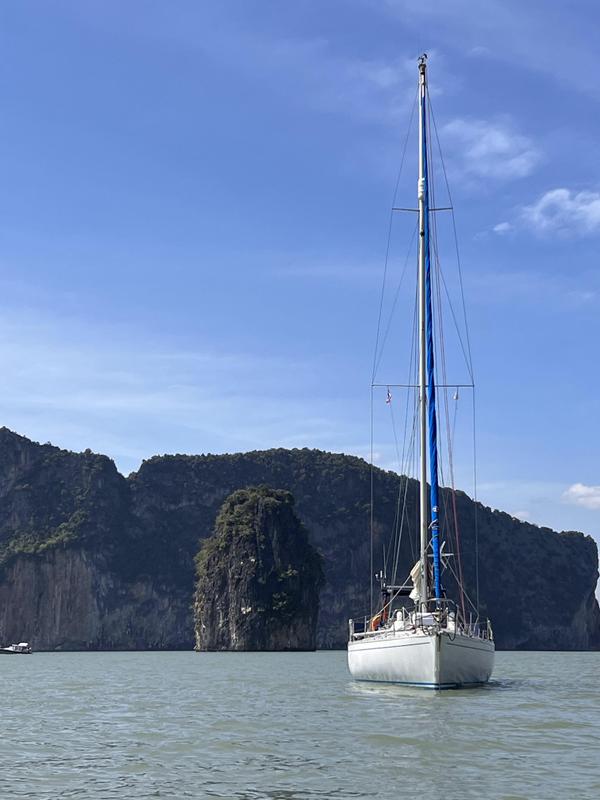
Kurukulla, anchored at James Bond Island, Thailand

Saturday, 9 July 2011

Down with one and up with the other.

NE end of Ornos Potamias; Camilla getting under-way.
Samothraki at dawn
Anit Limani light and the British (ANZAC) War Memorial
On Wednesday morning at 1000 I took advantage of the wind from the stern and sailed Kurukulla off the berth and out of Kallirakhis harbour. There followed a very pleasant 15 mile sail, taking me past Thasos town, to the NE end of Potomias bay; a delightful anchorage round the eastern side of the island. On arrival I put Kurukulla alongside Camilla who, because of the poor state of her batteries, had motored all the way and arrived earlier. The night was spent rafted up on Camilla's anchor and at 1000 next morning we got under-way for Samothraki, our last Greek island before entering Turkey. I departed first, under sail, leaving David to weigh anchor and follow on. Knowing his need to motor again (his batteries can barely sustain the domestic load of the fridge for a night!) he was soon to overtake me as I ghosted along in a very light NE breeze and flat sea. An hour or so later I also had to resort to the engine as the last of the wind died away to nothing. Eventually we teamed up again in the harbour at Kamariotissa on the island of Samothraki where we berthed just inside the new harbour wall along with a few other yachts waiting for a weather window to pass through the Dardanelles. Curry supper, early to bed and an 0600 start were the order of the day as we had 55 miles to do the next day to reach Canakkale, 12 miles up the Dardanelles. On departure two dolphins appeared briefly as if to wish us “good morning” us and send us on our way! The motoring start was soon surpassed by a building breeze and what developed into an excellent sail. Thus it was, as we passed between Samothraki (Gr) and Gokceada (T), again accompanied by dolphins; down came the Greek courtesy ensign for the first time in 10 weeks, and up went the Turkish.
Dodgems and the Turkish War Memorial

As we approached the entrance to the Dardanelles the wind started to increase significantly, as forecast, and it was down to a reefed main and several rolls in the genoa. Passing south of the ANZAC monument on the Gallipoli peninsula, I stowed the genoa and started the engine to facilitate crossing the shipping separation scheme; it was a matter of choosing your gap and going for it with five or six ships in view at any one time! Once on the Asian side of the straights it was a motor sail against wind and current but provided you kept to the edges in the shallower water reasonable progress could be made despite up to 3 knots of current against and 30 knots of contrary wind. Two and a half hours later, slightly damp but otherwise none the worst for the transit, we berthed, stern to, in Canakkale marina. With strong winds pushing onto the jetty this was almost the greatest challenge of the day! Next starts the bureaucratic nightmare of getting into Turkey. We were offered the services of an agent but at €350 for services that cost €150 we decided to decline the offer and do battle ourselves. It is rather like a form of treasure hunt.
Kurukulla and Camilla at Canakkale
First you need to find a source of the necessary documentation, called a transit log, these come from various shipping agents at 100TL (€44) a time. Once filled in (all 5 sheets!) you set off to find the Port Health Office to declare that you have no communicable diseases aboard and no one has died whilst on passage.
From there it is Immigration, which is five kilometres out of town, for an entry visa (€15 a head); next comes Customs, on the ferry quay in town, to confirm you are not running contraband; and the final stamp is from the Harbour Master to confirm you have paid your port dues! Each has to duly stamp and sign your transit log. Phew. Only a day wasted! At least we are now officially in Turkey. I now have to wait in peace for Mike and Melvin, my next crew, to arrive here on 12 July. The next challenge is the hunt for new batteries for Camilla. More when we leave.

Tuesday, 5 July 2011

God and thunder.

Ak Psevdhokavos with Mount Athos in background
Anchored at Ornos Tsarki, Nissos Ammouliani, NW Akti
As planned we departed Koufos on Saturday, 2nd of July, and headed for an anchorage on Nisos Ammouliani, at the root of the Akti peninsula. With only a gentle breeze on the bow I sailed Kurukulla off the alongside berth and set off reasonably early, leaving Camilla to catch up later. The beat out through the entrance of the bay was great fun, after which I headed south to round Cape Psevdhokavos and then a 20 mile reach north, under spinnaker, to the anchorage. By the time I arrived at Nissos Ammouliani the southerly wind had freshened considerably but it was still possible to find shelter in Ornos Tsarki, a bay on the west side of the island with a beautiful sandy beach. You would expect a small island like this to be quiet, not a bit of it, hundreds of Greek holidaymakers and three competing bars all pumping out music at maximum volume. On the beach it must have been deafening, it was bad enough 100m offshore! Camilla arrived about half an hour later bringing with her the evening meal, it was David's turn to cook.
Xenofondos Coenobite Monastery
On the Sunday we set off at 0600 to do the seaborne tour of the 16 monasteries on the Akti peninsula. The southerly wind had not been replaced by an easterly as forecast and so we motored the first leg southwards in order to stay near the coast and get the best view. Many of the monasteries are spectacular but you are left to wonder what do they contribute to the church or society, all grouped together here and segregated from Greece, let alone the rest of the world? The architecture of many of them has much in common with Dartmoor Prison they are of similar size!
Simonopetra Coenobite Monastery

Our peaceful sightseeing was then interrupted by David motoring Camilla over to where I was, at high speed, to ask me what he should do as his tachometer had stopped working? A check of the fan belt showed all to be OK and then he found a lose wire on the regulator of the alternator (the alternator provides the input signal to the tachometer), with this reconnected it made no difference. The only choice was to shut the engine down and sail until I could get onboard and have a look and that was not going to be until we anchored that night. Hence we decided to continue our tour under sail. The wind had other ideas! As we rounded the southern tip of the Akti peninsula and Mount Athos the wind died to nothing and stayed that way for three hours. Camilla does not go well in light airs at the best of times and this was not the best of times as we had a slight swell rolling in spilling any breeze there was, making the sails flog. By 1600 it was obvious we either got Camilla under-way under her own power and risked writing off the alternator (if it was not already burnt out) or I took her in tow.
Camilla on tow with Mount Thasos in the background
Standby the storm!
For the next 7 hours Kurukulla and I towed her up the east side of the peninsula, through thunderstorms and calms, and made a night entry into Ormos Plati, on the NE side of the Akti peninsula. Officially we were not supposed to anchor here, it being within the confines of the peninsula special region but at midnight, on a moonless night, we did not expect anyone to object! The tow repaid David for his kindness last year in towing me in when my engine failed.
The sun re-appears at sunset!
The following morning I donned my overalls (figuratively speaking), moved Kurukulla alongside Camilla, and got to work! The old alternator was soon checked out in situ and then removed to dismantle; the problem was soon evident, three out of three diodes destroyed on one side and the other three looking as though they had been cooked! That was the end of that alternator! Fortunately David had his original, lower capacity, alternator onboard and so I set to and installed it. Started the engine.............nothing. No output. Further research identified that the supply from the start switch to provide the initial alternator field was not present so I rigged a jury rig, using a spare lamp as a resistance, and hey presto charging and a working tachometer. Next there followed a teach in on how to fire up the alternator with the jury rig on each occasion the engine was started. So far so good. By now most of the day had passed and so we decided to stay put and sail next morning. Supper of “Toad in the hole” followed by the film “My Fair Lady”, both in Kurukulla, finished the day.
Alongside at Kallirhakis at sunset.
Next morning we rechecked the charging ability and then set off but not before we had also set up the rigging in Camilla to try to make her perform rather better to windward, until now she has had the windward performance of Kon Tiki! Ten minutes after getting under way, which was just enough time to get Kurukulla under full sail, we were forced to return to the anchorage to free a jammed mainsail in the mast of Camilla (how I hate in mast furling). Second time lucky, we enjoyed a superb close reach the 25 miles across to Kallirakhis, inThasos, our next port of call. Very much improved from the diagram in the latest pilot. A modern small port with one and a half million Euros worth of new alongside berths, empty! Such is the generosity of the EU! On arrival we berthed the boats alongside each other and set off on a shopping expedition followed by supper ashore. All of which was very enjoyable and concluded in an internet café from which I am currently publishing this Blog.

Friday, 1 July 2011

Onwards and upwards.


Scrabble as evening entertainment in Kurukulla!

After a four days delay we left Skopelos town and headed north to the island of Alonnisos for Tuesday night. The passage was only six miles and, although a bit lumpy in the stretch between Skopelos and Alonnisos, once we were in the lee of Alonnisos it was plain sailing. The intended anchorage was Steni Vala in the centre of the east coast but on arrival it was obvious the better anchorage was in the bay 100m to the south where we swam, supped and spent a quiet night; or at least until 0600 when the wind got up again. At 1100 we set sail for the north end of the next island, Nisos Panayia where there is a large enclosed bay called Planitis, this was our intended anchorage for the night and departure point for the passage across to one of the three Khalkidhiki peninsulas; which one was to be decided by the wind direction. A midnight swim in the most amazing phosphorescence was the order of the moonless night!
In the event Thursday morning dawned bright and clear and we set off at 0545 in a very gentle westerly breeze. I sailed Kurukula off the anchor and crept out of the anchorage disturbing no one. It was 2 or 3 knots maximum until I got out of the lee of the island. Once clear the wind freshened and held for four hours giving a good start to the crossing, after which it died away and then filled in from the south allowing me to set the running spinnaker for the first time this year. As ever, getting it up is the easy part but getting it down represents the greater challenge; in the event all went well.
Under spinnaker
The most suitable destination turned out to be Koufos on Sinthonia, the middle of the three peninsulas. 
Entry to Koufos
The entry was spectacular, sailing through a gap in the cliffs, into a large enclosed bay and another superb anchorage. After an hour at anchor a space was created by another yacht departing from a berth alongside the town quay and we moved both Camilla and then Kurukulla alongside for the night.
Alongside in Koufos
The plan is to stay here tomorrow and then head to Mount Athos and the Akti peninsula to view the multitude of monasteries, from the sea, landing is not permitted without a permit which takes days to get, before heading for an overnight anchorage.

Monday, 27 June 2011

One in 6,930,000,000!


Mike's last supper
Thursday night we all went out for dinner to mark Mike's departure, a simple meal in the central piazza of Skopelos town; it was a meal rather reminiscent of the stalls in Singapore; tables in the centre and food from any one of a variety of tavernas surrounding the square. Mike duly departed next morning on the 0715 fast catamaran to Skiathos and I settled down to a day of victualling and maintenance. With the winds forecast to be strong northerlies within the next 48 hours David and I decided that we would stay here and see it through before putting to sea. No point in volunteering for a wet uncomfortable beat to windward!
The sea outside!
Next day, Saturday, an Australian flag, Brisbane registered, yacht came in with a mixed group onboard which reminded me of a days sailing I had been fortunate to be offered during the visit of HMS Tiger, to Brisbane in spring 1978.
Nick and I
On meeting one of the senior members of the crew walking along the water front I struck up conversation by asking him perchance if he knew a dentist, by now retired, who was also a keen sailor, by the name of Nick Girdis. His reply “you are speaking to him”! The world is a small place despite a population of 6.93 thousand million people! We were later able to meet up again and talk over the past over a G&T onboard Camilla; an amazing coincidence! Perhaps I should take up doing the lottery!
The berth at Skopelos
As it is the strong winds are now forecast to last until Tuesday, almost 5 days, a considerable amount of maintenance will get done whilst pinned down here and the pressure comes on to make ground NE towards the Dardanelles and Istanbul in order to meet up with my next crew who are due to join on the 12th of July in Kanakkale, near the entrance to the Dardanelles. There is still plenty of time in hand but the weather from here on becomes much less benign. Time to bend on the number 2 Genoa! Next post will be from Thessalonica area in a few days time.

Thursday, 23 June 2011

The bridge opens, at last!

After a further delay of 24 hours the bridge workers finally conceded to open the bridge, five days after the previous opening. The opening was due at 0355 on Wednesday morning. Night openings are normal but it is intended to be a daily occurrence! The process of booking the transit with the Port Police was humourless but also painless and I even received a 10cent discount as they had no change; the intended cost being €18.70!
Derelict Ottoman Mosque at Khalkis
The delay at Khalkis was not all wasted time as a fair amount of maintenance got done in the time alongside plus fuel, water and shore power were arranged; albeit on an ad hoc basis with massively long hoses and extension leads. Kurukulla was berthed outboard of a Swiss yacht, a delightful couple who when I asked whether they were also waiting for the bridge to open replied “no, we are waiting for the baby to arrive”. My powers of observation on such things have never been good but at second glance she was, although still relatively slim, obviously expecting. They informed me the baby is due in July so not long to go. I have rarely berthed alongside such willing and helpful people, the baby is lucky to have such splendid parents.
The dreaded bridge
At 2000 Tuesday night I said goodbye to my neighbours and moved Kurukulla out into the stream and anchored in the designated waiting anchorage to await the bridge opening. David in Camilla did likewise. The promised Channel 12 radio call at 2200, to confirm the exact opening time, did not materialise but ….......... this is Greece. What did materialise was a call at 0345 instructing Kurukulla to prepare to pass through the bridge as the first yacht through, Some hope, with Germans and Austrians also waiting. No amount of prior organisation by the Port Police would sort them out. There ensued the usual scrum which I declined to get involved in; when single handed fending off and helming are mutually incompatible! The reason for the scrum was that there are only four alongside berths to the north of the bridge, As I intended to go a mile further out and anchor in a wide bay, to avoid the hassle of securing alongside in the early hours, this did not worry me but I was amused to observe, as I steamed past, that the southbound yachts were still securely tied up alongside; occupying all four berths and exactly where they had been told to stay by the Port Police to await the southward passage of a merchant ship. Those who had barged through were all trying to hold position in the stream whilst avoiding each other and the oncoming ship!
Flying Dolphins, to be avoided!
After spending what remained of the night at anchor I awoke to a brisk northerly wind. I sailed off the anchor for what was going to be another day beating to windward. Fortunately the wind never rose sufficiently to require more than a few rolls in the No1 Genoa and by the end of the day it had gone light and variable leading to a frustrating finish. David decided to stop for the night after 24 miles; however, with Kurukulla being somewhat faster than Camilla upwind I decided to press on towards Skiathos as I only had two and a half days to get there before my next crew member, Mike Owens, was due to arrive and I was still 80 miles away. In all Kurukulla and I made 38 miles to windward in 10 hours that day before anchoring at Cape Lithada, the most north westerly tip of Evia. Not a bad sail!
Krassa (Small Banana) Beach
Kurukulla and Camilla off Krassa Beach
Thursday the 16th dawned with a moderate westerly wind blowing and the opportunity to get to Skiathos, downwind; hence it was an early start, a quick motor round the corner and then full main and poled out genoa for the whole trip. On arrival in Skiathos I anchored Kurukulla in Koukounaries bay near the SW tip of the island and then went ashore to revisit Krassa Beach (aka Little Banana), slightly to the NW of Koukounaries, the favourite beach of a family holiday in Skiathos some 25 years ago but not marked on any chart or pilot as a suitable anchorage. Having satisfied myself that it was suitable I moved round there at 0800 next morning, anchored and stayed there three days. Mike arrived at the beach at 1430 on the Friday and slightly to his surprise was plucked off the beach with the dinghy, bags and all. Later that same afternoon David Ashby, in Camilla, arrived and after some trouble finding the anchorage, anchored in the same bay. The beach was much more commercialised than 25 years ago but there was still only one small beach bar whose proprietor was very accommodating, agreeing to provide us with fresh bread and meats as and when required. The result was lazy days and two evenings spent barbecuing on the beach.
Moving to Skiathos town was not an option for that weekend as the harbour is jam packed with charter yachts doing their changeover and day trip vessels touting for trade. We were eventually forced to vacate the anchorage on Monday morning with the onset of a strong N wind; the start of the Meltemi, the wind to do battle with on the journey north to Istanbul.
Mike relaxing!
As a consequence we motored round to Skiathos Town in a lumpy and unpleasant sea with winds gusting up to 30+ knots and getting goffered on a regular basis. Rather than risk berthing in a strong crosswind in Skiathos harbour we anchored for the afternoon off one of the town beaches. In fact we need not have worried for on entering the port in the calmer winds of the evening it was still full to overflowing and hence we anchored off inside the harbour and headed ashore in the dinghy. Skiathos is a lively town dedicated to tourists. Some of us were sensible and returned onboard relatively early, others were not; however, my hangover had improved sufficiently to go to sea by mid day the next day!

Tuesday we sailed off the anchor and set off on a brisk reach for a beautiful anchorage at Panormou, on Skopelos, where we were escorted in by three dolphins playing round the boat. We anchored with line ashore for the night and managed a small shop in a local mini-market a mile away. It is a really delightful anchorage only slightly spoilt by the number of Sunsail yachts also present.
Mourtia Beach
Knowing that I had to have Mike back in Skopelos town for the 0700 Flying Dolphin departure on Friday morning we decided to add one more island to our total before his departure and sailed across to Ormos Mourtia, on Alonnisos, for Wednesday night before heading back to Skopelos town for his final night onboard on Thursday. Although the holding in the most easterly bay of the three possible anchorages at Mourtia was not great it was by far the best protected and hence we had supper onboard Camilla and then spent the evening watching a film in Kurukulla, “School for scoundrels” (an old British film production) followed by the night at anchor.
The town of Skopelos
Thursday morning dawned with the now familiar cloudless sky and northerly wind and after a swim, at midday, we set sail for Skopelos town to seek out a berth. By 1315 we were safely berthed, stern to, in the port of Skopelos and by 1400 seated in a restaurant having lunch.

Sunday, 12 June 2011

Across the Gulf and northwards


Poros lunch venue


Poros was an excellent stop where we managed to get victuals and enjoyed a very good lunch in a local taverna in the back streets, sadly I omitted to record its name. All that done we decided to head for the anchorage at the west of Poros, Yerolimena, where we anchored in 5 metres of crystal clear water, in the northern bay, for the night.
Anchorage at Yerolimena
That evening we also received an SMS from David Ashby in Camilla to say that they too were in the area and asking where would we like to meet up tomorrow? We decided to head north east and meet up in the anchorage at Sounion, near the headland to the east of Athens. Anchoring at Yerolimena overnight gave us a head start on our voyage north but it was a flat calm day and hence five hours of motoring to reach Sounion. We anchored in the bay at 1500 in the shadow of the temple and Camilla duly arrived at 1830.
Anchorage at Sounion with temple in background
There followed a few gin and tonics in the cockpit of Kurukulla followed by supper.
Rafted up at Porto Rafti
Next morning we both set off in convoy to sail the 15 miles up the east coast to Porto Rafti, on the wind but a very pleasant sail. It was from here that Simon, my nephew, was to depart the next day and being only a 20€ taxi fare to the new Athens airport it is a very convenient drop off point. There then followed the usual saga with the Coastguard/Port Police getting him taken off the crew list and registering into and out of Porto Rafti. It took some persuasion to get them to log us in and out on the same visit notwithstanding the fact that we were leaving on the same day that we logged in! Oh the joys of bureaucracy! In fact we spent 48 hours anchored in Porto Rafti but to have admitted that to the port police would simply have created more time wasting and, as we were unable to get alongside, they were unaware of our presence. Porto Rafti only has five stern to berths suitable for yachts and all of these are taken up with permanent local boats; something which also makes it all but impossible, without some nifty manoeuvring, to embark water here. Fortunately neither of us believed we needed it (but more later). On the day after Simon's departure one of David's crew, Alistair, also departed via the same route and then, next morning, we were off; on the wind again, beating northwards.
View of anchorage at Nisos Stira "Marina"
Our chosen destination was the anchorage between Nisos Stira nad Nisos Petousi but on arrival we found the depths to be much greater than described in the pilot and, with a strong northerly wind blowing, anchoring with a line ashore was out of the question. We therefore moved further north into the anchorage behind Nisos Ay Andreas where, according to the pilot, there are plans for a marina. The attached photo shows how far they have got! One of the most deserted anchorages we have found. The next discovery was that Camilla was completely out of water so finding a jetty with a public water supply became a top priority. Next morning the wind had shifted and Kurukulla dragged her anchor so it was a sudden start and a move to a better protected anchorage on the eastern side of the island. After an afternoon of sunning and swimming, whilst waiting for the strong northerlies to abate, we set off at 1500 to sail north to Eretria, We enjoyed a late afternoon, 24 mile, beat to windward, on the limits for full main and No 1 genoa, finishing with a quiet night at anchor inside Eretria harbour.
Khalkis yacht club
Saturday the 11th started bright and clear but with the now habitual “wind on the nose”. As a consequence we motored a few miles along the coast and then anchored for a lunchtime swim at Ormos Levkanti before pushing on towards Khalkis and the bridge transit. By luck I found a telephone number from the internet which allowed me to check when the next bridge opening was due, Tuesday at 0250, three days hence; so we were in for an enforced delay of 48 hours at least. As a consequence we moored in the half finished marina at Khalkis, searched out a water supply, and made several new friends with the members of the Khalkis Yacht Club; a very sociable group and very keen to help.
Khalkis "marina" as yet unfinished!
More when we leave for the bridge transit.

Saturday, 4 June 2011

Northwards from Spetses (with a stowaway!)

Spetses inner old harbour

Simon, my nephew, joined as planned on the evening of the 1st of June. We decided to eat ashore that night and enjoyed “Pesche alla Speziaola” in the Old Olive Press bordering on the edge of the old harbour, and very good it was too. White Tuna fillet cooked in a wine, tomato and vegetable sauce with the addition of some feta cheese. Next morning we set off at 1000 to do battle with the port police, to get Simon officially put on the crew list, and to do some victualling. The former took nearly an hour of bureaucracy and the latter ten minutes in the supermarket. I know which was better use of our time!
Simon on passsage
That done we set off for the inner reach of the inner harbour to refuel and fill up with water. Refuelling in Greece needs to be managed with care. Fuelling stations on the waterfront are few and far between and not to be ignored when available. !40litres embarked via a gravity feed from the fuel station up the hill and water replete, we set off in the direction of Hydra. Initially a good sail but as so often happens ending under motor in a flat calm. On arrival in the vicinity of Nisos Dhokos we decided to opt for the peace of the anchorage at Ornos Skindos and not to go to the always overcrowded harbour at Hydra. The American crew of the yacht berthed next to us in Spetses had already warned us that even at this time of year berthing was three deep on the outer mole in Hydra (that is three one in front of the other med-moor fashion, not alongside each other!).

The NE anchorage in Ornos Skindos was blissful. Clear blue sky and water, and not a soul, That is until a Swedish charter group turned up two hours later for a beach BBQ! Three boats but they were no problem. After a pork steak supper it was off to bed and a reasonably early night. That was until at 0130 Simon woke me to tell me we had a visitor, (according to Manuel of Fawlty Towers “a Siberian Hamster”) otherwise known as a rat. Simon had been woken to the sound of him scrabbling in the veg basket and on turning on the light had come face to face. Needless to say he woke me in no time at all!
Entering Poros
There followed a 90 minute farce, worthy of the Whitehall Theatre, chasing the rat into all corners of the boat, the final act of which was me holding the wriggling rat in a folded towel and dispatching him overboard for an unexpected swim. That done we returned to bed! The assumption was that he had come onboard in Spetses via the gangplank which had been left down overnight for the benefit of our neighbours, whose gangplank could not reach the jetty and who therefore had used Kurukulla to access their boat.
Arriving alongside

From Ornos Skindos we sailed north to Poros but again the wind defeated us and so we diverted to an anchorage just west of Nisos Spathi, four miles short of Poros, where we sat out the ensuing thunder storm and settled for the night. Next morning, in brilliant sunshine again, we finished the four miles into Poros and at the moment I am sitting on the boat waiting for the water man to arrive to allow us to top up before spending the day ashore.
Med-moored in Poros

Monday, 30 May 2011

Round the Peloponnese

After a weekend on Zakynthos town quay I finally departed on the Monday morning after watering ship and victualling from the local supermarket. Before leaving Zakynthos I thought it prudent to refuel as well but the only fuelling point is a garage on the landward side of the seafront road. A brief visit confirmed that they had a tank on wheels into which they decant the fuel from the ordinary forecourt pump and then dispense it under gravity to the boat concerned. On arrival alongside, or almost, it was obvious that I was aground, 5 metres from the jetty. Back off and try again, this time 50 metres along the jetty; at least it was not me who would have to push the tank! My request for 40 litres was initially interpreted as 400 followed by a look of disappointment! I suspect they do not fuel many sailing yachts!
The Abbey at Strofhades Islands
That done it was off and the “where next” question arose. The choices were follow the mainland coast or head out and visit the Strofadhes Islands. My liking for out the way places got the better of me and off to the Strofadhes it was. There are two main islands and according to the pilot one inhabitant, a lone monk who inhabits the abbey on the major island. During my visit the abbey and its environs looked well cared for so, although I saw no one, the lone monk is either an assiduous worker or the numbers on the island have increased. I anchored overnight in Ornos Taverna on Nisis Arpia (the smaller island) with the intention of landing on Nisis Stamfani the next day and visiting the abbey. This was not to be, the next day dawned with an easterly wind blowing making the Nisis Stefani anchorage too risky to leave the boat in unattended, hence my visit to the abbey will have to wait another opportunity.
Self at Methoni with fortifications in background
From the Strofadhes Islands it was a 45 mile passage south eastwards, in a fickle wind, to Methoni; the leg was part sailed but with a frustrating number of sail changes. Methoni is a fantastic landfall with enormous Turkish and Venetian fortifications guarding its harbour. Along the way I passed the entrance to Navarino Bay, scene of Admiral Codringtons (26 ships, 1270 guns) victory over the combined Turkish and Egyptian fleets (89 ships, 2450 guns) which effectively gave the Greeks victory in their war for independence from Turkish rule.
Methoni is a very well preserved town with much good quality restoration work still going on, unlike the concrete monstrosities being constructed along the coastlines of the Ionian Islands. The harbour is dominated by the Turkish Tower and the Venetian fortifications. Next morning a quick shopping trip ashore followed by a stop for a morning coffee left a lasting, favourable, impression. The harbour is reasonably well protected (southerly swell can roll in) with good holding. From here I set off to investigate the island to the south of Methoni, Nisis Sapientya, where I spent a very pleasant afternoon anchored in Port Longos, a deserted bay, with only a fish farm for company! As the evening drew in I moved back to Methoni to achieve an internet connection (very slow) and do some admin. Thereafter bed!
Cape Matapan

Next day it was off eastwards to continue the passage round the southern tip of the Greek mainland. I awoke to an eerie calm, not a breath of wind, hence we set off under motor for the first part of the day. After two hours there were ominous rumbles of thunder in a grey overcast sky and the occasional heavy shower but none of them lasted more than a few minutes. We rounded Cape Akritas the most westerly of the three fingers of the Peloponnese and headed for Cape Tainaron (better known but its English name Cape Matapan, scene of another famous Naval battle in March 1941 when the RN Mediterranean fleet sank five Italian ships ) which is the most southerly point of mainland Greece. This started as a much better leg with enough wind to do 5 knots on a broad reach, good sailing at last but it was not to last! As the afternoon drew on the wind went astern and fluctuated between 20deg off the port quarter and 20deg off the stbd, How many times can you gybe a poled out genoa in an afternoon? I think I have the record! Finally a mile short of Cape Matapan the wind suddenly appeared on the nose at 30kts, fortunately I saw it coming and had handed the genoa and reefed the main before it hit. The final three miles to the anchorage at Kayio, on the eastern side of Cape Matapan, were a bit of a roller-coaster ride but ended well. The anchorage was crowded but with boats all heading east but I managed to find a space, tight though it was.
Crowded anchorage at Kayio
If the wind holds we will all swing clear of each other but if it falls to nothing tonight there will be mayhem! Next entry tomorrow morning!
Over the night the wind died and all the boats made at least two pirouettes, fortunately without any incidents, that is that I know of. A disturbed night with constant checking of position. Not one to be repeated; it is going to be an open, spacious, anchorage tonight! Today dawned grey and with the residual swell still rolling in, consequently I left it until midday before I decided to set off. No wind, swell on the nose, grey sky, grey sea, and cold! Just like the English Channel, even the shipping is similar, I currently have nine large freighters in view all lining up to round Cape Maleas. The first hour or so was an uncomfortable passage under motor but the wind then roused itself to provide a fast close fetch for a pair of hours before dying away again but leaving behind sunshine! Rather like yesterday the wind came up on the nose at 20kts just one hour before arrival at Elafonisos, my chosen overnight anchorage! The fickle winds of the Mediterranean! Nevertheless I needed to make progress towards Spetses in order to pick up my next crew; hence, the uncomfortable first part was worth it.
Anchorage at Ornos Frangos, Elafonisos
The anchorages at Nisos Elafanisos are many but I chose the smaller of two on the south coast, this offered the better protection from the prevailing wind. Safely anchored in 3m on pure white sand and in crystal clear water I immediately fell in love with the place. Given the forecast for light, contrary, winds after Maleas I took little persuading to stay for two nights and enjoy the swimming and beaches, plus a climb to the top of the headland separating the two anchorages. After 36 hours in paradise I set off again to round Maleas and head for the protected harbour at Ieraka.
Cape Maleas with hermitage and bell house
Waterfront at Ieraka
Ieraka was a fascinating place, almost cut off from the rest of the world. Having anchored off the village,in the middle of the small channel which leads into a very shallow, enclosed, lake, I rowed ashore to have a walk around and to get some fresh bread. I set off first to visit the “extensive ruined acropolis, probably of the Mycenaean period” referred to in the pilot. My request for directions from a taverna owner was greeted with a slightly surprised look and then a brief nod of the head, up the hill. I set off, only later was I to realise that the slightly surprised look was brought about by my wearing shorts and flip-flops. As I found to my cost the path was well overgrown with that thorny grass which abounds in Greece! This, combined with the lecture I had received from Stephanos the week previous, when he had warned me how many poisonous snakes are to be found in Greece, had me looking very carefully where I was treading! The acropolis was barely discernible as such, extensive ruins but little left standing, but was worth the visit and the path down, following the slightly more established route, was easier to negotiate. Next came the search for bread; my request of another taverna owner, by chance a Danish lady, married to a Greek, elicited the information that bread arrived here on Fridays. The local shop holds a stock but it was probably more stale than that which I already had onboard. At this point she took pity on me and offered to sell me a loaf from her freezer! A pasta supper onboard and an early night followed.
The morning broke with wind but not necessarily from the right direction. From the shelter of Ieraka it was difficult to tell. Not to waste it I weighed anchor and set forth for the entrance and yes there was wind, 15kts of it, from the north! I put Kurukulla on the wind, port tack, and went below for breakfast. Three hours and three tacks later the wind died to nothing and I had my first open sea swim of the season, the boat was going nowhere! This being the case I motored into Kiparissi bay and dropped anchor. Either I could stay the night or if the wind came up it was an easy place to set off from. Two hours later at 1630 the onshore started and provided a splendid 5kt reach northwards for the final 20 miles to Spetses.
Sunset over Spetses
This final photograph was taken just as I arrived. Kurukulla is now berthed in the outer harbour at Spetses and will be here for a pair of days. At last I have an internet connection fast enough to publish a Blog!